
Pulp Fiction, 1887 · page 146 of 399
The Argosy — page 146: what you’re looking at
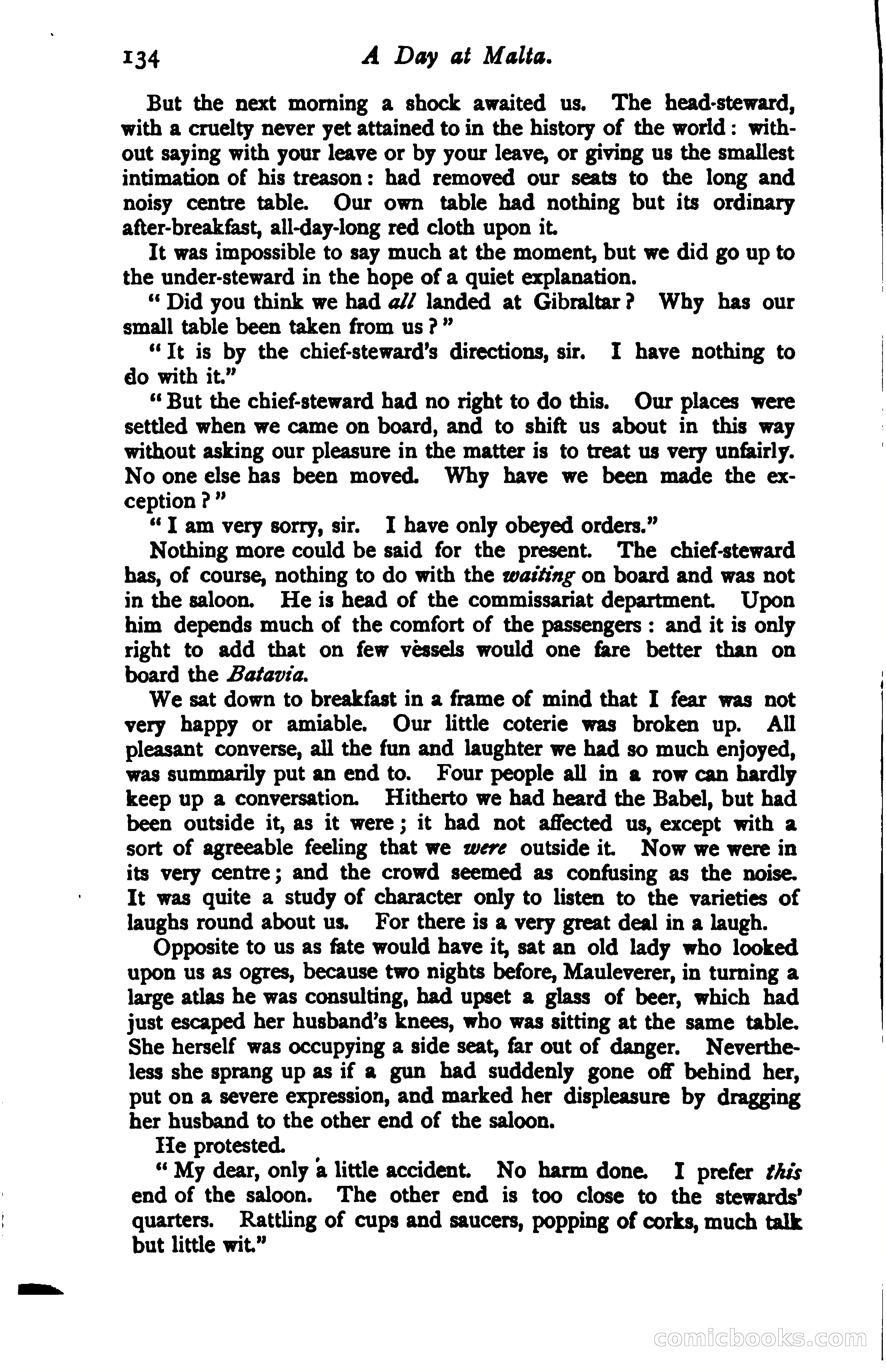
A restored page from Pulp Fiction, 1887. Page through the whole issue in the reader above.
📄 Transcribed text from this page (OCR, searchable)
Machine-transcribed from the original scan — historical spelling and the odd misread are preserved.
—_—s — 134 A Day at Malta. But the next morning a shock awaited us. The head-steward, with a cruelty never yet attained to in the history of the world: with- out saying with your leave or by your leave, or giving us the smallest intimation of his treason: had removed our seats to the long and noisy centre table. Our own table had nothing but its ordinary after-breakfast, all-day-long red cloth upon it. It was impossible to say much at the moment, but we did go up to the under-steward in the hope of a quiet explanation. ‘* Did you think we had @// landed at Gibraltar? Why has our small table been taken from us ?” “Jt is by the chief-steward’s directions, sir. I have nothing to do with it.” ‘But the chief-steward had no right to do this. Our places were settled when we came on board, and to shift us about in this way without asking our pleasure in the matter is to treat us very unfairly. No one else has been moved. Why have we been made the ex- ception P” ‘J am very sorry, sir. I have only obeyed orders.” Nothing more could be said for the present. The chief-steward has, of course, nothing to do with the wat#ng on board and was not in the saloon. He is head of the commissariat department. Upon him depends much of the comfort of the passengers : and it is only right to add that on few vessels would one fare better than on board the Batavia. We sat down to breakfast in a frame of mind that I fear was not very happy or amiable. Our little coterie was broken up. All pleasant converse, all the fun and laughter we had so much enjoyed, was summarily put an end to. Four people all in a row can hardly keep up a conversation. Hitherto we had heard the Babel, but had been outside it, as it were; it had not affected us, except with a sort of agreeable feeling that we were outside it. Now we were in its very centre; and the crowd seemed as confusing as the noise. It was quite a study of character only to listen to the varieties of laughs round about us, For there is a very great deal in a laugh. Opposite to us as fate would have it, sat an old lady who looked upon us as ogres, because two nights before, Mauleverer, in turning a large atlas he was consulting, had upset a glass of beer, which had just escaped her husband’s knees, who was sitting at the same table. She herself was occupying a side seat, far out of danger. Neverthe- less she sprang up as if a gun had suddenly gone off behind her, put on a severe expression, and marked her displeasure by dragging her husband to the other end of the saloon. He protested. “« My dear, only a little accident. No harm done. I prefer fhis end of the saloon. The other end is too close to the stewards’ quarters. Rattling of cups and saucers, popping of corks, much talk but little wit.” ECOMiCcOOolkKS —_— (CO