
Pulp Fiction, 1887 · page 14 of 399
The Argosy — page 14: what you’re looking at
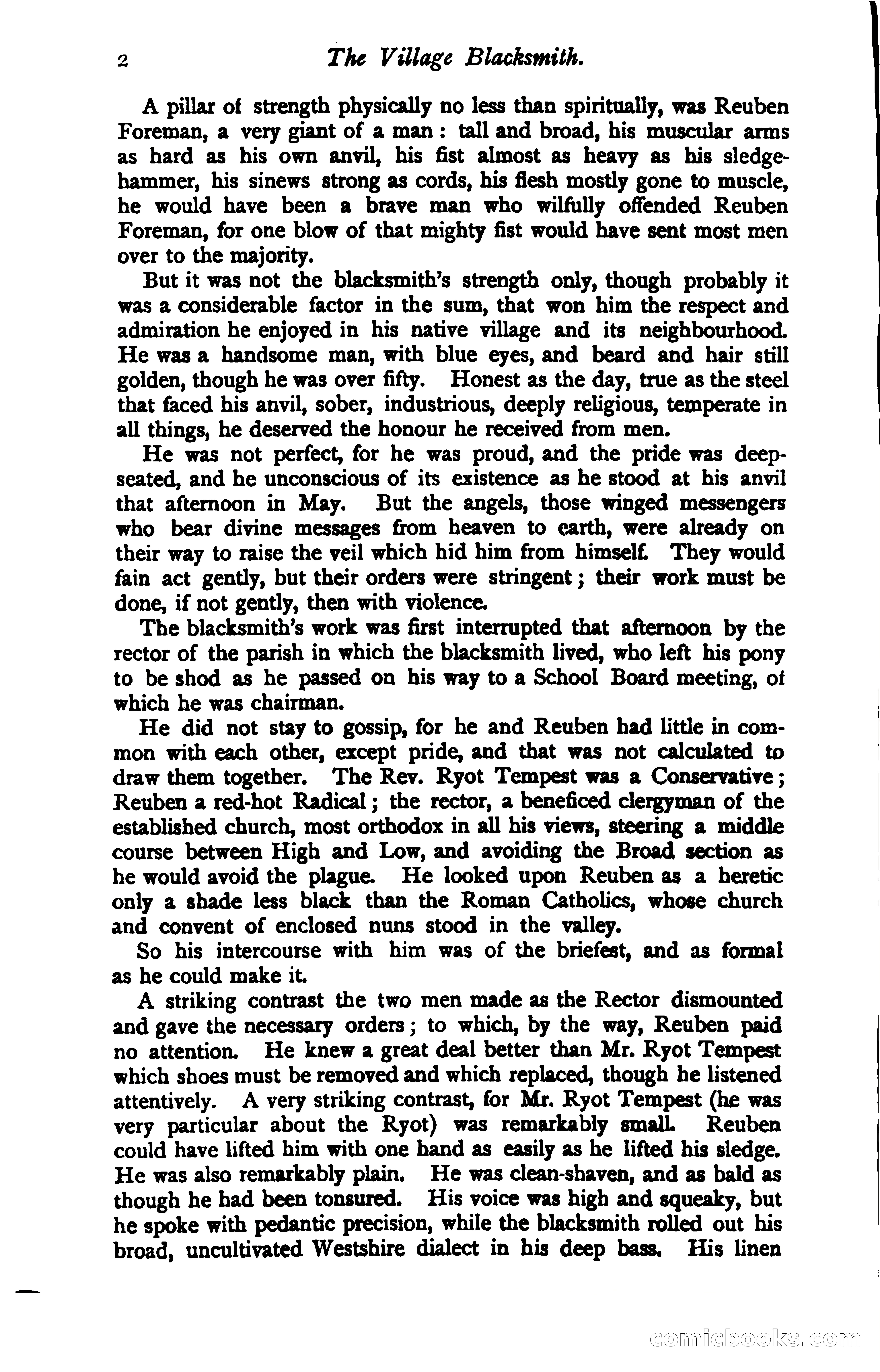
A restored page from Pulp Fiction, 1887. Page through the whole issue in the reader above.
📄 Transcribed text from this page (OCR, searchable)
Machine-transcribed from the original scan — historical spelling and the odd misread are preserved.
The Village Blacksmith. bo A pillar of strength physically no less than spiritually, was Reuben Foreman, a very giant of a man: tall and broad, his muscular arms as hard as his own anvil, his fist almost as heavy as his sledge- hammer, his sinews strong as cords, his flesh mostly gone to muscle, he would have been a brave man who wilfully offended Reuben Foreman, for one blow of that mighty fist would have sent most men over to the majority. But it was not the blacksmith’s strength only, though probably it was a considerable factor in the sum, that won him the respect and admiration he enjoyed in his native village and its neighbourhood. He was a handsome man, with blue eyes, and beard and hair still golden, though he was over fifty. Honest as the day, true as the steel that faced his anvil, sober, industrious, deeply religious, temperate in all things, he deserved the honour he received from men. He was not perfect, for he was proud, and the pride was deep- seated, and he unconscious of its existence as he stood at his anvil that afternoon in May. But the angels, those winged messengers who bear divine messages from heaven to carth, were already on their way to raise the veil which hid him from himself. They would fain act gently, but their orders were stringent ; their work must be done, if not gently, then with violence. The blacksmith’s work was first interrupted that afternoon by the rector of the parish in which the blacksmith lived, who left his pony to be shod as he passed on his way to a School Board meeting, of which he was chairman. He did not stay to gossip, for he and Reuben had little in com- mon with each other, except pride, and that was not calculated to draw them together. The Rev. Ryot Tempest was a Conservative ; Reuben a red-hot Radical; the rector, a beneficed clergyman of the established church, most orthodox in all his views, steering a middle course between High and Low, and avoiding the Broad section as he would avoid the plague. He looked upon Reuben as a heretic only a shade less black than the Roman Catholics, whose church and convent of enclosed nuns stood in the valley. So his intercourse with him was of the briefest, and as formal as he could make it. A striking contrast the two men made as the Rector dismounted and gave the necessary orders ; to which, by the way, Reuben paid no attention. He knew a great deal better than Mr. Ryot Tempest which shoes must be removed and which replaced, though he listened attentively. A very striking contrast, for Mr. Ryot Tempest (he was very particular about the Ryot) was remarkably small. Reuben could have lifted him with one hand as easily as he lifted his sledge, He was also remarkably plain. He was clean-shaven, and as bald as though he had been tonsured. His voice was high and squeaky, but he spoke with pedantic precision, while the blacksmith rolled out his broad, uncultivated Westshire dialect in his deep bass, His linen conniclooolkks CO