
Pulp Fiction, 1865 · page 143 of 399
The Argosy — page 143: what you’re looking at
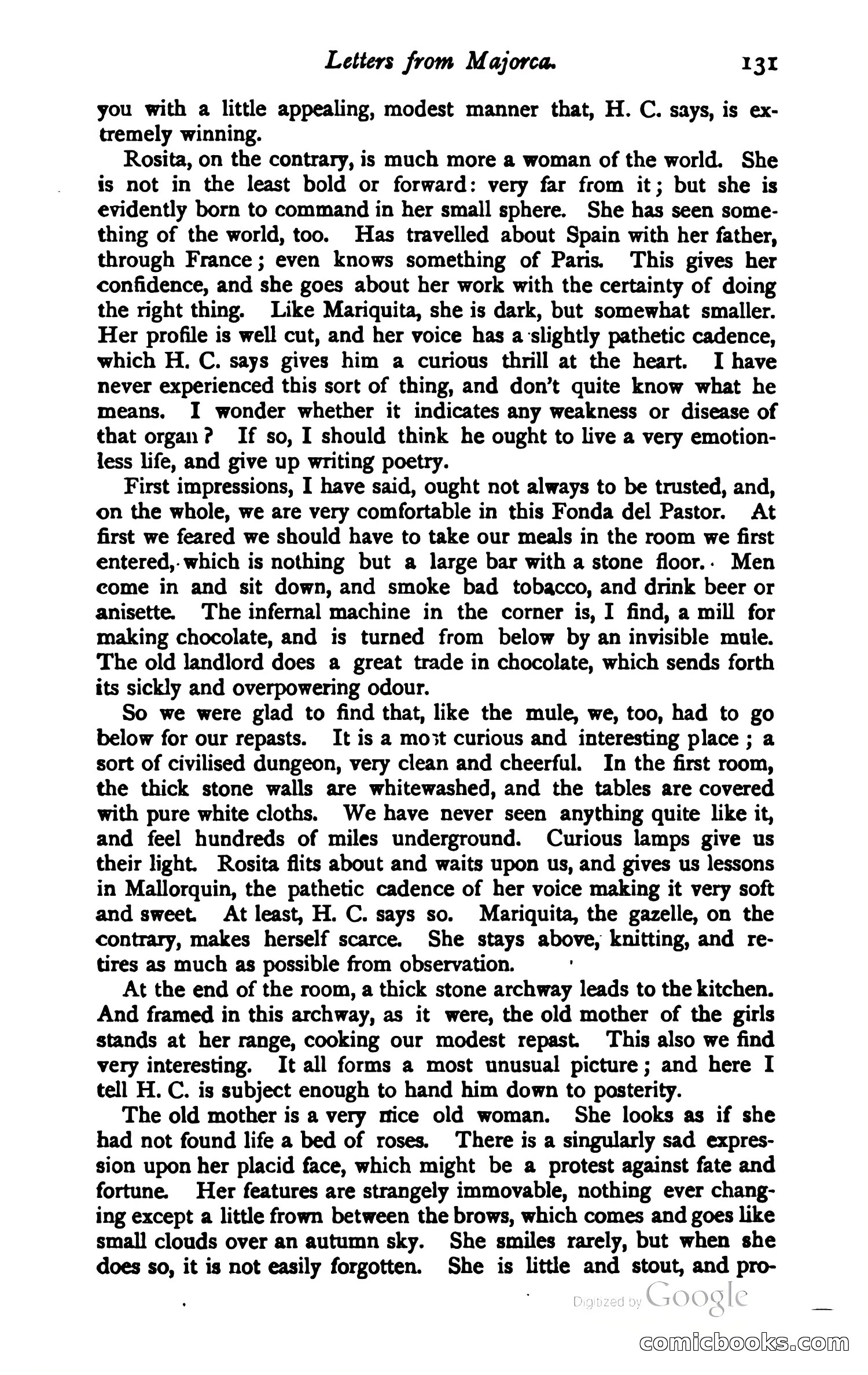
A restored page from Pulp Fiction, 1865. Page through the whole issue in the reader above.
📄 Transcribed text from this page (OCR, searchable)
Machine-transcribed from the original scan — historical spelling and the odd misread are preserved.
Letters from Majorca. 131 you with a little appealing, modest manner that, H. C. says, is ex- tremely winning. Rosita, on the contrary, is much more a woman of the world. She is not in the least bold or forward: very far from it; but she is evidently born to command in her small sphere. She has seen some- thing of the world, too. Has travelled about Spain with her father, through France ; even knows something of Paris. This gives her confidence, and she goes about her work with the certainty of doing the right thing. Like Mariquita, she is dark, but somewhat smaller. Her profile is well cut, and her voice has a:slightly pathetic cadence, which H. C. says gives him a curious thrill at the heart. I have never experienced this sort of thing, and don’t quite know what he means. I wonder whether it indicates any weakness or disease of that organ? If so, I should think he ought to live a very emotion- less life, and give up writing poetry. First impressions, I have said, ought not always to be trusted, and, on the whole, we are very comfortable in this Fonda del Pastor. At first we feared we should have to take our meals in the room we first entered,- which is nothing but a large bar with a stone floor.. Men eome in and sit down, and smoke bad tobacco, and drink beer or anisette. The infernal machine in the corner is, I find, a mill for making chocolate, and is turned from below by an invisible mule. The old landlord does a great trade in chocolate, which sends forth its sickly and overpowering odour. So we were glad to find that, like the mule, we, too, had to go below for our repasts. It is a most curious and interesting place ; a sort of civilised dungeon, very clean and cheerful. In the first room, the thick stone walls are whitewashed, and the tables are covered with pure white cloths. We have never seen anything quite like it, and feel hundreds of miles underground. Curious lamps give us their light. Rosita flits about and waits upon us, and gives us lessons in Mallorquin, the pathetic cadence of her voice making it very soft and sweet. At least, H. C. says so. Mariquita, the gazelle, on the contrary, makes herself scarce. She stays above, knitting, and re- tires as much as possible from observation. ; At the end of the room, a thick stone archway leads to the kitchen. And framed in this archway, as it were, the old mother of the girls stands at her range, cooking our modest repast. This also we find very interesting. It all forms a most unusual picture; and here I tell H. C. is subject enough to hand him down to posterity. The old mother is a very nice old woman. She looks as if she had not found life a bed of roses. There is a singularly sad expres- sion upon her placid face, which might be a protest against fate and fortune. Her features are strangely immovable, nothing ever chang- ing except a little frown between the brows, which comes and goes like small clouds over an autumn sky. She smiles rarely, but when she does so, it is not easily forgotten. She is little and stout, and pro- comicbooks.com