
Pulp Fiction, 1901 · page 88 of 400
The Argosy — page 88: what you’re looking at
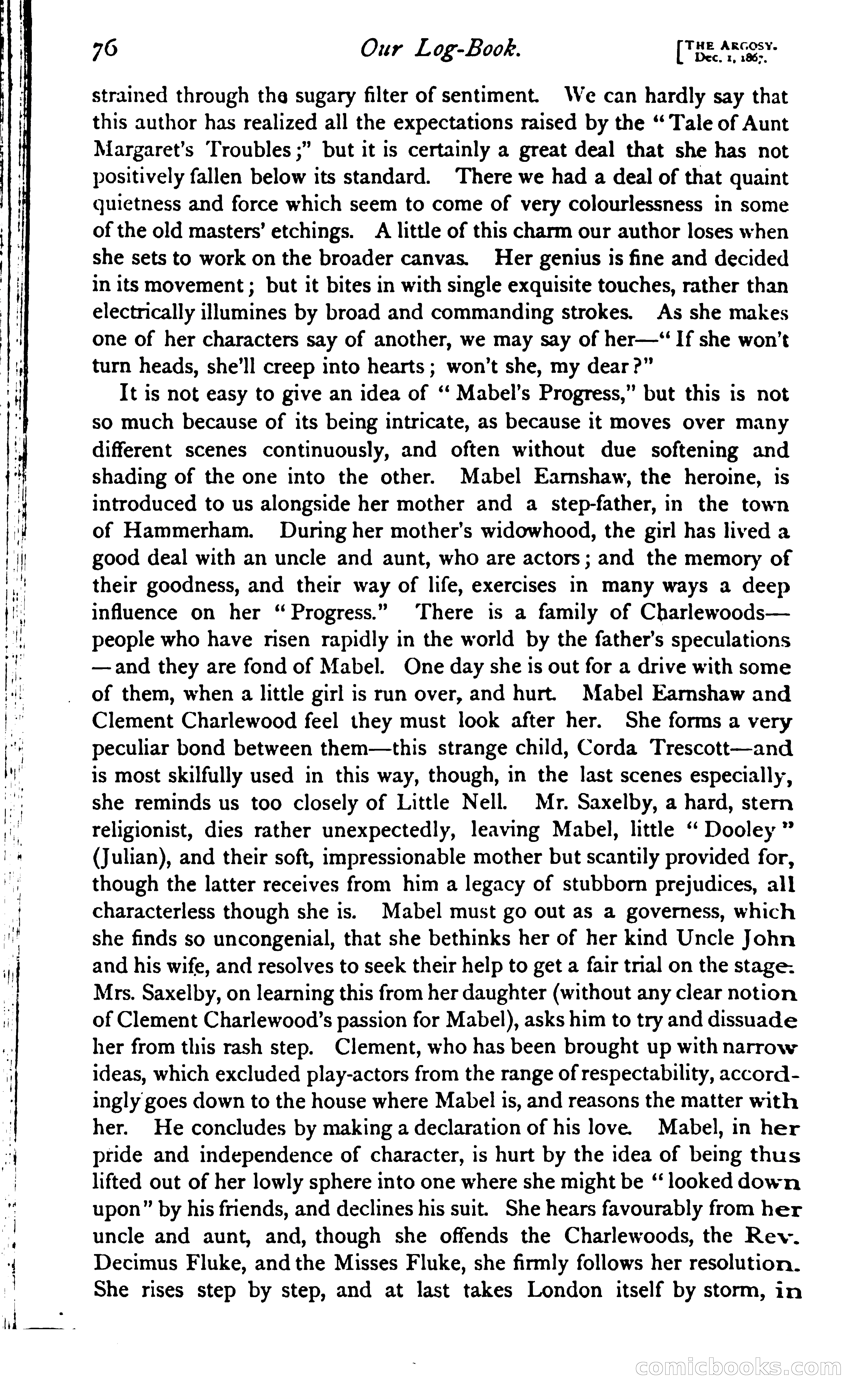
A restored page from Pulp Fiction, 1901. Page through the whole issue in the reader above.
📄 Transcribed text from this page (OCR, searchable)
Machine-transcribed from the original scan — historical spelling and the odd misread are preserved.
7 6 Our Log-Book. THE ARGOSY. . I, 3186>, strained through the sugary filter of sentiment. We can hardly say that this author has realized all the expectations raised by the “ Tale of Aunt Margaret’s Troubles ;” but it is certainly a great deal that she has not positively fallen below its standard. There we had a deal of that quaint quietness and force which seem to come of very colourlessness in some of the old masters’ etchings. A little of this charm our author loses when she sets to work on the broader canvas. Her genius }s fine and decided in its movement ; but it bites in with single exquisite touches, rather than electrically illumines by broad and commanding strokes. As she makes one of her characters say of another, we may say of her—‘“‘ If she won’t turn heads, she’ll creep into hearts; won’t she, my dear ?” It is not easy to give an idea of ‘‘ Mabel’s Progress,” but this 1s not so much because of its being intricate, as because it moves over many different scenes continuously, and often without due softening and shading of the one into the other. Mabel Earmshaw, the heroine, 1s introduced to us alongside her mother and a step-father, in the town of Hammerham. During her mother’s widowhood, the girl has hved a good deal with an uncle and aunt, who are actors; and the memory of their goodness, and their way of life, exercises in many ways a deep influence on her “Progress.” There is a family of Charlewoods— people who have nmsen rapidly in the world by the father’s speculations —and they are fond of Mabel. One day she 1s out for a drive with some of them, when a little girl is run over, and hurt. Mabel Earnshaw and Clement Charlewood feel they must look after her. She forms a very peculiar bond between them—this strange child, Corda Trescott—and is most skilfully used in this way, though, in the last scenes especially, she reminds us too closely of Little Nell. Mr. Saxelby, a hard, stern religionist, dies rather unexpectedly, leaving Mabel, little ‘ Dooley ” (Julian), and their soft, impressionable mother but scantily provided for, though the latter receives from him a legacy of stubborn prejudices, all characterless though she 1s. Mabel must go out as a governess, which she finds so uncongenial, that she bethinks her of her kind Uncle John and his wife, and resolves to seek their help to get a fair trial on the stage. Mrs. Saxelby, on learning this from her daughter (without any clear notion of Clement Charlewood’s passion for Mabel), asks him to try and dissuade her from this rash step. Clement, who has been brought up with narrow ideas, which excluded play-actors from the range of respectability, accord- ingly goes down to the house where Mabel 1s, and reasons the matter with her. He concludes by making a declaration of his love. Mabel, in her pride and independence of character, is hurt by the idea of being thus lifted out of her lowly sphere into one where she might be ‘“‘ looked down upon” by his fnends, and declines his suit. She hears favourably from her uncle and aunt, and, though she offends the Charlewoods, the Rev. Decimus Fluke, and the Misses Fluke, she firmly follows her resolution. She rises step by step, and at last takes London itself by storm, in ECOMiIcoOolxs.cO©