
Pulp Fiction, 1901 · page 70 of 400
The Argosy — page 70: what you’re looking at
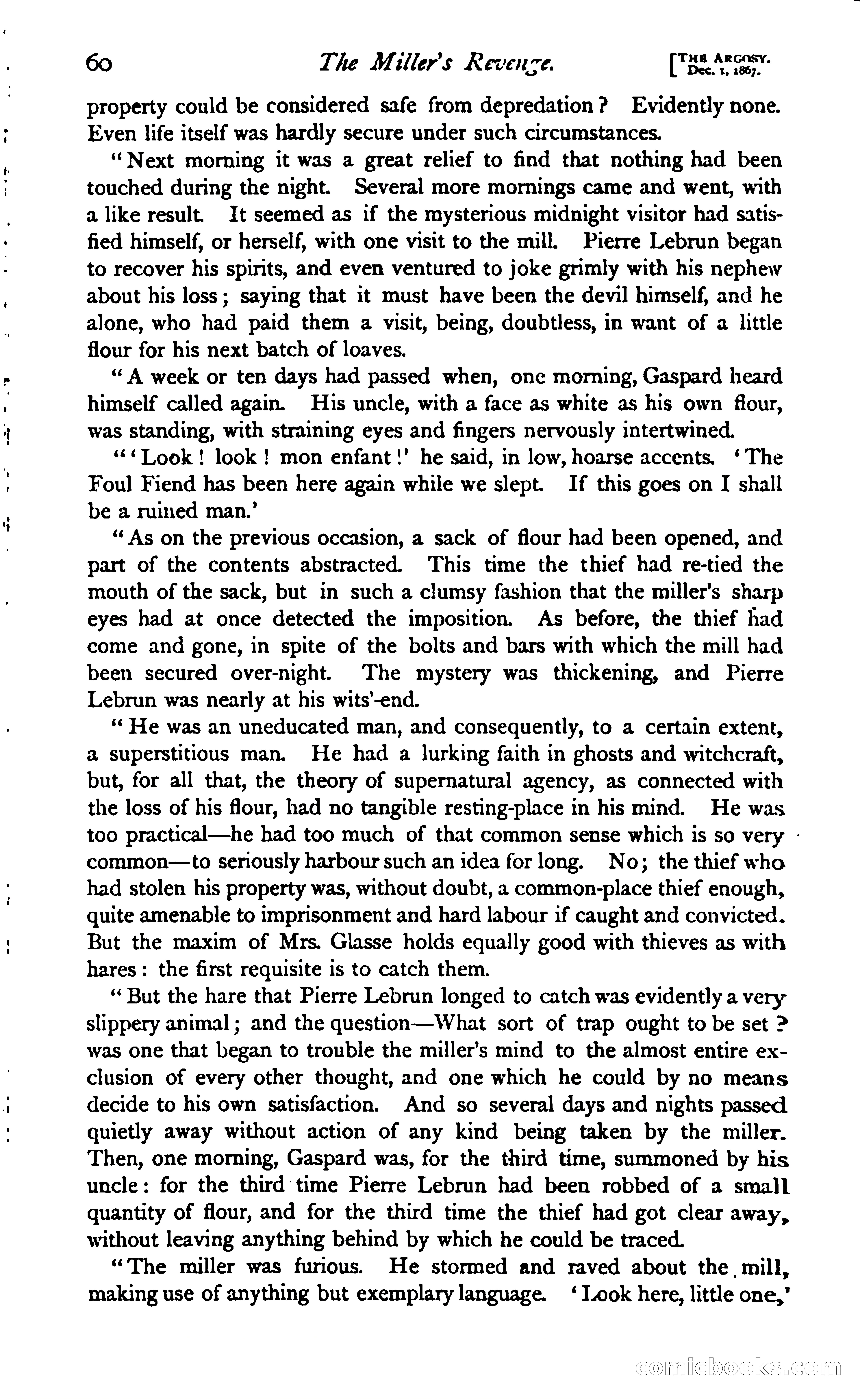
A restored page from Pulp Fiction, 1901. Page through the whole issue in the reader above.
📄 Transcribed text from this page (OCR, searchable)
Machine-transcribed from the original scan — historical spelling and the odd misread are preserved.
60 The Miller's Revenze. Te er property could be considered safe from depredation? Evidently none. Even life itself was hardly secure under such circumstances. ‘Next morning it was a great relief to find that nothing had been touched during the night. Several more mornings came and went, with a like result. It seemed as if the mysterious midnight visitor had satis- fied himself, or herself, with one visit to the mill. Pierre Lebrun began to recover his spints, and even ventured to joke gnmly with his nephew about his loss; saying that it must have been the devil himself, and he alone, who had paid them a visit, being, doubtless, in want of a little flour for his next batch of loaves. “ A week or ten days had passed when, one morning, Gaspard heard himself called again. His uncle, with a face as white as his own flour, was standing, with straining eyes and fingers nervously intertwined. “¢T ook! look ! mon enfant!’ he said, in low, hoarse accents. ‘The Foul Fiend has been here again while we slept. If this goes on I shall be a ruined man.’ ‘“‘ As on the previous occasion, a sack of flour had been opened, and part of the contents abstracted. This time the thief had re-tied the mouth of the sack, but in such a clumsy fashion that the miller’s sharp eyes had at once detected the imposition. As before, the thief had come and gone, in spite of the bolts and bars with which the mill had been secured over-night. The mystery was thickening, and Pierre Lebrun was nearly at his wits’-end. ‘¢ He was an uneducated man, and consequently, to a certain extent, a superstitious man. He had a lurking faith in ghosts and witchcraft, but, for all that, the theory of supernatural agency, as connected with the loss of his flour, had no tangible resting-place in his mind. He was too practical—he had too much of that common sense which 1s so very - common—to seriously harbour such an idea for long. No; the thief who had stolen his property was, without doubt, a common-place thief enough, quite amenable to imprisonment and hard labour if caught and convicted. But the maxim of Mrs. Glasse holds equally good with thieves as with hares: the first requisite is to catch them. ‘But the hare that Pierre Lebrun longed to catch was evidently a very slippery animal; and the question—What sort of trap ought to be set 2 was one that began to trouble the miller’s mind to the almost entire ex- clusion of every other thought, and one which he could by no means decide to his own satisfaction. And so several days and nights passed. quietly away without action of any kind being taken by the miller. Then, one morning, Gaspard was, for the third time, summoned by his uncle: for the third time Pierre Lebrun had been robbed of a small quantity of flour, and for the third time the thief had got clear away, without leaving anything behind by which he could be traced. “The miller was furious. He stormed and raved about the mill, making use of anything but exemplary language. ‘Took here, little one,’ comicaocks (GO)