
Pulp Fiction, 1901 · page 68 of 400
The Argosy — page 68: what you’re looking at
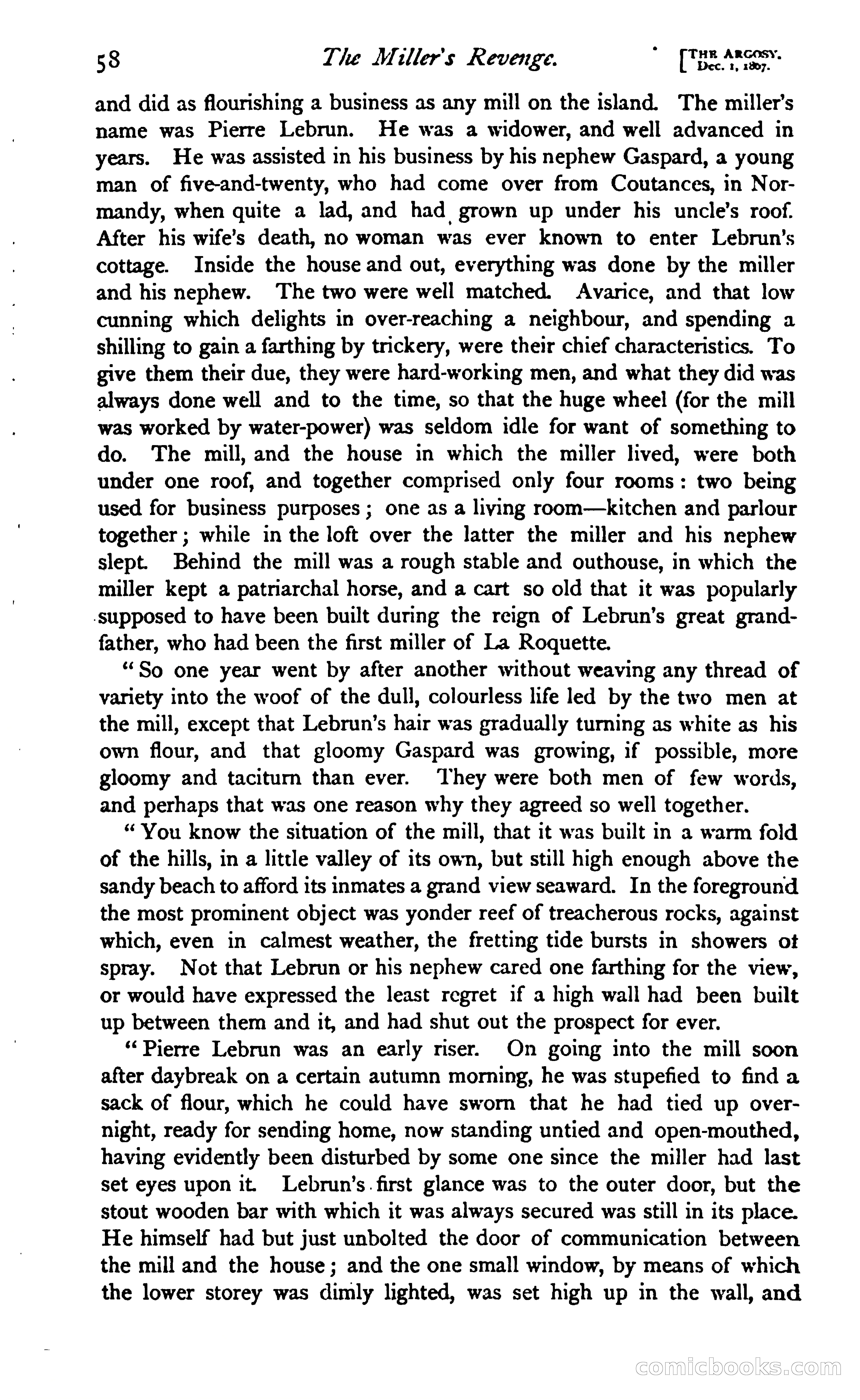
A restored page from Pulp Fiction, 1901. Page through the whole issue in the reader above.
📄 Transcribed text from this page (OCR, searchable)
Machine-transcribed from the original scan — historical spelling and the odd misread are preserved.
58 The Miller's Revenge. " [THR ARcosy, Dec. 1, 1807. and did as flourishing a business as any mill on the island. The miller’s name was Pierre Lebrun. He was a widower, and well advanced in years. He was assisted in his business by his nephew Gaspard, a young man of five-and-twenty, who had come over from Coutances, in Nor- mandy, when quite a lad, and had grown up under his uncle's roof. After his wife’s death, no woman was ever known to enter Lebrun’s cottage. Inside the house and out, everything was done by the miller and his nephew. The two were well matched. Avarice, and that low cunning which delights in over-reaching a neighbour, and spending a shilling to gain a farthing by trickery, were their chief characteristics. To give them their due, they were hard-working men, and what they did was always done well and to the time, so that the huge wheel (for the mill was worked by water-power) was seldom idle for want of something to do. The mill, and the house in which the miller hved, were both under one roof, and together comprised only four rooms: two being used for business purposes ; one as a living room—kitchen and parlour together ; while in the loft over the latter the miller and his nephew slept. Behind the mill was a rough stable and outhouse, in which the miller kept a patnarchal horse, and a cart so old that it was popularly supposed to have been built during the reign of Lebrun’s great grand- father, who had been the first miller of La Roquette. ‘So one year went by after another without weaving any thread of variety into the woof of the dull, colourless life led by the two men at the mill, except that Lebrun’s hair was gradually turning as white as his own flour, and that gloomy Gaspard was growing, if possible, more gloomy and tacitum than ever. ‘They were both men of few words, and perhaps that was one reason why they agreed so well together. “You know the situation of the mill, that it was built in a warm fold of the hills, in a little valley of its own, but still high enough above the sandy beach to afford its inmates a grand view seaward. In the foreground the most prominent object was yonder reef of treacherous rocks, against which, even in calmest weather, the fretting tide bursts in showers ot spray. Not that Lebrun or his nephew cared one farthing for the view, or would have expressed the least regret if a high wall had been built up between them and it, and had shut out the prospect for ever. ‘Pierre Lebrun was an early riser. On going into the mill soon after daybreak on a certain autumn morning, he was stupefied to find a sack of flour, which he could have sworn that he had tied up over- night, ready for sending home, now standing untied and open-mouthed, having evidently been disturbed by some one since the miller had last set eyes upon it. Lebrun’s first glance was to the outer door, but the stout wooden bar with which it was always secured was still in its place. He himself had but just unbolted the door of communication between the mill and the house; and the one small window, by means of which the lower storey was dimly hghted, was set high up in the wall, and ECOMiIcoOolxs.cO©