
Pulp Fiction, 1901 · page 62 of 400
The Argosy — page 62: what you’re looking at
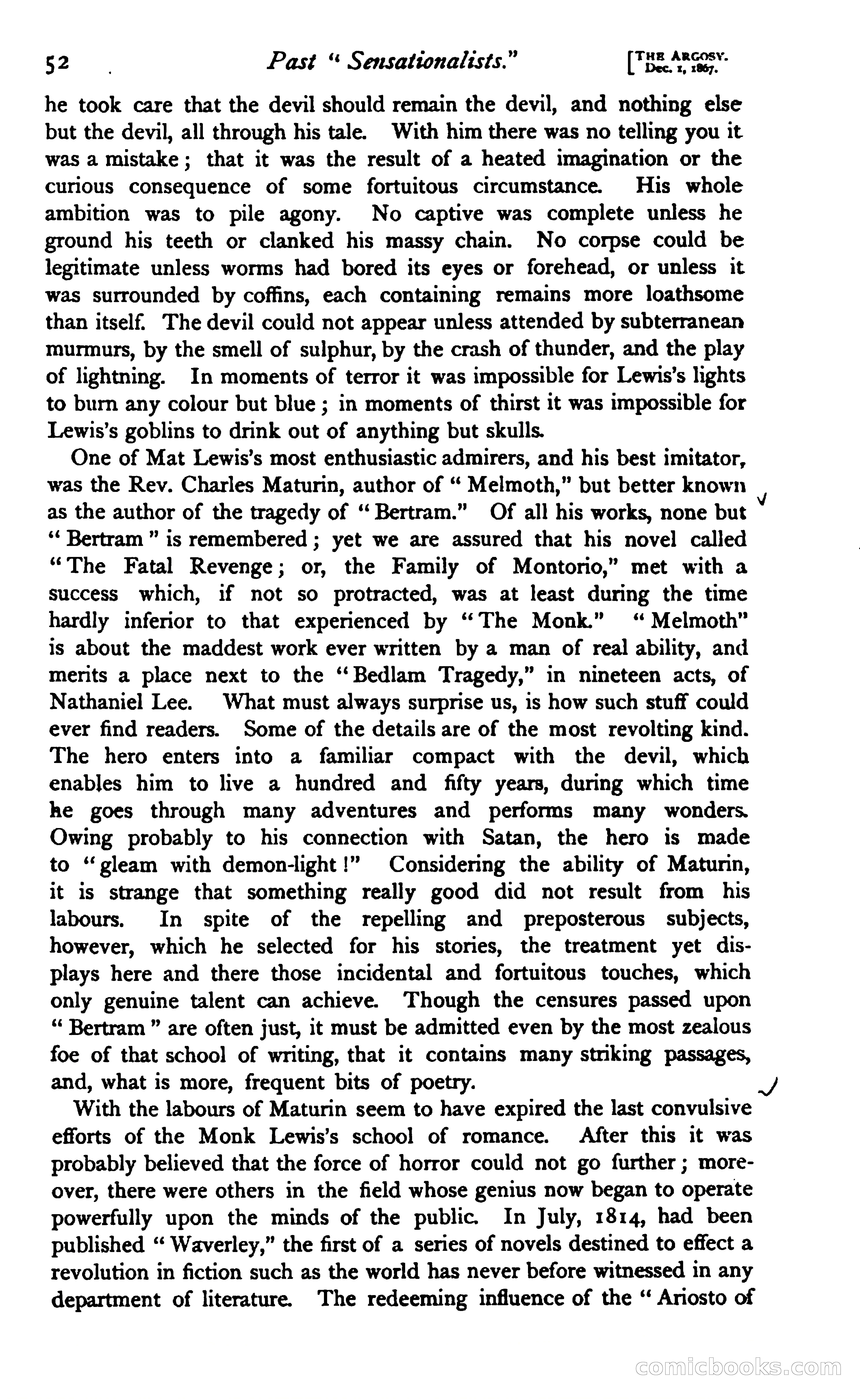
A restored page from Pulp Fiction, 1901. Page through the whole issue in the reader above.
📄 Transcribed text from this page (OCR, searchable)
Machine-transcribed from the original scan — historical spelling and the odd misread are preserved.
52 CO Past “ Sensationalists.” (TBE ARs he took care that the devil should remain the devil, and nothing else but the devil, all through his tale. With him there was no telling you it was a mistake; that it was the result of a heated imagination or the curlous consequence of some fortuitous circumstance. His whole ambition was to pile agony. No captive was complete unless he ground his teeth or clanked his massy chain. No corpse could be legitimate unless worms had bored its eyes or forehead, or unless it was surrounded by coffins, each containing remains more loathsome than itself. The devil could not appear unless attended by subterranean murmurs, by the smell of sulphur, by the crash of thunder, and the play of lightning. In moments of terror it was impossible for Lewis’s hghts to burn any colour but blue ; in moments of thirst it was impossible for Lewis's goblins to drink out of anything but skulls. One of Mat Lewis’s most enthusiastic admirers, and his best imitator, was the Rev. Charles Maturin, author of “ Melmoth,” but better known as the author of the tragedy of “ Bertram.” Of all his works, none but ‘‘ Bertram ” is remembered ; yet we are assured that his novel called “The Fatal Revenge; or, the Family of Montorio,” met with a success which, if not so protracted, was at least during the time hardly infenor to that expenenced by ‘The Monk.” ‘“ Melmoth” is about the maddest work ever written by a man of real ability, and merits a place next to the ‘‘Bedlam Tragedy,” in nineteen acts, of Nathaniel Lee. What must always surprise us, 1s how such stuff could ever find readers. Some of the details are of the most revolting kind. The hero enters into a familiar compact with the devil, which enables him to live a hundred and fifty years, during which time he goes through many adventures and performs many wonders. Owing probably to his connection with Satan, the hero is made to “‘gleam with demon-light!” Considering the ability of Matumn, it is strange that something really good did not result from his labours. In spite of the repelling and preposterous subjects, however, which he selected for his stories, the treatment yet dis- plays here and there those incidental and fortuitous touches, which only genuine talent can achieve. Though the censures passed upon “ Bertram ” are often just, it must be admitted even by the most zealous foe of that school of writing, that it contains many stnking passages, and, what is more, frequent bits of poetry. With the labours of Maturin seem to have expired the last convulsive efforts of the Monk Lewis’s school of romance. After this it was probably believed that the force of horror could not go further ; more- over, there were others in the field whose genius now began to operate powerfully upon the minds of the public. In July, 1814, had been published ‘‘ Waverley,” the first of a series of novels destined to effect a revolution in fiction such as the world has never before witnessed in any department of literature. The redeeming influence of the “ Anosto of CONnniClOO @ <S (GO)