
Pulp Fiction, 1901 · page 53 of 400
The Argosy — page 53: what you’re looking at
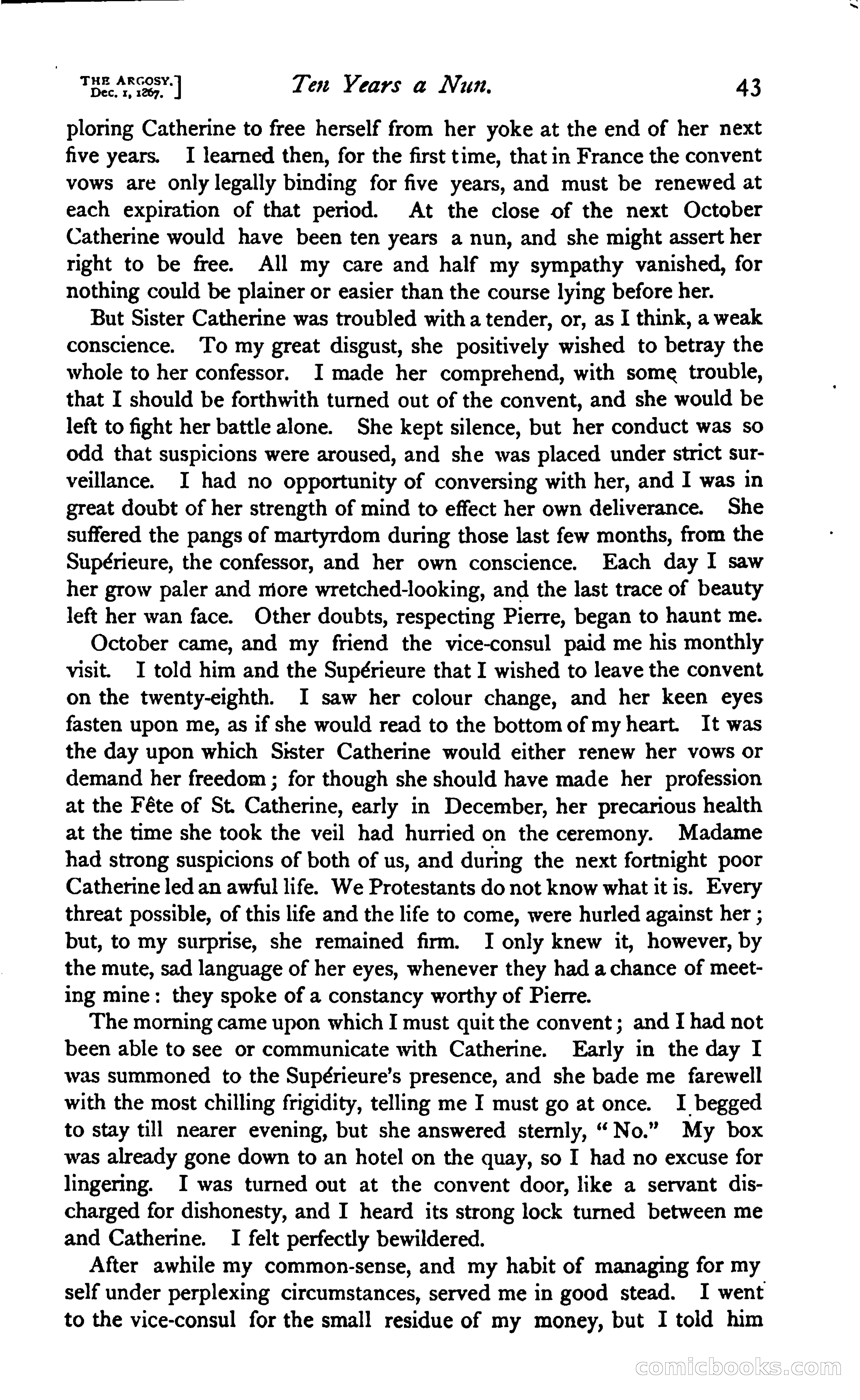
A restored page from Pulp Fiction, 1901. Page through the whole issue in the reader above.
📄 Transcribed text from this page (OCR, searchable)
Machine-transcribed from the original scan — historical spelling and the odd misread are preserved.
Thee een | Ten Years a Nun. 43 ploring Catherine to free herself from her yoke at the end of her next five years. I learned then, for the first time, that in France the convent vows are only legally binding for five years, and must be renewed at each expiration of that period. At the close of the next October Catherine would have been ten years a nun, and she might assert her right to be free. All my care and half my sympathy vanished, for nothing could be plainer or easier than the course lying before her. But Sister Catherine was troubled with a tender, or, as I think, a weak conscience. ‘To my great disgust, she positively wished to betray the whole to her confessor. I made her comprehend, with some trouble, that I should be forthwith turned out of the convent, and she would be left to fight her battle alone. She kept silence, but her conduct was so odd that suspicions were aroused, and she was placed under strict sur- veillance. I had no opportunity of conversing with her, and I was in great doubt of her strength of mind to effect her own deliverance. She suffered the pangs of martyrdom during those last few months, from the Supérieure, the confessor, and her own conscience. Each day I saw her grow paler and miore wretched-looking, and the last trace of beauty left her wan face. Other doubts, respecting Pierre, began to haunt me. October came, and my friend the vice-consul paid me his monthly visit. I told him and the Supérieure that I wished to leave the convent on the twenty-eighth. I saw her colour change, and her keen eyes fasten upon me, as if she would read to the bottom of my heart. It was the day upon which Sister Catherine would either renew her vows or demand her freedom ; for though she should have made her profession at the Féte of St. Catherine, early in December, her precarious health at the time she took the veil had hurried on the ceremony. Madame had strong suspicions of both of us, and during the next fortnight poor Catherine led an awful life. We Protestants do not know what it is. Every threat possible, of this life and the life to come, were hurled against her ; but, to my surprise, she remained firm. I only knew it, however, by the mute, sad language of her eyes, whenever they had a chance of meet- ing mine: they spoke of a constancy worthy of Pierre. The morning came upon which I must quit the convent; and I had not been able to see or communicate with Catherine. Early in the day I was summoned to the Supérieure’s presence, and she bade me farewell with the most chilling frigidity, telling me I must go at once. I begged to stay till nearer evening, but she answered sternly, “No.” My box was already gone down to an hotel on the quay, so I had no excuse for lingering. I was turned out at the convent door, like a servant dis- charged for dishonesty, and I heard its strong lock turned between me and Catherine. I felt perfectly bewildered. After awhile my common-sense, and my habit of managing for my self under perplexing circumstances, served me in good stead. I went to the vice-consul for the small residue of my money, but I told him comicaocks (GO)