
Pulp Fiction, 1901 · page 396 of 400
The Argosy — page 396: what you’re looking at
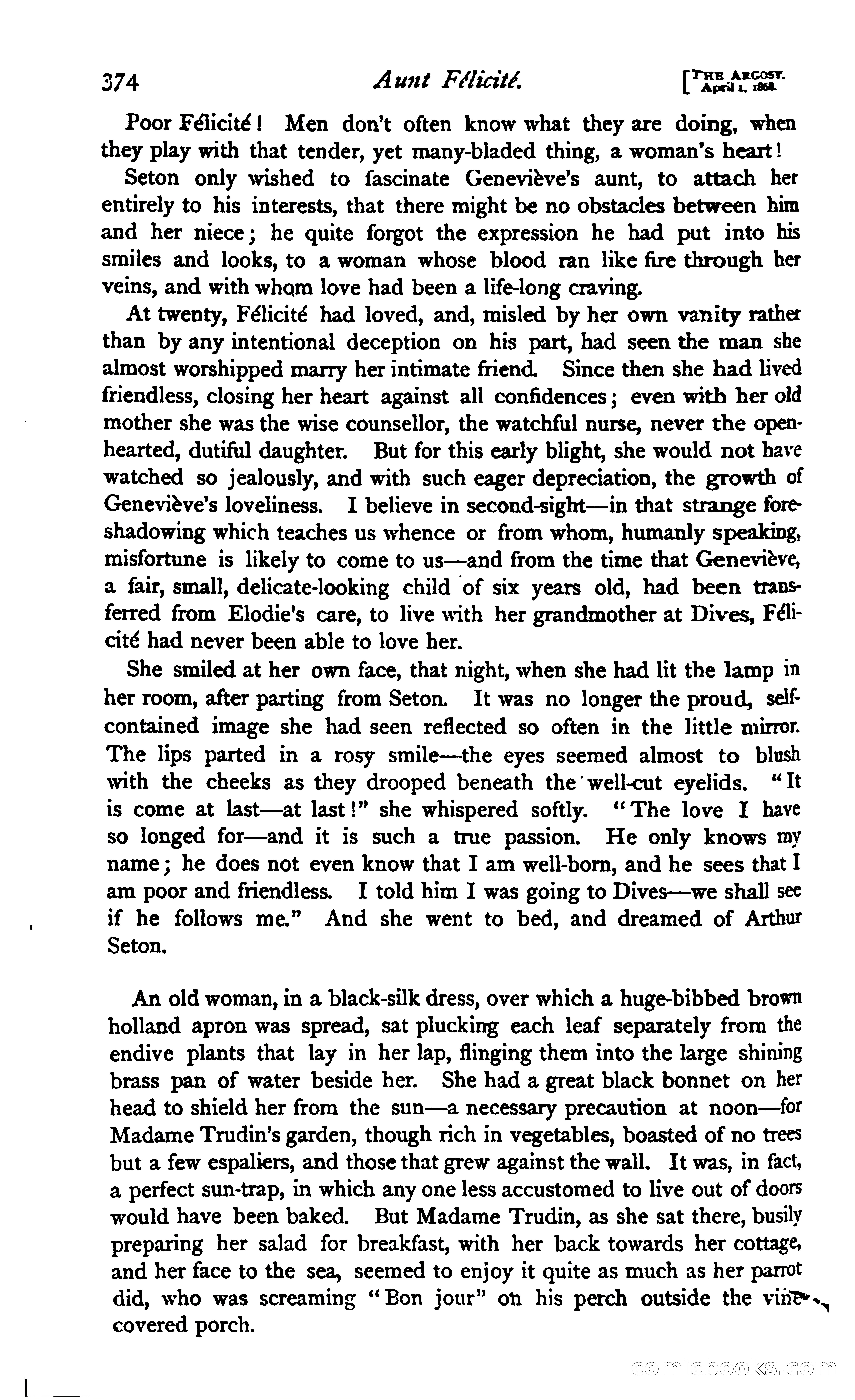
A restored page from Pulp Fiction, 1901. Page through the whole issue in the reader above.
📄 Transcribed text from this page (OCR, searchable)
Machine-transcribed from the original scan — historical spelling and the odd misread are preserved.
374 Aunt Félicté ae sae Poor Félicité! Men don’t often know what they are doing, when they play with that tender, yet many-bladed thing, a woman’s heart! Seton only wished to fascinate Geneviéve’s aunt, to attach her entirely to his interests, that there might be no obstacles between him and her niece; he quite forgot the expression he had put into his smiles and looks, to a woman whose blood ran like fire through her veins, and with wham love had been a life-long craving. At twenty, Félicité had loved, and, misled by her own vanity rather than by any intentional deception on his part, had seen the man she almost worshipped marry her intimate friend. Since then she had lived friendless, closing her heart against all confidences; even with her old mother she was the wise counsellor, the watchful nurse, never the open- hearted, dutiful daughter. But for this early blight, she would not have watched so jealously, and with such eager depreciation, the growth of Geneviéve’s loveliness. I believe in second-sight—in that strange fore- shadowing which teaches us whence or from whom, humanly speaking, misfortune is likely to come to us—and from the time that Genevieve, a fair, small, delicate-looking child of six years old, had been trans- ferred from Elodie's care, to live with her grandmother at Dives, Feéli- cité had never been able to love her. She smiled at her own face, that night, when she had lit the lamp in her room, after parting from Seton. It was no longer the proud, self- contained image she had seen reflected so often in the little mirror. The lips parted in a rosy smile—the eyes seemed almost to blush with the cheeks as they drooped beneath the ‘well-cut eyelids. “It is come at last—at last!” she whispered softly. ‘The love I have so longed for—and it is such a true passion. He only knows my name; he does not even know that I am well-born, and he sees that I am poor and fnendless. I told him I was going to Dives—we shall see if he follows me.” And she went to bed, and dreamed of Arthur Seton. An old woman, in a black-silk dress, over which a huge-bibbed brown holland apron was spread, sat plucking each leaf separately from the endive plants that lay in her lap, flmging them into the large shining brass pan of water beside her. She had a great black bonnet on her head to shield her from the sun—a necessary precaution at noon—for Madame Trudin’s garden, though rich in vegetables, boasted of no trees but a few espaliers, and those that grew against the wall. It was, in fact, a. perfect sun-trap, in which any one less accustomed to live out of doors would have been baked. But Madame Trudin, as she sat there, busily preparing her salad for breakfast, with her back towards her cottage, and her face to the sea, seemed to enjoy it quite as much as her parrot did, who was screaming “Bon jour” on his perch outside the vines, covered porch. COMIC OOOKS. EO mn _