
Pulp Fiction, 1901 · page 393 of 400
The Argosy — page 393: what you’re looking at
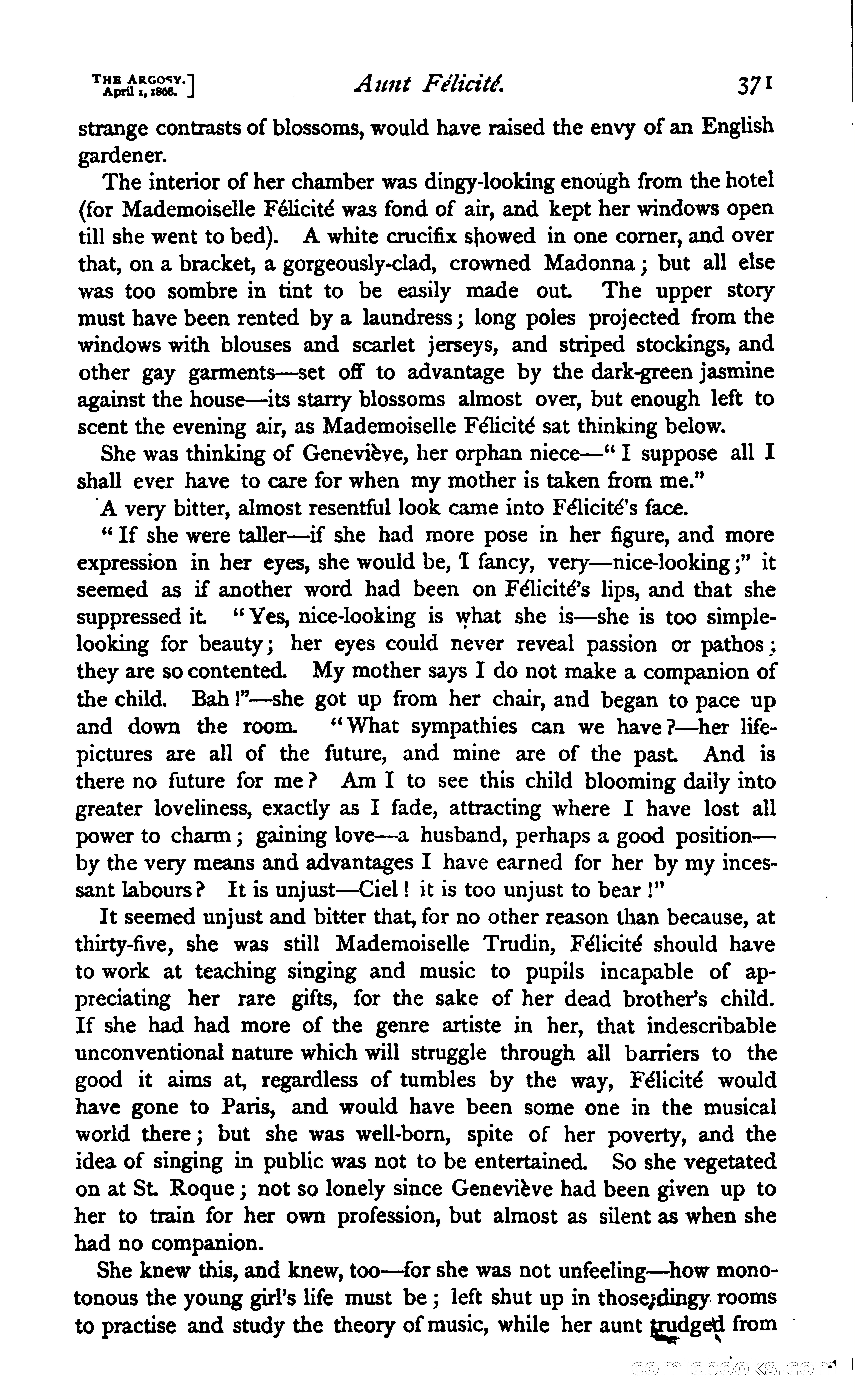
A restored page from Pulp Fiction, 1901. Page through the whole issue in the reader above.
📄 Transcribed text from this page (OCR, searchable)
Machine-transcribed from the original scan — historical spelling and the odd misread are preserved.
Te Dk con | | Aunt Feltcteé. 371 strange contrasts of blossoms, would have raised the envy of an English gardener. The interior of her chamber was dingy-looking enough from the hotel (for Mademoiselle Félicité was fond of air, and kept her windows open till she went to bed). A white crucifix showed in one corner, and over that, on a bracket, a gorgeously-clad, crowned Madonna; but all else was too sombre in tint to be easily made out. The upper story must have been rented by a laundress; long poles projected from the windows with blouses and scarlet jerseys, and striped stockings, and other gay garments—set off to advantage by the dark-green jasmine against the house—its starry blossoms almost over, but enough left to scent the evening air, as Mademoiselle Félicité sat thinking below. She was thinking of Genevitye, her orphan niece—“ I suppose all I shall ever have to care for when my mother is taken from me.” A very bitter, almost resentful look came into Félicité’s face. “If she were taller—if she had more pose in her figure, and more expression in her eyes, she would be, T fancy, very—nice-looking ;” it seemed as if another word had been on Félicité’s lips, and that she suppressed it. ‘‘ Yes, nice-looking is what she is—she is too simple- looking for beauty; her eyes could never reveal passion or pathos ; they are socontented. My mother says I do not make a companion of the child. Bah!”—she got up from her chair, and began to pace up and down the room. ‘What sympathies can we have ?—her life- pictures are all of the future, and mine are of the past. And is there no future for me? Am to see this child blooming daily into greater loveliness, exactly as I fade, attracting where I have lost all power to charm; gaining love—a husband, perhaps a good position— by the very means and advantages I have earned for her by my inces- sant labours? It is unjust—Ciel! it is too unjust to bear !” It seemed unjust and bitter that, for no other reason than because, at thirty-five, she was still Mademoiselle Trudin, Félicité should have to work at teaching singing and music to pupils incapable of ap- preciating her rare gifts, for the sake of her dead brother’s child. If she had had more of the genre artiste in her, that indescribable unconventional nature which will struggle through all barriers to the good it aims at, regardless of tumbles by the way, Félicité would have gone to Paris, and would have been some one in the musical world there; but she was well-born, spite of her poverty, and the idea of singing in public was not to be entertained. So she vegetated on at St. Roque ; not so lonely since Geneviéve had been given up to her to train for her own profession, but almost as silent as when she had no companion. She knew this, and knew, too—for she was not unfeeling—how mono- tonous the young girl’s life must be; left shut up in thosesdingy: rooms to practise and study the theory of music, while her aunt frudgel from ~ comicbooks (CO)