
Pulp Fiction, 1901 · page 364 of 400
The Argosy — page 364: what you’re looking at
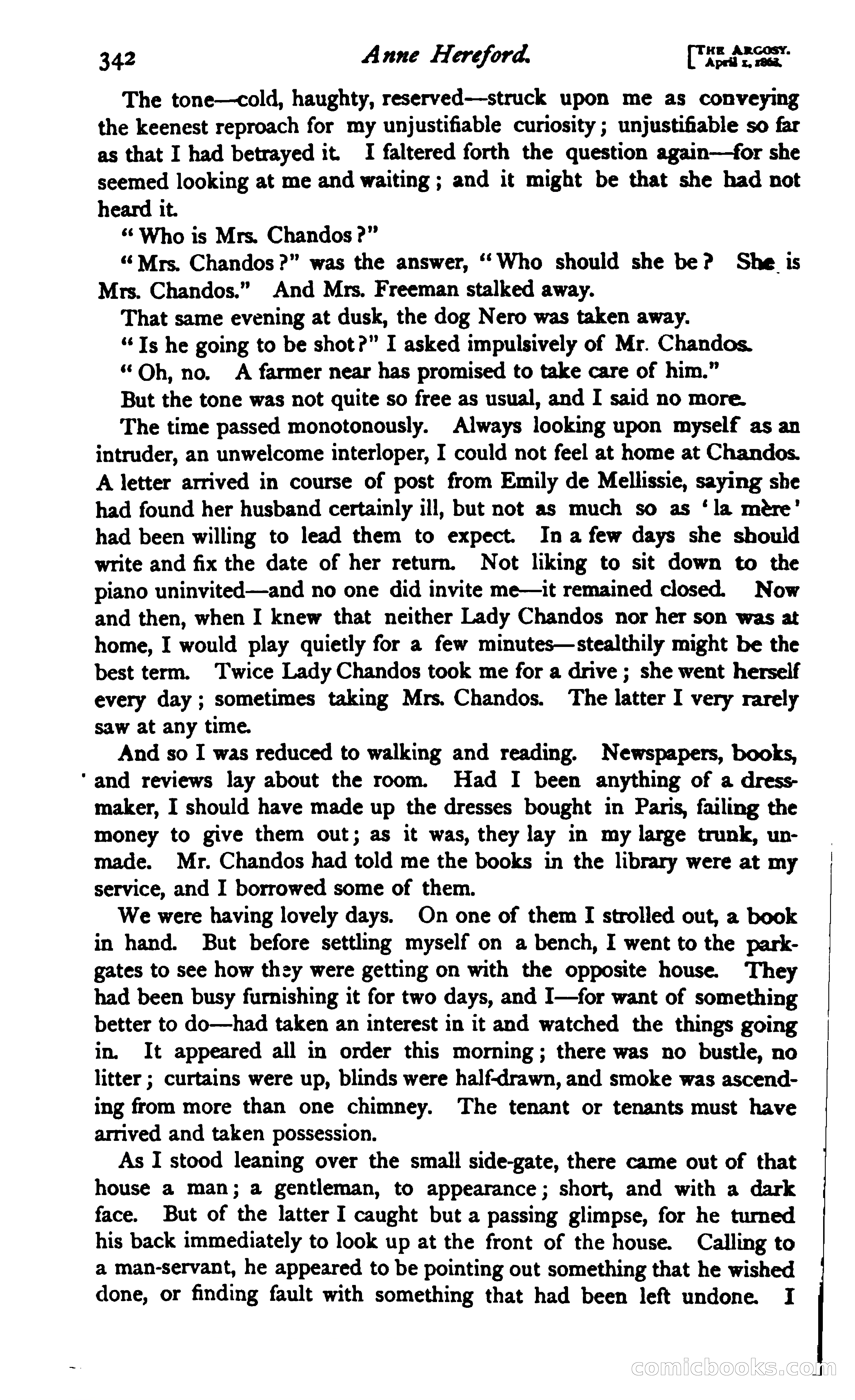
A restored page from Pulp Fiction, 1901. Page through the whole issue in the reader above.
📄 Transcribed text from this page (OCR, searchable)
Machine-transcribed from the original scan — historical spelling and the odd misread are preserved.
342 Anne Ht ereford. we Ancor. The tone—cold, haughty, reserved—-struck upon me as conveying the keenest reproach for my unjustifiable curiosity; unjustifiable so far as that I had betrayed it. I faltered forth the question again—for she seemed looking at me and waiting ; and it might be that she had not heard it. ‘Who is Mrs. Chandos ?” ‘‘ Mrs. Chandos ?” was the answer, “Who should she be? She ts Mrs. Chandos.” And Mrs. Freeman stalked away. That same evening at dusk, the dog Nero was taken away. “Ts he going to be shot?” I asked impulsively of Mr. Chandos. ‘Qh, no. A farmer near has promised to take care of him.” But the tone was not quite so free as usual, and I said no more. The time passed monotonously. Always looking upon myself as an intruder, an unwelcome interloper, I could not feel at home at Chandos. A letter arrived in course of post from Emily de Mellissie, saying she had found her husband certainly ill, but not as much so as ‘la mére’ had been willing to lead them to expect. In afew days she should write and fix the date of her return. Not liking to sit down to the piano uninvited—and no one did invite me—it remained closed. Now and then, when I knew that neither Lady Chandos nor her son was at home, I would play quietly for a few minutes—stealthily might be the best term. Twice Lady Chandos took me for a drive ; she went herself every day ; sometimes taking Mrs. Chandos. The latter I very rarely saw at any time. And so I was reduced to walking and reading. Newspapers, books, ‘and reviews lay about the room. Had I been anything of a dress- maker, I should have made up the dresses bought in Paris, failing the money to give them out; as it was, they lay in my large trunk, un- made. Mr. Chandos had told me the books in the library were at my service, and I borrowed some of them. We were having lovely days. On one of them [I strolled out, a book in hand. But before settling myself on a bench, I went to the park- gates to see how they were getting on with the opposite house. They had been busy furnishing it for two days, and I—for want of something better to do—had taken an interest in it and watched the things going | in. It appeared all in order this morning; there was no bustle, no litter ; curtains were up, blinds were half-drawn, and smoke was ascend- ing from more than one chimney. The tenant or tenants must have arrived and taken possession. As I stood leaning over the small side-gate, there came out of that house a man; a gentleman, to appearance; short, and with a dark face. But of the latter I caught but a passing glimpse, for he turned his back immediately to look up at the front of the house. Calling to a man-servant, he appeared to be pointing out something that he wished done, or finding fault with something that had been left undone. I GONMMGIOOKSEEOM