
Pulp Fiction, 1901 · page 352 of 400
The Argosy — page 352: what you’re looking at
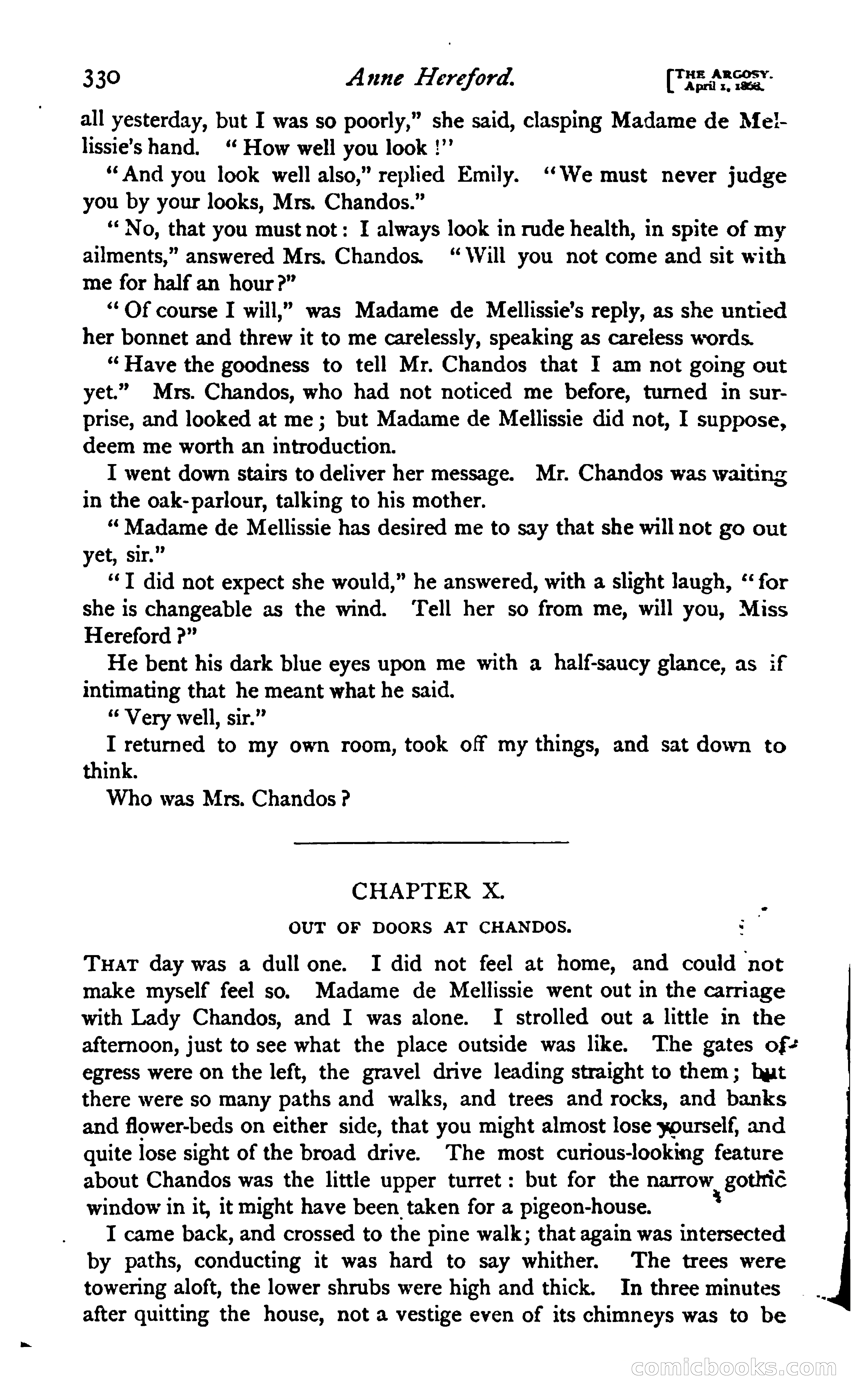
A restored page from Pulp Fiction, 1901. Page through the whole issue in the reader above.
📄 Transcribed text from this page (OCR, searchable)
Machine-transcribed from the original scan — historical spelling and the odd misread are preserved.
330 Anne Hereford. tex Aacos- all yesterday, but I was so poorly,” she said, clasping Madame de Mel- lissie’s hand. ‘“ How well you look !”’ “And you look well also,” rephed Emily. ‘‘We must never judge you by your looks, Mrs. Chandos.” ‘No, that you must not: I always look in rude health, in spite of my ailments,” answered Mrs. Chandos. “Will you not come and sit with me for half an hour ?” ‘* Of course I will,” was Madame de Mellissie’s reply, as she untied her bonnet and threw it to me carelessly, speaking as careless words. ‘“‘ Have the goodness to tell Mr. Chandos that I am not going out yet.” Mrs. Chandos, who had not noticed me before, turned in sur- prise, and looked at me ; but Madame de Mellissie did not, I suppose, deem me worth an imtroduction. I went down stairs to deliver her message. Mr. Chandos was waiting in the oak-parlour, talking to his mother. “Madame de Mellissie has desired me to say that she will not go out yet, sir.” ‘“‘T did not expect she would,” he answered, with a shght laugh, ‘for she 1s changeable as the wind. ‘Tell her so from me, will you, Miss Hereford ?” He bent his dark blue eyes upon me with a half-saucy glance, as if intimating that he meant what he said. Very well, sir.” I returned to my own room, took off my things, and sat down to think. Who was Mrs. Chandos ? CHAPTER X. OUT OF DOORS AT CHANDOS. TuatT day was a dull one. I did not feel at home, and could not make myself feel so. Madame de Mellissie went out in the carriage with Lady Chandos, and I was alone. I strolled out a little in the afternoon, just to see what the place outside was like. The gates of- egress were on the left, the gravel dnve leading straight to them; byt there were so many paths and walks, and trees and rocks, and banks and flower-beds on either side, that you might almost lose yourself, and quite lose sight of the broad drive. The most curious-looking feature about Chandos was the little upper turret: but for the narrow gothic window in it, it might have been taken for a pigeon-house. I came back, and crossed to the pine walk; that again was intersected by paths, conducting it was hard to say whither. The trees were towering aloft, the lower shrubs were high and thick. In three minutes after quitting the house, not a vestige even of its chimneys was to be COMIC OOOKS. EO _