
Pulp Fiction, 1901 · page 337 of 400
The Argosy — page 337: what you’re looking at
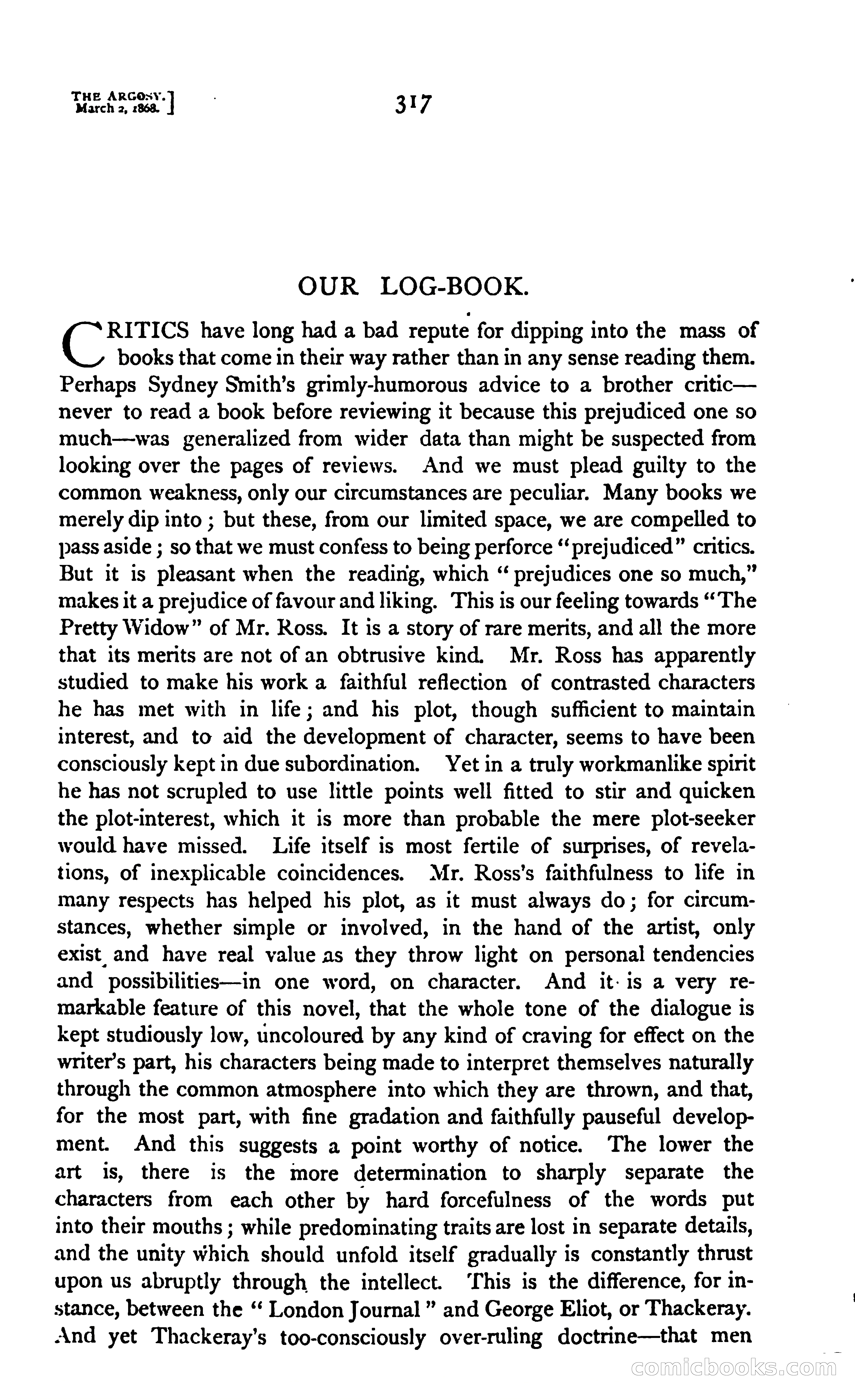
A restored page from Pulp Fiction, 1901. Page through the whole issue in the reader above.
📄 Transcribed text from this page (OCR, searchable)
Machine-transcribed from the original scan — historical spelling and the odd misread are preserved.
THE ARGOSY. ; March 2, 1868. 3 I / OUR LOG-BOOK. RITICS have long had a bad repute for dipping into the mass of books that come in their way rather than in any sense reading them. Perhaps Sydney Smith’s grimly-humorous advice to a brother critic— never to read a book before reviewing it because this prejudiced one so much—was generalized from wider data than might be suspected from looking over the pages of reviews. And we must plead guilty to the common weakness, only our circumstances are peculiar. Many books we merely dip into ; but these, from our limited space, we are compelled to pass aside ; so that we must confess to being perforce “‘ prejudiced” critics. But it is pleasant when the reading, which “ prejudices one so much,” makes it a prejudice of favour and liking. This is our feeling towards “The Pretty Widow” of Mr. Ross. It 1s a story of rare merits, and all the more that its ments are not of an obtrusive kind. Mr. Ross has apparently studied to make his work a faithful reflection of contrasted characters he has met with in life; and his plot, though sufficient to maintain interest, and to aid the development of character, seems to have been consciously kept in due subordination. Yet in a truly workmanlike spint he has not scrupled to use little points well fitted to stir and quicken the plot-interest, which it is more than probable the mere plot-seeker would have missed. Life itself 1s most fertile of surpmnses, of revela- tions, of inexplicable coincidences. Mr. Ross’s faithfulness to life in many respects has helped his plot, as it must always do; for circum- stances, whether simple or involved, in the hand of the artist, only exist and have real value as they throw light on personal tendencies and possibilities—in one word, on character. And it-is a very re- markable feature of this novel, that the whole tone of the dialogue is kept studiously low, uncoloured by any kind of craving for effect on the writers part, his characters being made to interpret themselves naturally through the common atmosphere into which they are thrown, and that, for the most part, with fine gradation and faithfully pauseful develop- ment. And this suggests a point worthy of notice. The lower the art is, there is the more determination to sharply separate the characters from each other by hard forcefulness of the words put into their mouths ; while predominating traits are lost in separate details, and the unity which should unfold itself gradually is constantly thrust upon us abruptly through the intellect. This is the difference, for in- stance, between the “ London Journal ” and George Eliot, or Thackeray. And yet Thackeray’s too-consciously over-ruling doctrine—that men GONMGIOO SS (CO)