
Pulp Fiction, 1901 · page 30 of 400
The Argosy — page 30: what you’re looking at
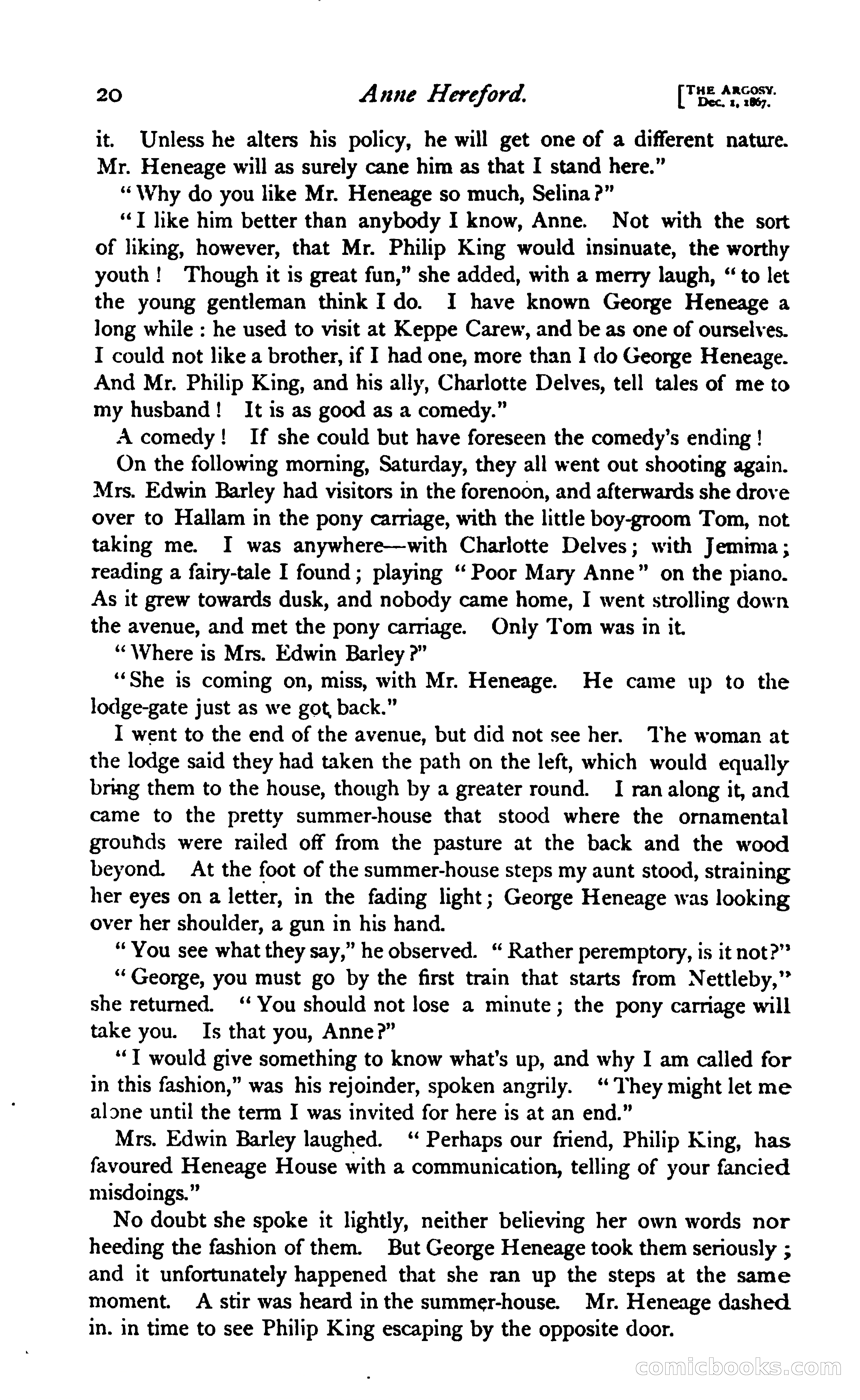
A restored page from Pulp Fiction, 1901. Page through the whole issue in the reader above.
📄 Transcribed text from this page (OCR, searchable)
Machine-transcribed from the original scan — historical spelling and the odd misread are preserved.
20 Anne Hereford. THE ARCosY, it. Unless he alters his policy, he will get one of a different nature. Mr. Heneage will as surely cane him as that I stand here.” “Why do you like Mr. Heneage so much, Selina ?” ‘“‘T hke him better than anybody I know, Anne. Not with the sort of liking, however, that Mr. Philip King would insinuate, the worthy youth! Though it 1s great fun,” she added, with a merry laugh, “to let the young gentleman think Ido. I have known George Heneage a Jong while : he used to visit at Keppe Carew, and be as one of ourselves. I could not like a brother, if I had one, more than I do George Heneage. And Mr. Philip King, and his ally, Charlotte Delves, tell tales of me to my husband! It 1s as good as a comedy.” A comedy! If she could but have foreseen the comedy’s ending ! On the following morning, Saturday, they all went out shooting again. Mrs. Edwin Barley had visitors in the forenoon, and afterwards she drove over to Hallam in the pony carnage, with the little boy-groom Tom, not taking me. I was anywhere—with Charlotte Delves; with Jemima; reading a fairy-tale I found; playing ‘“ Poor Mary Anne” on the piano. As it grew towards dusk, and nobody came home, I went strolling down the avenue, and met the pony carnage. Only Tom was in it. “Where is Mrs. Edwin Barley ?” ‘‘She is coming on, miss, with Mr. Heneage. He came up to the lodge-gate just as we got, back.” I went to the end of the avenue, but did not see her. The woman at the lodge said they had taken the path on the left, which would equally bring them to the house, though by a greater round. I ran along it, and came to the pretty summer-house that stood where the ornamental grounds were railed off from the pasture at the back and the wood beyond. At the foot of the summer-house steps my aunt stood, straining her eyes on a letter, in the fading light; George Heneage was looking over her shoulder, a gun in his hand. ‘You see what they say,” he observed. ‘“ Rather peremptory, is it not?” “George, you must go by the first train that starts from Nettleby,” she returned. ‘ You should not lose a minute; the pony carriage will take you. Is that you, Anne?” ‘“‘Y would give something to know what’s up, and why I am called for in this fashion,” was his rejoinder, spoken angrily. “They might let me alone until the term IJ was invited for here is at an end.” Mrs. Edwin Barley laughed. ‘‘ Perhaps our fmnend, Philip King, has favoured Heneage House with a communication, telling of your fancied miusdoings.” No doubt she spoke it lightly, neither believing her own words nor heeding the fashion of them. But George Heneage took them seriously ; and it unfortunately happened that she ran up the steps at the same moment. A stir was heard inthe summer-house. Mr. Heneage dashed in. in time to see Philip King escaping by the opposite door. comicaocks (GO)