
Pulp Fiction, 1901 · page 158 of 400
The Argosy — page 158: what you’re looking at
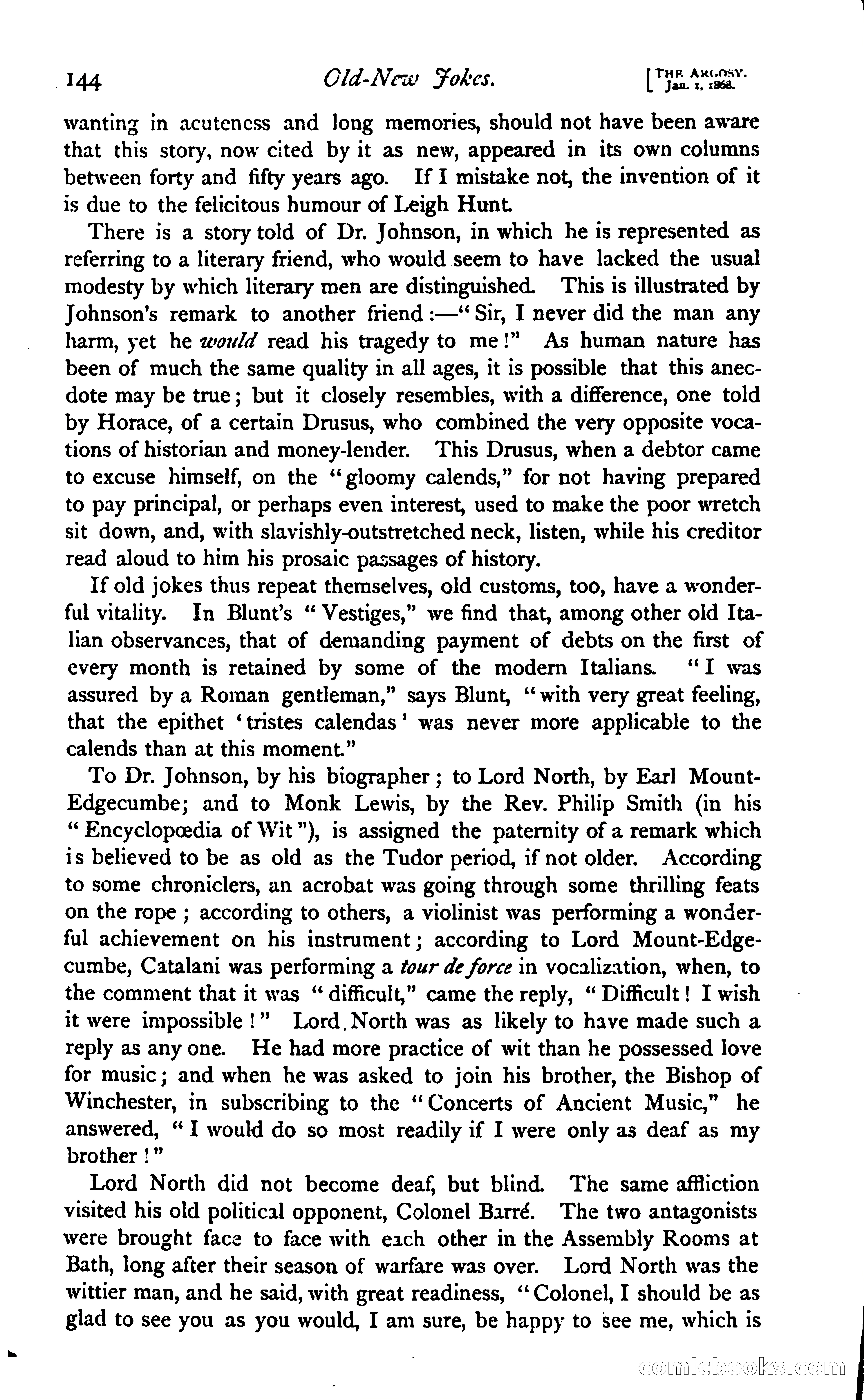
A restored page from Pulp Fiction, 1901. Page through the whole issue in the reader above.
📄 Transcribed text from this page (OCR, searchable)
Machine-transcribed from the original scan — historical spelling and the odd misread are preserved.
144 Cld-New Fokes. Tes Amie. wanting in acutencss and long memories, should not have been aware that this story, now cited by it as new, appeared in its own columns between forty and fifty years ago. If I mistake not, the invention of it is due to the felicitous humour of Leigh Hunt. There is a story told of Dr. Johnson, in which he Is represented as referring to a literary friend, who would seem to have lacked the usual modesty by which literary men are distinguished. This is illustrated by Johnson’s remark to another friend :—‘“‘ Sir, I never did the man any harm, yet he wold read his tragedy to me!” As human nature has been of much the same quality in all ages, it is possible that this anec- dote may be true; but it closely resembles, with a difference, one told by Horace, of a certain Drusus, who combined the very opposite voca- tions of historian and money-lender. This Drusus, when a debtor came to excuse himself, on the ‘‘ gloomy calends,” for not having prepared to pay principal, or perhaps even interest, used to make the poor wretch sit down, and, with slavishly-outstretched neck, listen, while his creditor read aloud to him his prosaic passages of history. If old jokes thus repeat themselves, old customs, too, have a wonder- ful vitality. In Blunt’s “ Vestiges,” we find that, among other old Ita- lian observances, that of demanding payment of debts on the first of every month is retained by some of the modern Italians. ‘I was assured by a Roman gentleman,” says Blunt, ‘with very great feeling, that the epithet ‘tristes calendas’ was never more applicable to the calends than at this moment.” To Dr. Johnson, by his biographer ; to Lord North, by Earl Mount- Edgecumbe; and to Monk Lewis, by the Rev. Philip Smith (in his “ Encyclopoedia of Wit”), 1s assigned the paternity of a remark which is believed to be as old as the Tudor period, if not older. According to some chroniclers, an acrobat was going through some thrilling feats on the rope ; according to others, a violinist was performing a wonder- ful achievement on his instrument; according to Lord Mount-Edge- cumbe, Catalani was performing a four de force in vocalization, when, to the comment that it was “ difficult,” came the reply, “ Difficult! I wish it were impossible!” Lord, North was as likely to have made such a reply as any one. He had more practice of wit than he possessed love for music ; and when he was asked to join his brother, the Bishop of Winchester, in subscribing to the ‘Concerts of Ancient Music,” he answered, “I would do so most readily if I were only as deaf as my brother !” Lord North did not become deaf, but blind. The same affliction visited his old political opponent, Colonel Barré. The two antagonists were brought face to face with each other in the Assembly Rooms at Bath, long after their season of warfare was over. Lord North was the wittier man, and he said, with great readiness, ‘‘ Colonel, I should be as glad to see you as you would, I am sure, be happy to see me, which is GOHRMGIOO <S GO)