
Pulp Fiction, 1901 · page 156 of 400
The Argosy — page 156: what you’re looking at
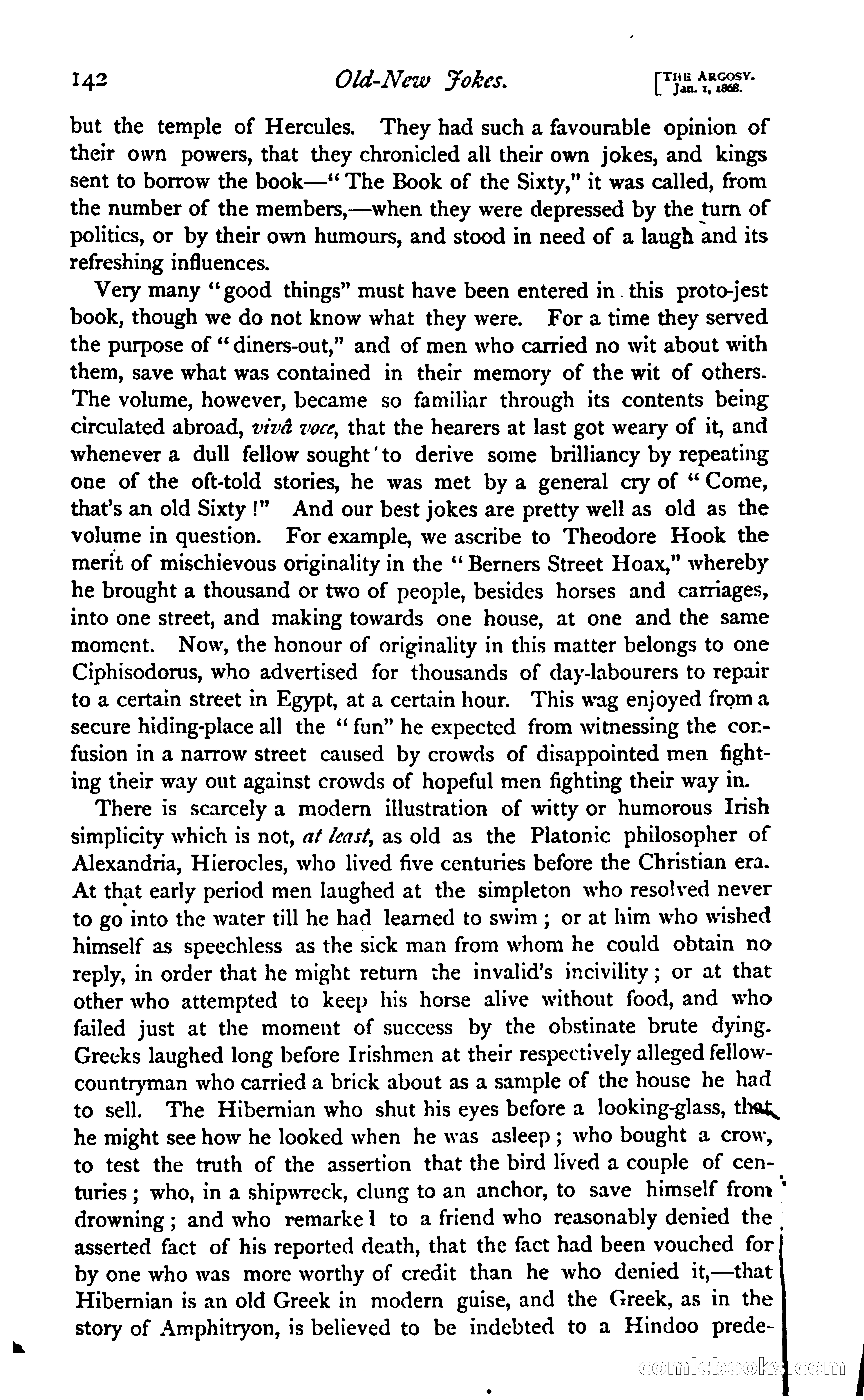
A restored page from Pulp Fiction, 1901. Page through the whole issue in the reader above.
📄 Transcribed text from this page (OCR, searchable)
Machine-transcribed from the original scan — historical spelling and the odd misread are preserved.
142 Old-New Fokes. THE ARGOSY. an. 1, 1968. but the temple of Hercules. They had such a favourable opinion of their own powers, that they chronicled all their own jokes, and kings sent to borrow the book—“‘ The Book of the Sixty,” it was called, from the number of the members,—when they were depressed by the turn of politics, or by their own humours, and stood in need of a laugh and its refreshing influences. Very many ‘‘good things” must have been entered in. this proto-jest book, though we do not know what they were. For a time they served the purpose of ‘‘diners-out,” and of men who carried no wit about with them, save what was contained in their memory of the wit of others. The volume, however, became so familiar through its contents being circulated abroad, zizé@ voce, that the hearers at last got weary of it, and whenever a dull fellow sought’to derive some bnilliancy by repeating one of the oft-told stories, he was met by a general cry of ‘“ Come, that’s an old Sixty!” And our best jokes are pretty well as old as the volume in question. For example, we ascribe to Theodore Hook the merit of mischievous orginality in the ‘“‘ Berners Street Hoax,” whereby he brought a thousand or two of people, besides horses and carriages, into one street, and making towards one house, at one and the same moment. Now, the honour of originality in this matter belongs to one Ciphisodorus, who advertised for thousands of day-labourers to repair to a certain street in Egypt, at a certain hour. This wag enjoyed froma secure hiding-place all the ‘‘ fun” he expected from witnessing the cor- fusion in a narrow street caused by crowds of disappointed men fight- ing their way out against crowds of hopeful men fighting their way in. There is scarcely a modern illustration of witty or humorous Insh simplicity which is not, af /east, as old as the Platonic philosopher of Alexandria, Hierocles, who lived five centuries before the Christian era. At that early period men laughed at the simpleton who resolved never to go into the water till he had learned to swim ; or at him who wished himself as speechless as the sick man from whom he could obtain no reply, in order that he might return the invalid’s incivility; or at that other who attempted to keep his horse alive without food, and who failed just at the moment of success by the obstinate brute dying. Grecks laughed long before Irishmen at their respectively alleged fellow- countryman who carried a brick about as a sample of the house he had to sell. The Hibernian who shut his eyes before a looking-glass, that, he might see how he looked when he was asleep; who bought a crow, to test the truth of the assertion that the bird lived a couple of cen- turies ; who, in a shipwreck, clung to an anchor, to save himself from . drowning ; and who remarkel to a friend who reasonably denied the | asserted fact of his reported death, that the fact had been vouched for by one who was more worthy of credit than he who dented 1t,—that Hibernian is an old Greek in modern guise, and the Greek, as in the story of Amphitryon, is believed to be indebted to a Hindoo prede- comiclaoolkx¢e GO)