
Pulp Fiction, 1901 · page 138 of 400
The Argosy — page 138: what you’re looking at
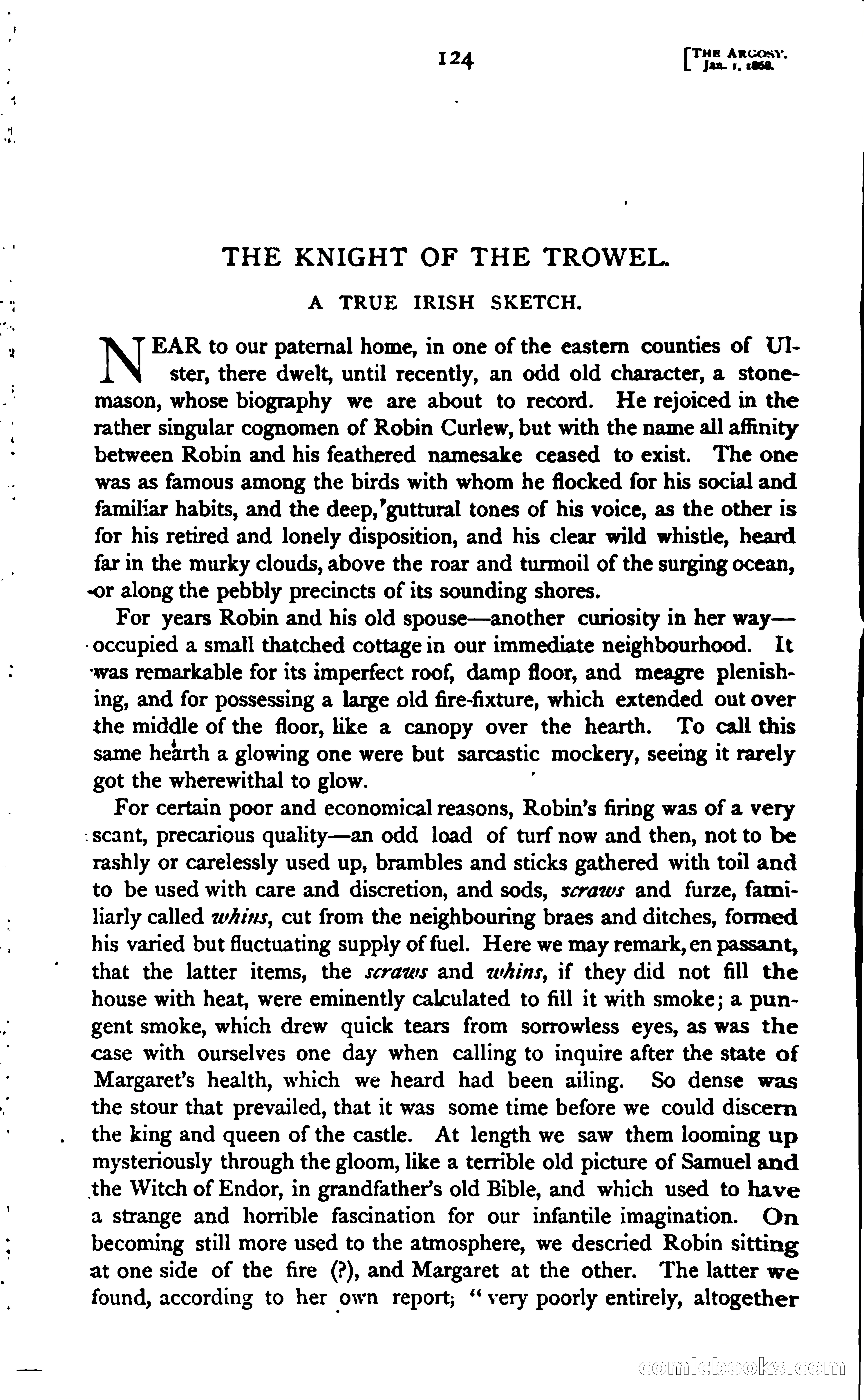
A restored page from Pulp Fiction, 1901. Page through the whole issue in the reader above.
📄 Transcribed text from this page (OCR, searchable)
Machine-transcribed from the original scan — historical spelling and the odd misread are preserved.
124 ry AN THE KNIGHT OF THE TROWEL. A TRUE IRISH SKETCH. EAR to our paternal home, in one of the eastern counties of UI- ster, there dwelt, until recently, an odd old character, a stone- mason, whose biography we are about to record. He rejoiced in the rather singular cognomen of Robin Curlew, but with the name all affinity between Robin and his feathered namesake ceased to exist. The one was as famous among the birds with whom he flocked for his social and familiar habits, and the deep, guttural tones of his voice, as the other is for his retired and lonely disposition, and his clear wild whistle, heard far in the murky clouds, above the roar and turmoil of the surging ocean, -or along the pebbly precincts of its sounding shores. For years Robin and his old spouse—another cunosity in her way— -occupied a small thatched cottage in our immediate neighbourhood. It "was remarkable for its imperfect roof, damp floor, and meagre plentsh- ing, and for possessing a large old fire-fixture, which extended out over the middle of the floor, hke a canopy over the hearth. To call this same hearth a glowing one were but sarcastic mockery, seeing it rarely got the wherewithal to glow. For certain poor and economical reasons, Robin’s firing was of a very Scant, precarious quality—an odd load of turf now and then, not to be rashly or carelessly used up, brambles and sticks gathered with toil and to be used with care and discretion, and sods, scraws and furze, fami- liarly called wAzus, cut from the neighbouring braes and ditches, formed his varied but fluctuating supply of fuel. Here we may remark, en passant, that the latter items, the scraws and whins, if they did not fill the house with heat, were eminently calculated to fill it with smoke; a pun- gent smoke, which drew quick tears from sorrowless eyes, as was the case with ourselves one day when calling to inquire after the state of Margaret’s health, which we heard had been ailing. So dense was the stour that prevailed, that it was some time before we could discern the king and queen of the castle. At length we saw them looming up mysteriously through the gloom, like a terrible old picture of Samuel and the Witch of Endor, 1n grandfather’s old Bible, and which used to have a strange and horrible fascination for our infantile imagination. On becoming still more used to the atmosphere, we descried Robin sitting at one side of the fire (?), and Margaret at the other. The latter we found, according to her own report; “‘ very poorly entirely, altogether ECOMicoOolkxs.cO©