
Pulp Fiction, 1901 · page 108 of 400
The Argosy — page 108: what you’re looking at
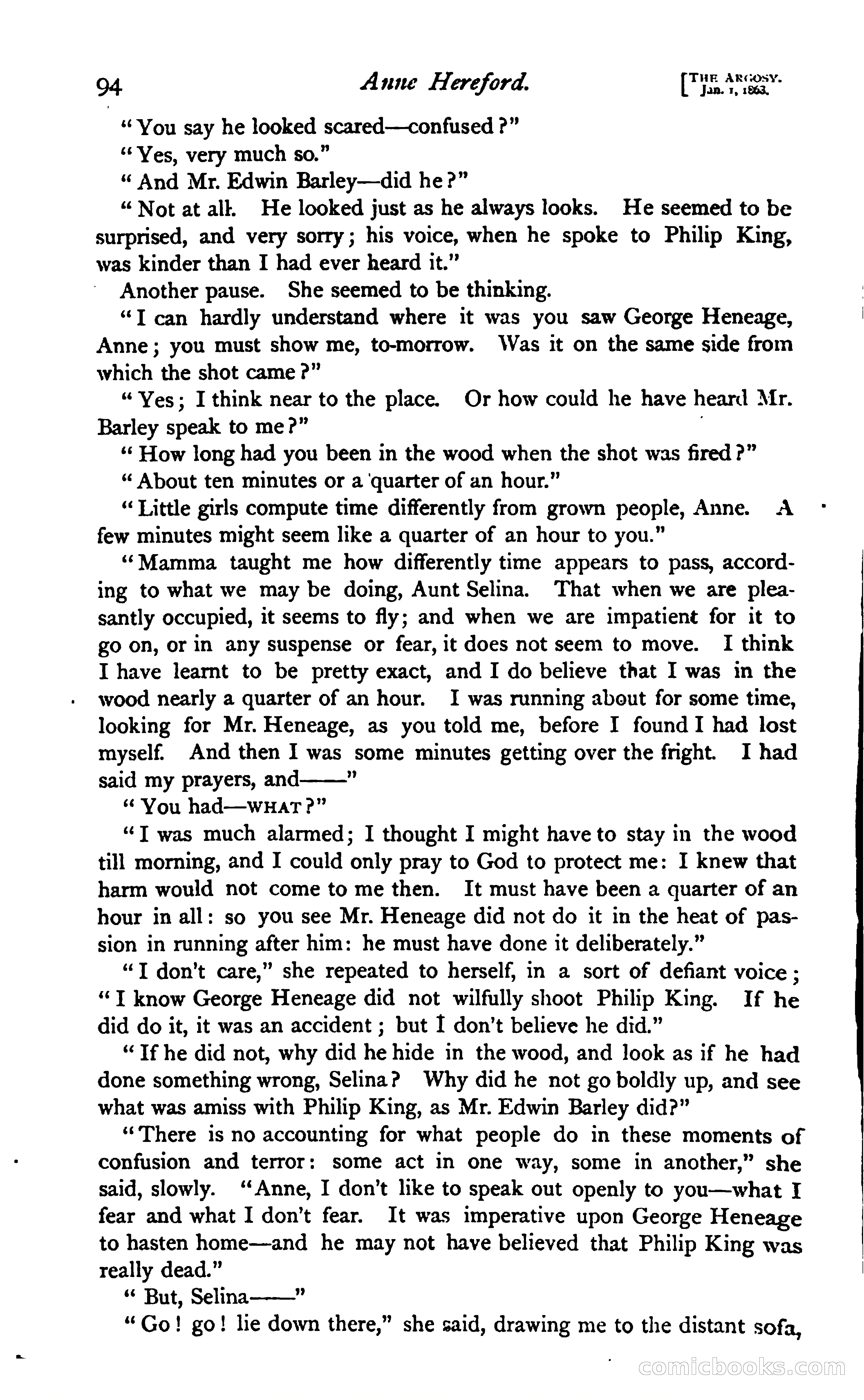
A restored page from Pulp Fiction, 1901. Page through the whole issue in the reader above.
📄 Transcribed text from this page (OCR, searchable)
Machine-transcribed from the original scan — historical spelling and the odd misread are preserved.
O4 Anne H. ereford. THE ARGOSY. Jan. 1, 1863. “You say he looked scared—confused ?” ‘Ves, very much so.” “ And Mr. Edwin Barley—did he ?” “Not at alk. He looked just as he always looks. He seemed to be surprised, and very sorry; his voice, when he spoke to Philip King, was kinder than I had ever heard it.” Another pause. She seemed to be thinking. “T can hardly understand where it was you saw George Heneage, Anne; you must show me, to-morrow. Was it on the same side from which the shot came ?” “Ves; I think near to the place. Or how could he have heard Mr. Barley speak to me?” | ‘¢ How long had you been in the wood when the shot was fired ?” “ About ten minutes or a ‘quarter of an hour.” “Tittle girls compute time differently from grown people, Anne. <A few minutes might seem like a quarter of an hour to you.” ‘‘Mamma taught me how differently time appears to pass, accord- ing to what we may be doing, Aunt Selina. That when we are plea- santly occupied, it seems to fly; and when we are impatient for it to go on, or in any suspense or fear, it does not seem to move. I think I have learnt to be pretty exact, and I do believe that I was in the wood nearly a quarter of an hour. I was running about for some time, looking for Mr. Heneage, as you told me, before I found I had lost myself. And then I was some minutes getting over the fnght. I had said my prayers, and " “You had—wuHar ?” “T was much alarmed; I thought I might have to stay in the wood till morning, and I could only pray to God to protect me: I knew that harm would not come to me then. It must have been a quarter of an hour in all: so you see Mr. Heneage did not do it in the heat of pas- sion in running after him: he must have done it deliberately.” “T don't care,” she repeated to herself, in a sort of defiant voice ; “TI know George Heneage did not wilfully shoot Philip King. If he did do it, it was an accident ; but I don’t believe he did.” “Tf he did not, why did he hide in the wood, and look as if he had done something wrong, Selina? Why did he not go boldly up, and see what was amiss with Philip King, as Mr. Edwin Barley did?” ‘There 1s no accounting for what people do in these moments of confusion and terror: some act in one way, some in another,” she said, slowly. ‘Anne, I don’t like to speak out openly to you—what I fear and what I don’t fear. It was imperative upon George Heneage to hasten home—and he may not have believed that Philip King was really dead.” ‘* But, Selina ” “Go! go! he down there,” she said, drawing me to the distant sofa, ECOMicoOolkxs.cO©