
Pulp Fiction, 1865 · page 57 of 399
The Argosy — page 57: what you’re looking at
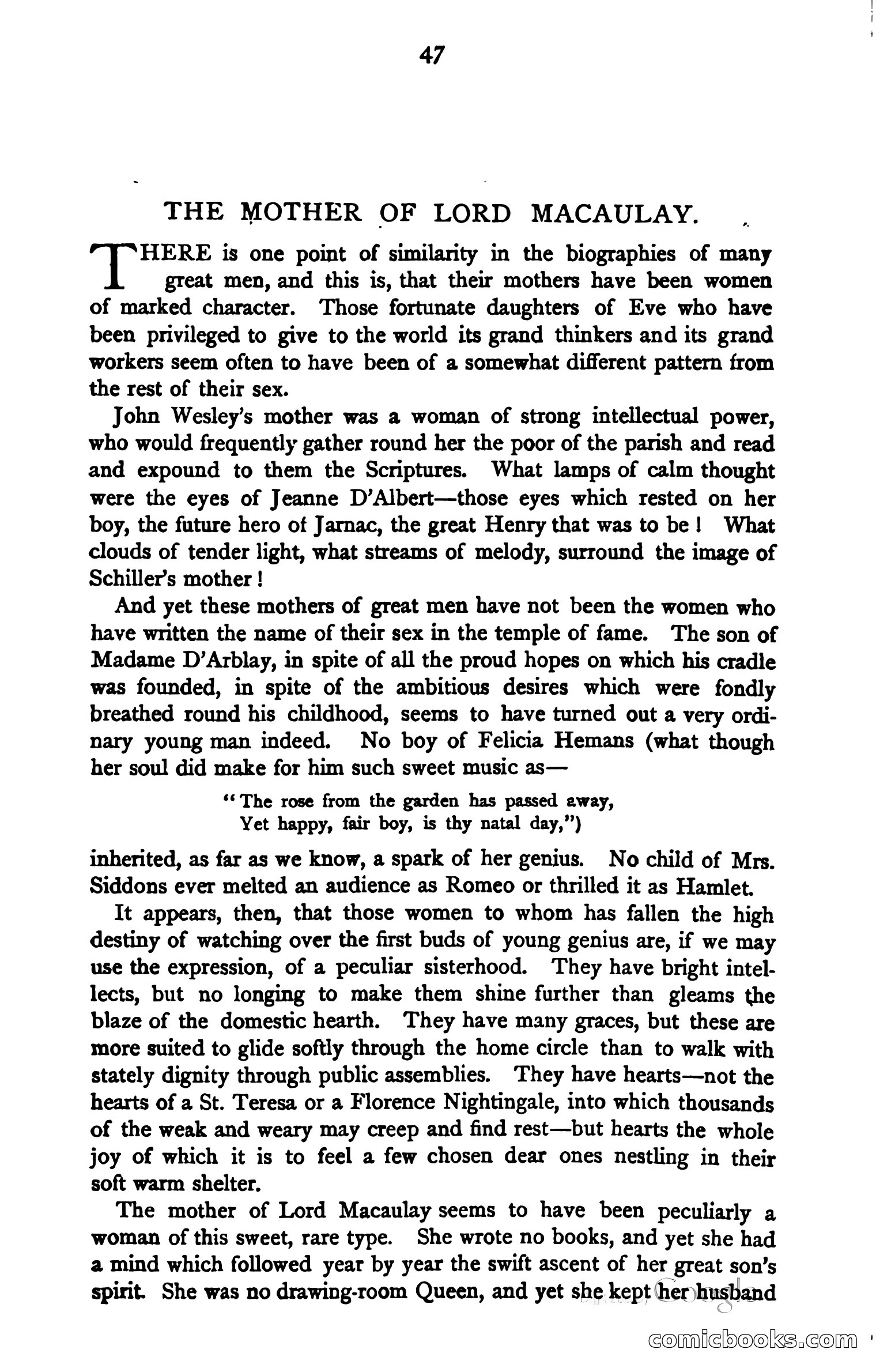
A restored page from Pulp Fiction, 1865. Page through the whole issue in the reader above.
📄 Transcribed text from this page (OCR, searchable)
Machine-transcribed from the original scan — historical spelling and the odd misread are preserved.
47 THE MOTHER OF LORD MACAULAY. HERE is one point of similarity in the biographies of many great men, and this is, that their mothers have been women of marked character. Those fortunate daughters of Eve who have been privileged to give to the world its grand thinkers and its grand workers seem often to have been of a somewhat different pattern from the rest of their sex. John Wesley’s mother was a woman of strong intellectual power, who would frequently gather round her the poor of the parish and read and expound to them the Scriptures. What lamps of calm thought were the eyes of Jeanne D’Albert—those eyes which rested on her boy, the future hero of Jarnac, the great Henry that was to be! What clouds of tender light, what streams of melody, surround the image of Schiller’s mother ! And yet these mothers of great men have not been the women who have written the name of their sex in the temple of fame. The son of Madame D’Arblay, in spite of all the proud hopes on which his cradle was founded, in spite of the ambitious desires which were fondly breathed round his childhood, seems to have turned out a very ordi- nary young man indeed. No boy of Felicia Hemans (what though her soul did make for him such sweet music as— **The rose from the garden has passed away, Yet happy, fair boy, is thy natal day,’’) inherited, as far as we know, a spark of her genius. No child of Mrs. Siddons ever melted an audience as Romeo or thrilled it as Hamlet. It appears, then, that those women to whom has fallen the high destiny of watching over the first buds of young genius are, if we may use the expression, of a peculiar sisterhood. They have bright intel- lects, but no longing to make them shine further than gleams the blaze of the domestic hearth. They have many graces, but these are more suited to glide softly through the home circle than to walk with stately dignity through public assemblies. They have hearts—not the hearts of a St. Teresa or a Florence Nightingale, into which thousands of the weak and weary may creep and find rest—but hearts the whole joy of which it is to feel a few chosen dear ones nestling in their soft warm shelter, The mother of Lord Macaulay seems to have been peculiarly a woman of this sweet, rare type. She wrote no books, and yet she had a mind which followed year by year the swift ascent of her great son’s spirit. She was no drawing-room Queen, and yet she kept her husband comicbooks.com '