
Pulp Fiction, 1865 · page 274 of 399
The Argosy — page 274: what you’re looking at
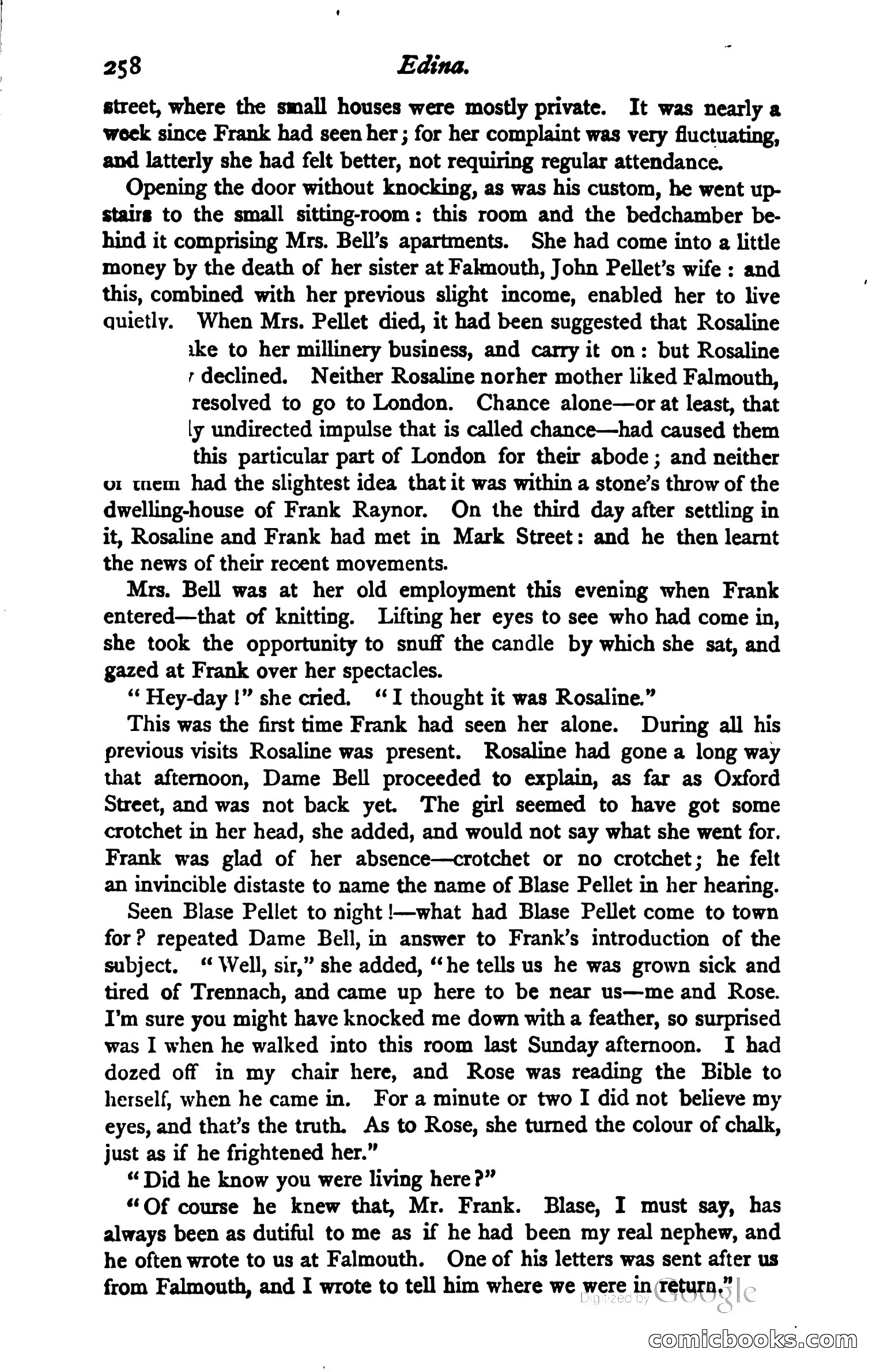
A restored page from Pulp Fiction, 1865. Page through the whole issue in the reader above.
📄 Transcribed text from this page (OCR, searchable)
Machine-transcribed from the original scan — historical spelling and the odd misread are preserved.
258 Edina. street, where the small houses were mostly private. It was nearly a week since Frank had seen her ; for her complaint was very fluctuating, and latterly she had felt better, not requiring regular attendance. Opening the door without knocking, as was his custom, he went up- stairs to the small sitting-room: this room and the bedchamber be- hind it comprising Mrs. Bell’s apartments. She had come into a little money by the death of her sister at Falmouth, John Pellet’s wife : and this, combined with her previous slight income, enabled her to live quietly. When Mrs. Pellet died, it had been suggested that Rosaline ike to her millinery business, and carry it on: but Rosaline ‘declined. Neither Rosaline norher mother liked Falmouth, resolved to go to London. Chance alone—or at least, that ly undirected impulse that is called chance—had caused them this particular part of London for their abode ; and neither or taem had the slightest idea that it was within a stone’s throw of the dwelling-house of Frank Raynor. On the third day after settling in it, Rosaline and Frank had met in Mark Street: and he then learnt the news of their recent movements. Mrs. Bell was at her old employment this evening when Frank entered—that of knitting. Lifting her eyes to see who had come in, she took the opportunity to snuff the candle by which she sat, and gazed at Frank over her spectacles. ““Hey-day !” she cried. ‘I thought it was Rosaline.” This was the first time Frank had seen her alone. During all his previous visits Rosaline was present. Rosaline had gone a long way that afternoon, Dame Bell proceeded to explain, as far as Oxford Street, and was not back yet. The girl seemed to have got some crotchet in her head, she added, and would not say what she went for. Frank was glad of her absence—crotchet or no crotchet; he felt an invincible distaste to name the name of Blase Pellet in her hearing. Seen Blase Pellet to night !—what had Blase Pellet come to town for? repeated Dame Bell, in answer to Frank’s introduction of the subject. ‘ Well, sir,” she added, “‘he tells us he was grown sick and tired of Trennach, and came up here to be near us—me and Rose. I’m sure you might have knocked me down with a feather, so surprised was I when he walked into this room last Sunday afternoon. I had dozed off in my chair here, and Rose was reading the Bible to herself, when he came in. For a minute or two I did not believe my eyes, and that’s the truth. As to Rose, she turned the colour of chalk, just as if he frightened her.” “Did he know you were living here ?” “Of course he knew that, Mr. Frank. Blase, I must say, has always been as dutiful to me as if he had been my real nephew, and he often wrote to us at Falmouth. One of his letters was sent after us from Falmouth, and I wrote to tell him where we were in return,” | comichooks.conn