
Pulp Fiction, 1865 · page 231 of 399
The Argosy — page 231: what you’re looking at
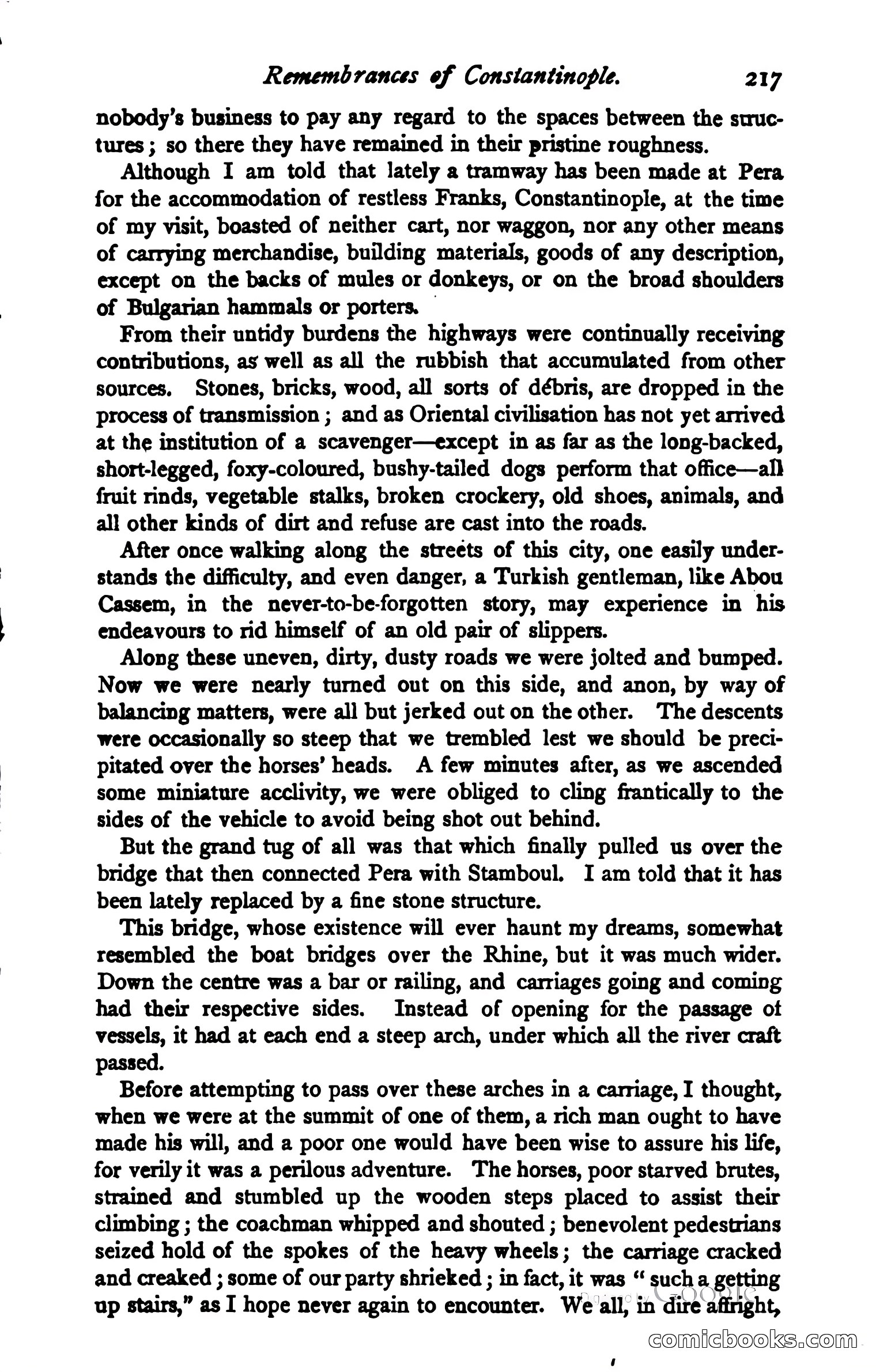
A restored page from Pulp Fiction, 1865. Page through the whole issue in the reader above.
📄 Transcribed text from this page (OCR, searchable)
Machine-transcribed from the original scan — historical spelling and the odd misread are preserved.
Remembrances of Constantinople. 217 nobody’s business to pay any regard to the spaces between the struc- tures ; so there they have remained in their pristine roughness. Although I am told that lately a tramway has been made at Pera for the accommodation of restless Franks, Constantinople, at the time of my visit, boasted of neither cart, nor waggon, nor any other means of carrying merchandise, building materials, goods of any description, except on the backs of mules or donkeys, or on the broad shoulders of Bulgarian hammals or porters. — From their untidy burdens the highways were continually receiving contributions, as well as all the rubbish that accumulated from other sources. Stones, bricks, wood, all sorts of débris, are dropped in the process of transmission ; and as Oriental civilisation has not yet arrived at the institution of a scavenger—except in as far as the long-backed, short-legged, foxy-coloured, bushy-tailed dogs perform that office—alh fruit rinds, vegetable stalks, broken crockery, old shoes, animals, and all other kinds of dirt and refuse are cast into the roads. After once walking along the streets of this city, one easily under- stands the difficulty, and even danger, a Turkish gentleman, like Abou Cassem, in the never-to-be-forgotten story, may experience in his endeavours to rid himself of an old pair of slippers. Along these uneven, dirty, dusty roads we were jolted and bumped. Now we were nearly turned out on this side, and anon, by way of balancing matters, were all but jerked out on the other. The descents were occasionally so steep that we trembled lest we should be preci- pitated over the horses’ heads. A few minutes after, as we ascended some miniature acclivity, we were obliged to cling frantically to the sides of the vehicle to avoid being shot out behind. But the grand tug of all was that which finally pulled us over the bridge that then connected Pera with Stamboul. I am told that it has been lately replaced by a fine stone structure. This bridge, whose existence will ever haunt my dreams, somewhat resembled the boat bridges over the Rhine, but it was much wider. Down the centre was a bar or railing, and carriages going and coming had their respective sides. Instead of opening for the passage of vessels, it had at each end a steep arch, under which all the river craft passed. Before attempting to pass over these arches in a carriage, I thought, when we were at the summit of one of them, a rich man ought to have made his will, and a poor one would have been wise to assure his life, for verily it was a perilous adventure. The horses, poor starved brutes, strained and stumbled up the wooden steps placed to assist their climbing ; the coachman whipped and shouted ; benevolent pedestrians seized hold of the spokes of the heavy wheels; the carriage cracked and creaked ; some of our party shrieked ; in fact, it was “sucha getting up stairs,” as I hope never again to encounter. We all, in dire ‘afiright, comliichooks.com ‘