
Pulp Fiction, 1865 · page 21 of 399
The Argosy — page 21: what you’re looking at
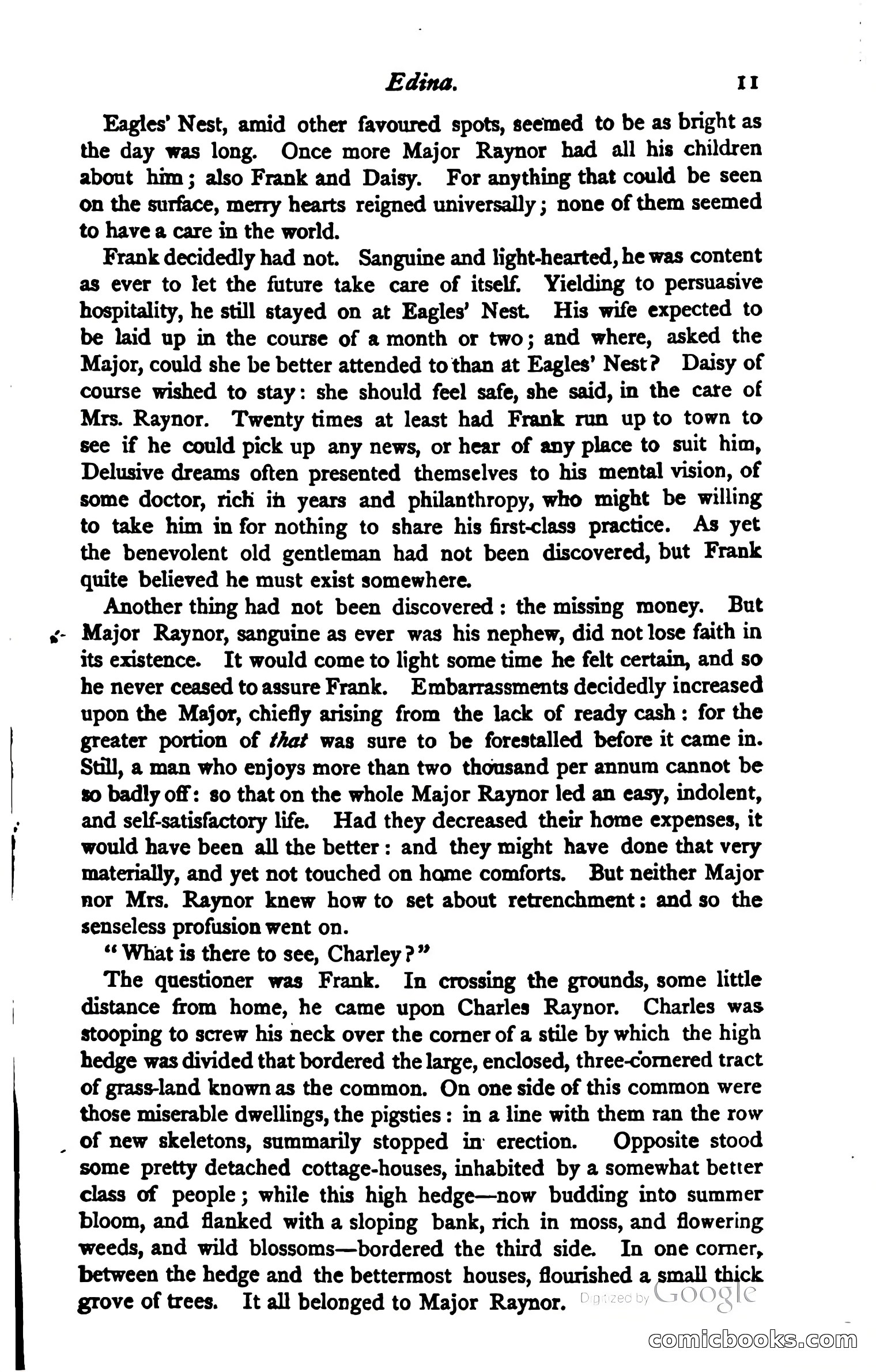
A restored page from Pulp Fiction, 1865. Page through the whole issue in the reader above.
📄 Transcribed text from this page (OCR, searchable)
Machine-transcribed from the original scan — historical spelling and the odd misread are preserved.
ww Edina. II Eagles’ Nest, amid other favoured spots, seemed to be as bright as the day was long. Once more Major Raynor had all his children about him; also Frank and Daisy. For anything that could be seen on the surface, merry hearts reigned universally ; none of them seemed to have a care in the world. Frank decidedly had not. Sanguine and light-hearted, he was content as ever to let the future take care of itself. Yielding to persuasive hospitality, he still stayed on at Eagles’ Nest. His wife expected to be laid up in the course of a month or two; and where, asked the Major, could she be better attended to than at Eagles’ Nest? Daisy of course wished to stay: she should feel safe, she said, in the care of Mrs. Raynor. Twenty times at least had Frank run up to town to see if he could pick up any news, or hear of any place to suit him, Delusive dreams often presented themselves to his mental vision, of some doctor, rich ih years and philanthropy, who might be willing to take him in for nothing to share his first-class practice. As yet the benevolent old gentleman had not been discovered, but Frank quite believed he must exist somewhere. Another thing had not been discovered: the missing money. But Major Raynor, sanguine as ever was his nephew, did not lose faith in its existence. It would come to light some time he felt certain, and so he never ceased to assure Frank. Embarrassments decidedly increased upon the Major, chiefly arising from the lack of ready cash: for the greater portion of ‘Aa? was sure to be forestalled before it came in. Still, a man who enjoys more than two thousand per annum cannot be so badly off: so that on the whole Major Raynor led an easy, indolent, and self-satisfactory life. Had they decreased their home expenses, it would have been all the better: and they might have done that very materially, and yet not touched on hame comforts. But neither Major nor Mrs. Raynor knew how to set about retrenchment: and so the senseless profusion went on. ‘* What is there to see, Charley?” The questioner was Frank. In crossing the grounds, some little distance from home, he came upon Charles Raynor. Charles was stooping to screw his neck over the corner of a stile by which the high hedge was divided that bordered the large, enclosed, three-cornered tract of grass-land known as the common. On one side of this common were those miserable dwellings, the pigsties: in a line with them ran the row of new skeletons, summarily stopped im erection. Opposite stood some pretty detached cottage-houses, inhabited by a somewhat better class of people; while this high hedge—now budding into summer bloom, and flanked with a sloping bank, rich in moss, and flowering weeds, and wild blossoms—bordered the third side. In one corner, between the hedge and the bettermost houses, flourished a small thick grove of trees. It all belonged to Major Raynor. gle comicbooks.com