
Pulp Fiction, 1865 · page 183 of 399
The Argosy — page 183: what you’re looking at
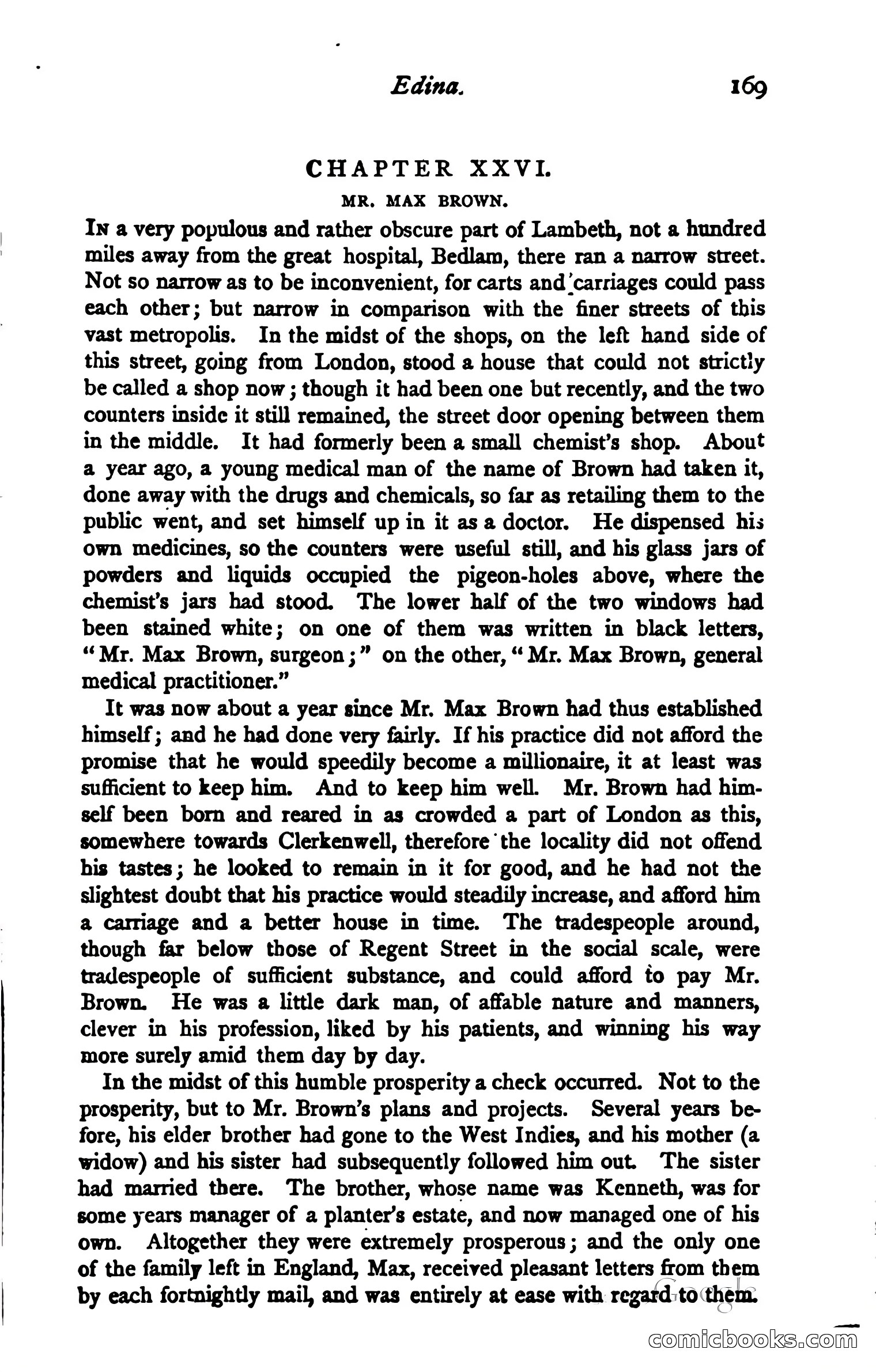
A restored page from Pulp Fiction, 1865. Page through the whole issue in the reader above.
📄 Transcribed text from this page (OCR, searchable)
Machine-transcribed from the original scan — historical spelling and the odd misread are preserved.
Edina. 169 CHAPTER XXVI. MR, MAX BROWN. IN a very populous and rather obscure part of Lambeth, not a hundred miles away from the great hospital, Bedlam, there ran a narrow street. Not so narrow as to be inconvenient, for carts and’carriages could pass each other; but narrow in comparison with the finer streets of this vast metropolis. In the midst of the shops, on the left hand side of this street, going from London, stood a house that could not strictly be called a shop now ; though it had been one but recently, and the two counters inside it still remained, the street door opening between them in the middle. It had formerly been a small chemist’s shop. About a year ago, a young medical man of the name of Brown had taken it, done away with the drugs and chemicals, so far as retailing them to the public went, and set himself up in it asa doctor. He dispensed his own medicines, so the counters were useful still, and his glass jars of powders and liquids occupied the pigeon-holes above, where the chemist’s jars had stood. The lower half of the two windows had been stained white; on one of them was written in black letters, ““Mr. Max Brown, surgeon ;” on the other, “ Mr. Max Brown, general medical practitioner.” It was now about a year since Mr. Max Brown had thus established himself ; and he had done very fairly. If his practice did not afford the promise that he would speedily become a millionaire, it at least was sufficient to keep him. And to keep him well. Mr. Brown had him- self been born and reared in as crowded a part of London as this, somewhere towards Clerkenwell, therefore ‘the locality did not offend his tastes; he looked to remain in it for good, and he had not the slightest doubt that his practice would steadily increase, and afford him a carriage and a better house in time. The tradespeople around, though far below those of Regent Street in the social scale, were tradespeople of sufficient substance, and could afford to pay Mr. Brown. He was a little dark man, of affable nature and manners, clever in his profession, liked by his patients, and winning his way more surely amid them day by day. In the midst of this humble prosperity a check occurred. Not to the prosperity, but to Mr. Brown’s plans and projects. Several years be- fore, his elder brother had gone to the West Indies, and his mother (a widow) and his sister had subsequently followed him out. The sister had married there. The brother, whose name was Kenneth, was for some years manager of a planter’s estate, and now managed one of his own. Altogether they were extremely prosperous; and the only one of the family left in England, Max, received pleasant letters from them by each fortnightly mail, and was entirely at ease with regatd:to< them, comichooks.conm