
Pulp Fiction, 1904 · page 80 of 122
The Argosy, June 1904 — page 80: what you’re looking at
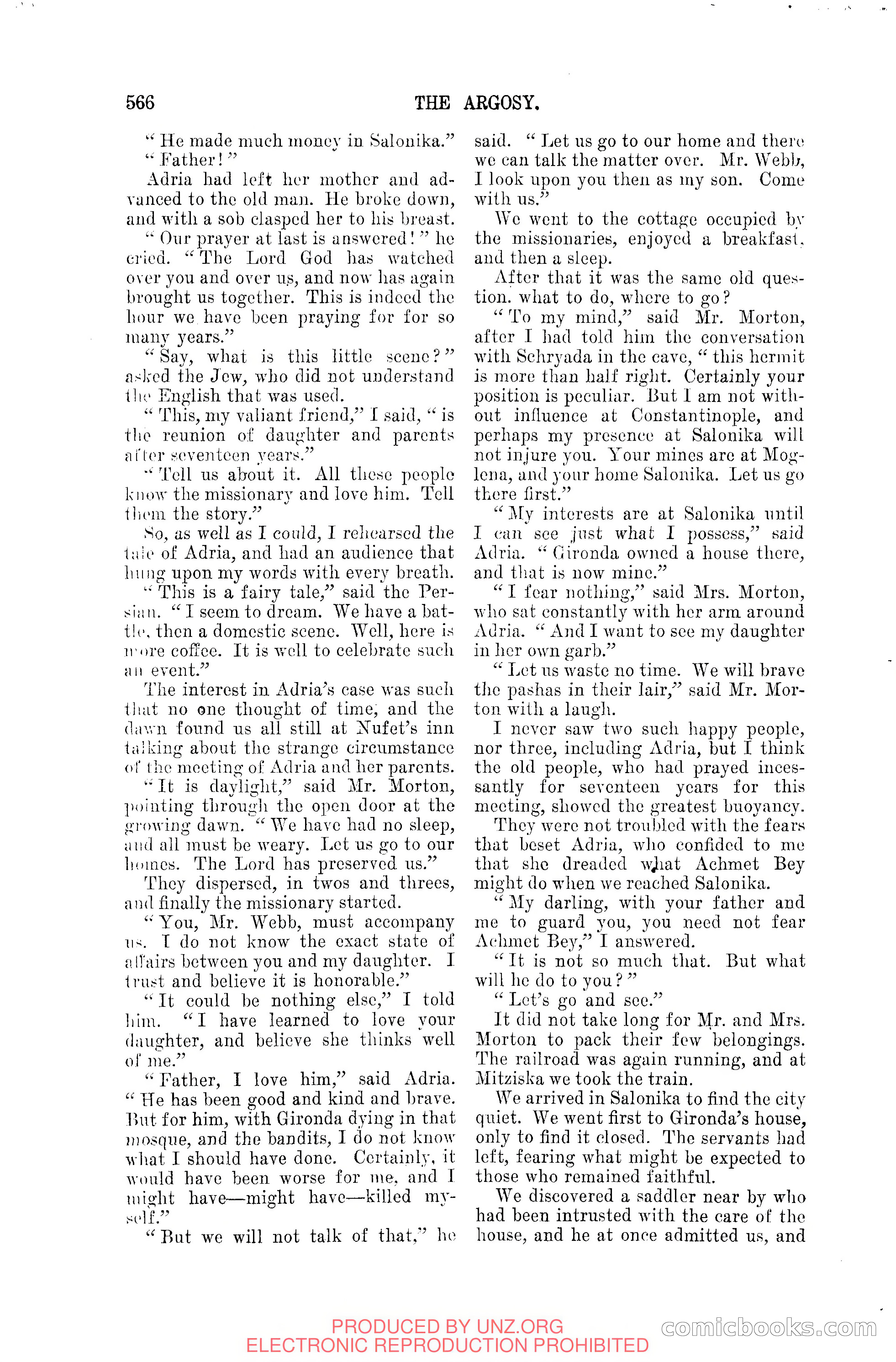
A restored page from Pulp Fiction, 1904. Page through the whole issue in the reader above.
📄 Transcribed text from this page (OCR, searchable)
Machine-transcribed from the original scan — historical spelling and the odd misread are preserved.
566 ‘“ He made much money in Salonika.” “ Father!” Adria had left her mother and ad- vanced to the old man. He broke down, and with a sob clasped her to his breast. * Our prayer at last is answered!” he cried. “The Lord God has watched over you and over us, and now has again brought us together. This is indeed the hour. we have been praying for for so many years.” “Say, what is this httle seene?” asked the Jew, who did not understand the English that was used. ‘ This, my valiant friend,” I said, ° the reunion of daughter and Aone after seventeen years.” “Pell us about it. know the missionary and love him. them the story.” So, as well as I could, I rehearsed the iuie of Adria, and had an audience that hung upon my words with every breath. “This is a fairy tale,” said the Per- n. “IT seem to dream. We have a bat- t!e, then a domestic scene. Well, here ts wore cofice. It is well to celebrate such ai event.” The interest in Adria’s case was such that no one thought of time, and the dawn found us all still at Nufet’s inn talking about the strange circumstance of the ‘meeting of Adria and her parents. “Tt is daylicht, ” said Mr. Morton, pointing through the open door at the growing dawn. “ We have had no sleep, und all must be weary. Let us go to our homes. The Lord has preserved us.’ They dispersed, in twos and threes, ancl finally the missionary started. “You, Mr. Webb, must accompany us. [ do not know the exact state of alfairs between you and my daughter. I {rust and believe it is honorable.” “Tt could be nothing else,” I told him. “I have learned to love your daughter, and believe she thinks well of me.” “Father, I love him,” said Adria. “ fe has been good and kind and brave. sut for him, with Gironda dying in that mosque, and the bandits, I do not know what I should have done. Cort tainly, it would have been worse for me, and I might have—might have—killed my- self.” “But we will not talk of that,” he All these people Tell sla PRODUCED BY UNZ.ORG COMNUC THE ARGOSY. said. ‘ Let us go to our home and there we can talk the matter over. Mr. Webh, I look upon you then as my son. Come with us.” We went to the cottage occupied by the missionaries, enjoyed a breakfast. and then a sleep. After that it was the same old ques- tion. what to do, where to go? “To my mind,” said Mr. Morton, after I had told him the conversation with Sehryada in the cave, “ this hermit is more than half right. Certainly your position is peculiar. But 1 am not with- out influence at Constantinople, and perhaps my presence at Salonika will not Injure you. Your mines are at Mog- Jena, and your home Salonika. Let us go there first.” “My interests are at Salonika until I can see just what I possess,” said Adria. “ Gironda owned a house there, and that is now mine.” “T fear nothing,” said Mrs. Morton, who sat constantly with her arm around Adria. “ And I want to see my daughter in her own garb.” “ Let us waste no time. We will brave the pashas in their lair,” said Mr. Mor- ton with a laugh. I never saw two such happy people, nor three, including Adria, but I think the old people, who had prayed inces- santly for seventeen ycars for this mecting, showed the greatest buoyancy. They were not troubled with the fears that beset Adria, who confided to me that she dreaded what Achmet Bey might do when we reached Salonika. ‘““My darling, with your father and me to guard you, you need not fear Achmet Bey,” T answered. “Tt is not so much that. But what will he do to you?” “Let’s go and see.’ It did not take long for Mr. and Mrs. Morton to pack their few belongings. The railroad was again running, and at Mitziska we took the train. We arrived in Salonika to find the city quiet. We went first to Gironda’s house, only to find it closed. The servants had left, fearing what might be expected to those who remained faithful, We discovered a saddler near by who had been intrusted with the care of the house, and he at once admitted us, and OO CO ELECTRONIC REPRODUCTION PROHIBITED