
Pulp Fiction, 1904 · page 68 of 122
The Argosy, June 1904 — page 68: what you’re looking at
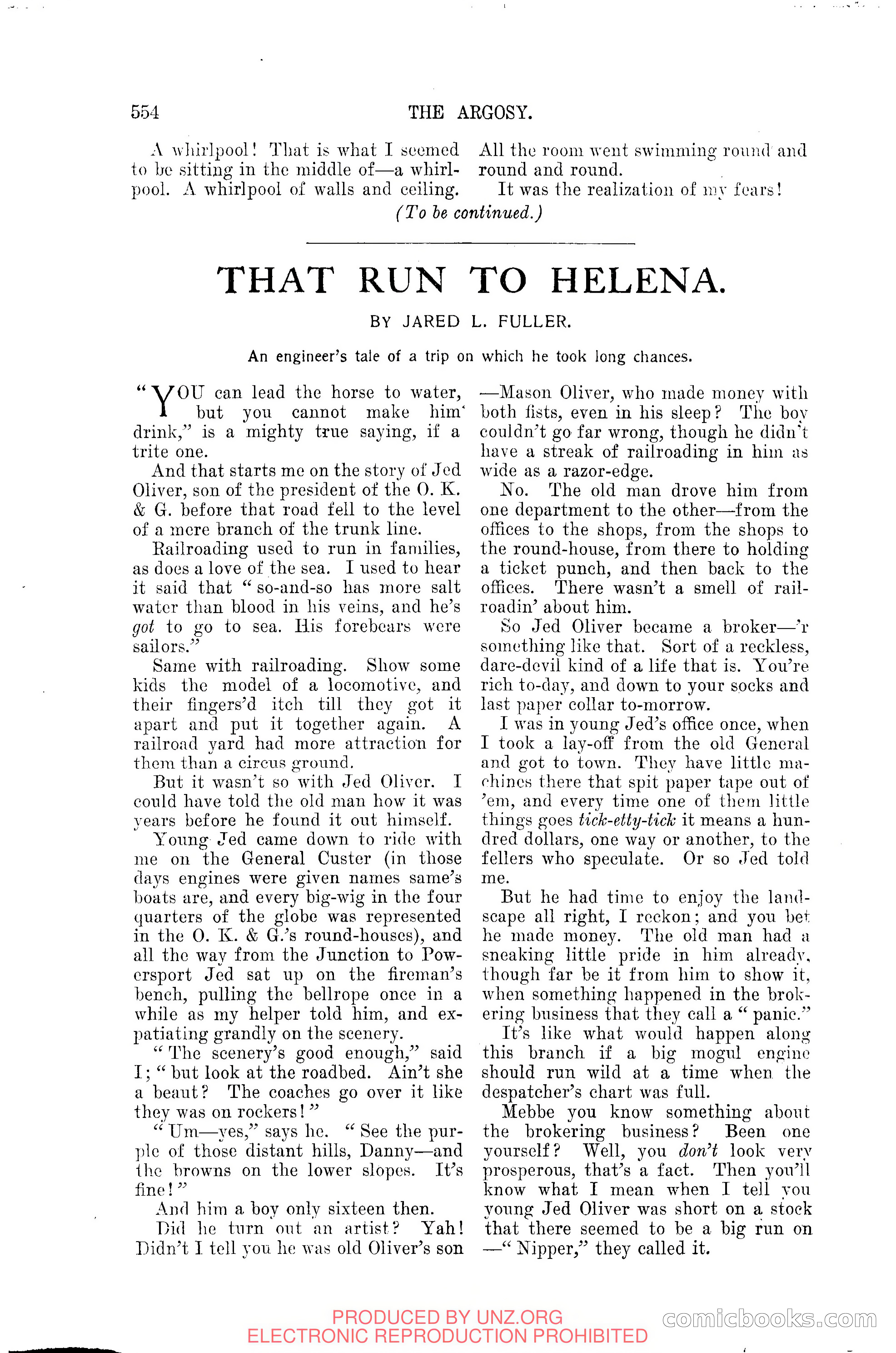
A restored page from Pulp Fiction, 1904. Page through the whole issue in the reader above.
📄 Transcribed text from this page (OCR, searchable)
Machine-transcribed from the original scan — historical spelling and the odd misread are preserved.
pod A whirlpool! That is what I seemed to be sitting in the middle of—a whirl- pool. A whirlpool of walls and ceiling. THE ARGOSY. All the room went swimming round and round and round. | It was the realization of my fears! (To be continued.) THAT RUN TO HELENA. BY JARED L. FULLER. An engineer’s tale of a trip on which he took long chances. OU can lead the horse to water, but you cannot make drink,” is a mighty true saying, trite one. And that starts me on the story of Jed Oliver, son of the president of the O. K. & G. before that road fell to the level of a mere branch of the trunk line. Railroading used to run in families, as does a love of the sea. I used to hear it said that “so-and-so has more salt water than blood in his veins, and he’s got to go to sea. His forebears were sailors.” Same with railroading. Show some kids the model of a locomotive, and their fingers’d itch till they got it apart and put it together again. A railroad yard had more attraction for them than a circus eround, But it wasn’t so with Jed Oliver. I could have told the old man how it was vears before he found it out himself. Young Jed came down to ride with me on the General Custer (in those days engines were given names same’s boats are, and every big-wig in the four quarters of the globe was represented in the O. K. & G.’s round-houses), and all the way from the Junction to Pow- ersport Jed sat up on the fireman’s bench, pulling the bellrope once in a while as my helper told him, and ex- patiating grandly on the scenery. “The scenery’s good enough,” said I; “ but look at the “roadbed. “Ain’t she a beaut? The coaches go over it like they was on rockers! ” “Um—yves,” says he. “ See the pur- ple of those distant hills, Danny—and ithe browns on the lower slopes. It’s fine!” And him a boy only sixteen then. Did he turn out an artist? Yah! Didn’t I tell you he was old Oliver’s son if a PRODUCED BY UNZ.ORG Conn ELECTRONIC REPRODUCTION PROHIBITED him‘ —Mason Oliver, who made money with both fists, even in his sleep? The boy couldn’t go far wrong, though he didn’t have a streak of railroading in hin as wide as a razor-edge. No. The old man drove him from one department to the other—from the offices to the shops, from the shops to the round-house, from there to holding a ticket punch, and then back to the offices. There wasn’t a smell of rail- roadin’ about him. So Jed Oliver became a broker—’r something like that. Sort of a reckless, dare-devil kind of a life that is. You’re rich to-day, and down to your socks and last paper collar to-morrow. I was in young Jed’s office once, when I took a lay-off from the old General and got to town. They have little ma- chines there that spit paper tape out of 7em, and every time one of them little things goes tick-etty-lick it means a hun- dred dollars, one way or another, to the fellers who speculate. Or so Jed told me. But he had time to enjoy the land- scape all right, I reckon; and you bet he made money. ‘he old man had a sneaking little pride in him already, though ‘far be it from him to show it, when something happened in the brok- ering business that they call a “ panic.” It’s like what would happen along this branch if a big mogul engine should run wild at a time when the despatcher’s chart was full. Mebbe you know something about the brokering business? Been one yourself? Well, you don’t look very prosperous, that’s a fact. Then you'll know what I mean when I tell you young Jed Oliver was short on a stock that there seemed to be a big run on —‘ Nipper,” they called it. OO d