
Pulp Fiction, 1904 · page 56 of 122
The Argosy, June 1904 — page 56: what you’re looking at
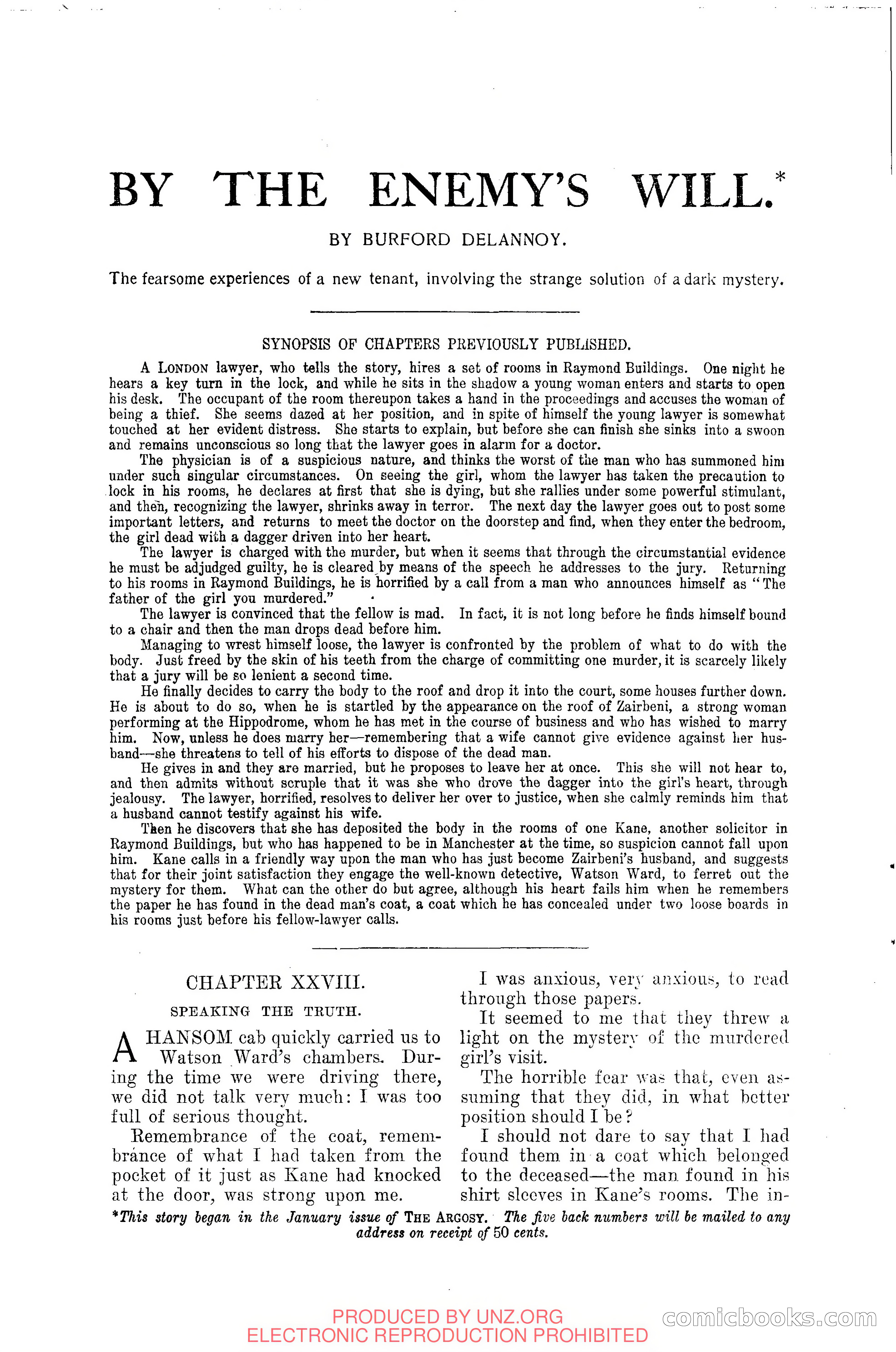
A restored page from Pulp Fiction, 1904. Page through the whole issue in the reader above.
📄 Transcribed text from this page (OCR, searchable)
Machine-transcribed from the original scan — historical spelling and the odd misread are preserved.
BY THE ENEMY’S WILL. BY BURFORD DELANNOY. The fearsome experiences of a new tenant, involving the strange solution of a dark mystery. SYNOPSIS OF CHAPTERS PREVIOUSLY PUBLISHED. A Lonpon lawyer, who tells the story, hires a set of rooms in Raymond Buildings. One night he hears a key turn in the lock, and while he sits in the shadow a young woman enters and starts to open his desk. The occupant of the room thereupon takes a hand in the proceedings and accuses the woman of being a thief. She seems dazed at her position, and in spite of himself the young lawyer is somewhat touched at her evident distress. She starts to explain, but before she can finish she sinks into a swoon and remains unconscious so long that the lawyer goes in alarm for a doctor. The physician is of a suspicious nature, and thinks the worst of the man who has summoned him under such singular circumstances. On seeing the girl, whom the lawyer has taken the precaution to lock in his rooms, he declares at first that she is dying, but she rallies under some powerful stimulant, and then, recognizing the lawyer, shrinks away in terror. The next day the lawyer goes out to post some important letters, and returns to meet the doctor on the doorstep and find, when they enter the bedroom, the girl dead with a dagger driven into her heart. The lawyer is charged with the murder, but when it seems that through the circumstantial evidence he must be adjudged guilty, he is cleared by means of the speech he addresses to the jury. Returning to his rooms in Raymond Buildings, he is horrified by a call from a man who announces himself as “The father of the girl you murdered.” The lawyer is convinced that the filow } is mad. In fact, it is not long before he finds himself bound to a chair and then the man drops dead before him. Managing to wrest himself loose, the lawyer is confronted by the problem of what to do with the body. Just freed by the skin of his teeth from the charge of committing one murder, it is scarcely likely that a jury will be so lenient a second time. He finally decides to carry the body to the roof and drop it into the court, some houses further down. He is about to do so, when he is startled by the appearance on the roof of Zairbeni, a strong woman performing at the Hippodrome, whom he has met in the course of business and who has wished to marry him. Now, unless he does marry her—remembering that a wife cannot give evidence against her hus- band-—she threatens to tell of his efforts to dispose of the dead man. He gives in and they are married, but he proposes to leave her at once. This she will not hear to, and then admits without scruple that it was she who drove the dagger into the girl’s heart, through jealousy. The lawyer, horrified, resolves to deliver her over to justice, when she calmly reminds him that a husband cannot testify against his wife. Tken he discovers that she has deposited the body in the rooms of one Kane, another solicitor in Raymond Buildings, but who has happened to be in Manchester at the time, so suspicion cannot fall upon him. Kane calls in a friendly way upon the man who has just become Zairbeni’s husband, and suggests that for their joint satisfaction they engage the well-known detective, Watson Ward, to ferret out the mystery for them. What can the other do but agree, although his heart fails him when he remembers the paper he has found in the dead man’s coat, a coat which he has concealed under two loose boards in his rooms just before his fellow-lawyer calls. ———. CHAPTER XXVIII. I was anxious, very anxious, to read through those papers. It seemed to me that they threw a HANSOM cab quickly carried us to light on the mystery of the murdered Watson Ward’s chambers. Dur- girl’s visit. SPEAKING THE TRUTH. ing the time we were driving there, The horrible fear was that, even as- we did not talk very much: [ was too suming that they did, in what better full of serious thought. position should I be? Remembrance of the coat, remem- I should not dare to say that I had brance of what I had taken from the found them ina coat which belonged pocket of it just as Kane had knocked to the deceased—the man found in his at the door, was strong upon me. shirt sleeves in Kane’s rooms. The in- *This story began in the January issue of THe ARGosy. The five back numbers will be mailed to any address on receipt of 50 cents. PRODUCED BY UNZ.ORG COMICOO® ELECTRONIC REPRODUCTION PROHIBITED CO