
Pulp Fiction, 1904 · page 54 of 122
The Argosy, June 1904 — page 54: what you’re looking at
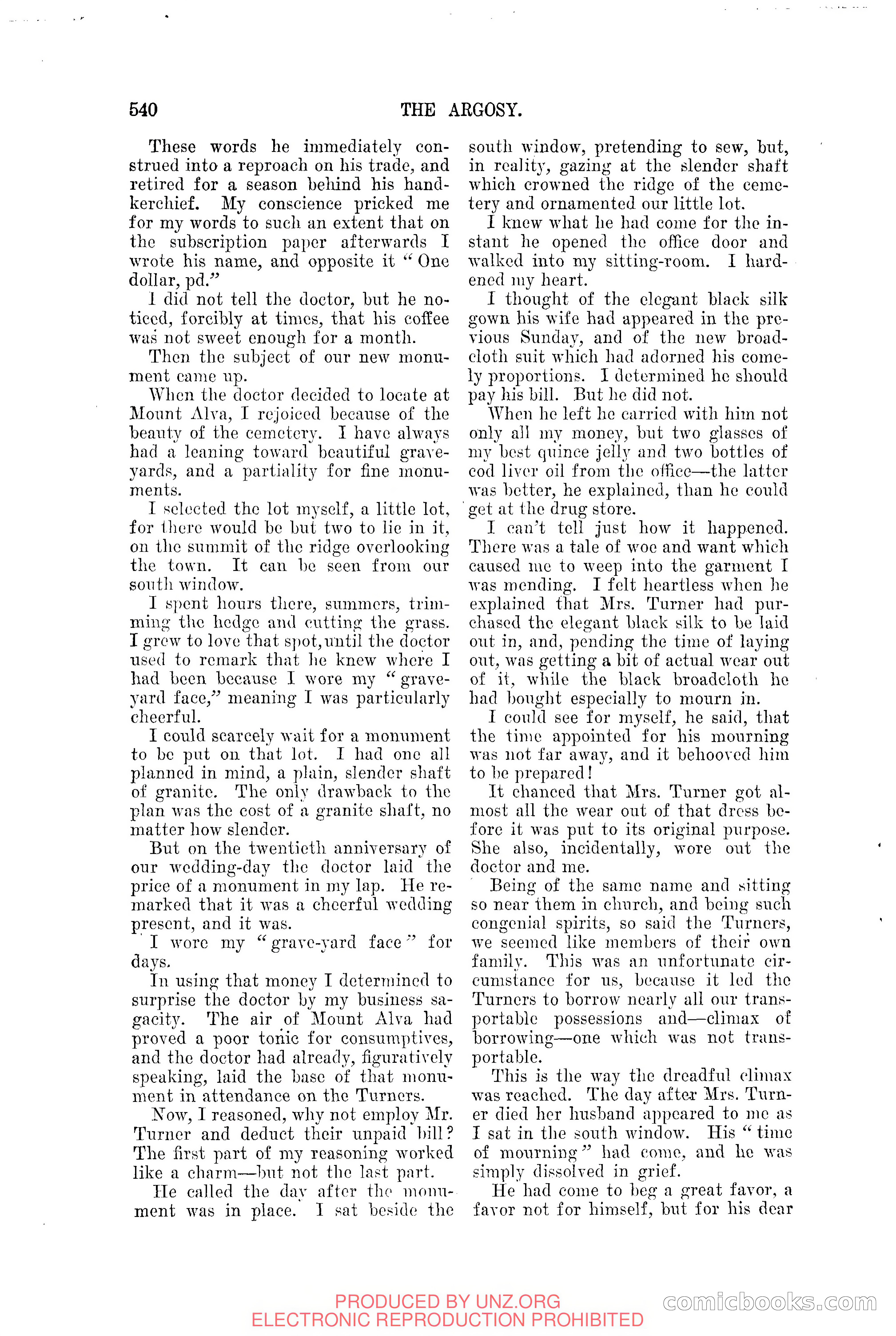
A restored page from Pulp Fiction, 1904. Page through the whole issue in the reader above.
📄 Transcribed text from this page (OCR, searchable)
Machine-transcribed from the original scan — historical spelling and the odd misread are preserved.
540 These words he immediately con- strued into a reproach on his trade, and retired for a season behind his hand- kerchief. My conscience pricked me for my words to such an extent that on the subscription paper afterwards I wrote his name, and opposite it “ One dollar, pd.” I did not tell the doctor, but he no- ticed, forcibly at times, that his coffee was not sweet enough for a month. Then the subject, of our new monu- ment came up. When the doctor decided to locate at Mount Alva, I rejoiced because of the beauty of the ean J have always had a leaning toward beautiful grave- yards, and a partiality for fine monu- ments. I selected the lot myself, a little lot, for there would be but two to lie in it, on the summit of the ridge overlooking the town. It can be seen from our south window. I spent hours there, summers, trim- ming the hedge and cutting the OTaSss. I erew to love ‘that spot, until the doctor used to remark that he knew where I had been because I wore my “ grave- yard face,” meaning I was particularly cheerful. I could scarcely wait for a monument to be put on that lot. I had one all planned in mind, a plain, slender shaft of granite. The only drawback to the plan was the cost of a granite shaft, no matter how slender. But on the twenticth anniversary of our wedding-day the doctor laid the price of a monument in my lap. He re- marked that it was a cheerful wedding present, and it was. I wore my “ graye-yard face” days. In using that money I determined to surprise the doctor by my business sa- gacity. The air of “Mount Alva had proved a poor tonic for consumptives, and the doctor had already, figuratively speaking, laid the base of that monu- ment in attendance on the Turners. Now, I reasoned, why not employ Mr. Turner and deduct their unpaid bill? The first part of my reasoning worked like a charm—hbut not the last part. for He called the dav after the monu- ment was in place. I sat beside the PRODUCED BY UNZ.ORG THE ARGOSY. south window, pretending to sew, but, in reality, gazing at the slender shaft which crowned the ridge of the ceme- tery and ornamented our little lot. I knew what he had come for the in- stant he opened the office door and walked into my sitting-room. I hard-. ened my heart. I thought of the clegant black silk gown his wife had appeared in the pre- vious Sunday, and of the new broad- cloth suit which had adorned his come- ly proportions. J determined he should pay his bill. But he did not. When he left he carried with him not only all my money, but two glasses of my best quince jelly and two bottles of cod liver oul from the office—the latter was better, he explained, than he could get at the drug store. I can’t tell just how it happened. There was a tale of woe and want which caused me to weep into the garment I was mending. I felt heartless when he explained that Mrs. Turner had pur- chased the elegant black silk to be laid out In, and, pending the time of laying out, was getting a bit of actual wear out of it, while the black broadcloth he had bought especially to mourn in. I could see for myself, he said, that the time appointed for his mourning was not far away, and it behooved him to be prepared! It chanced that Mrs. Turner got al- most all the wear out of that dress be- fore it was put to its original purpose. She also, incidentally, wore out the doctor and me. Being of the same name and sitting so near them in church, and being such congenial spirits, so said the Turners, we seemed like members of their own family. This was an unfortunate cir- cumstance for us, because it led the Turners to borrow nearly all our trans- portable possessions and—climax of borrowing—one which was not trans- portable. This is the way the dreadful climax was reached. The day after Mrs. Turn- er died her husband appeared to me as I sat in the south window. His “ time of mourning” had come, and he was simply dissolved in grief. He had come to beg a great favor, a favor not for himself, but for his dear COMiIclooo S CO ELECTRONIC REPRODUCTION PROHIBITED