
Pulp Fiction, 1904 · page 26 of 122
The Argosy, June 1904 — page 26: what you’re looking at
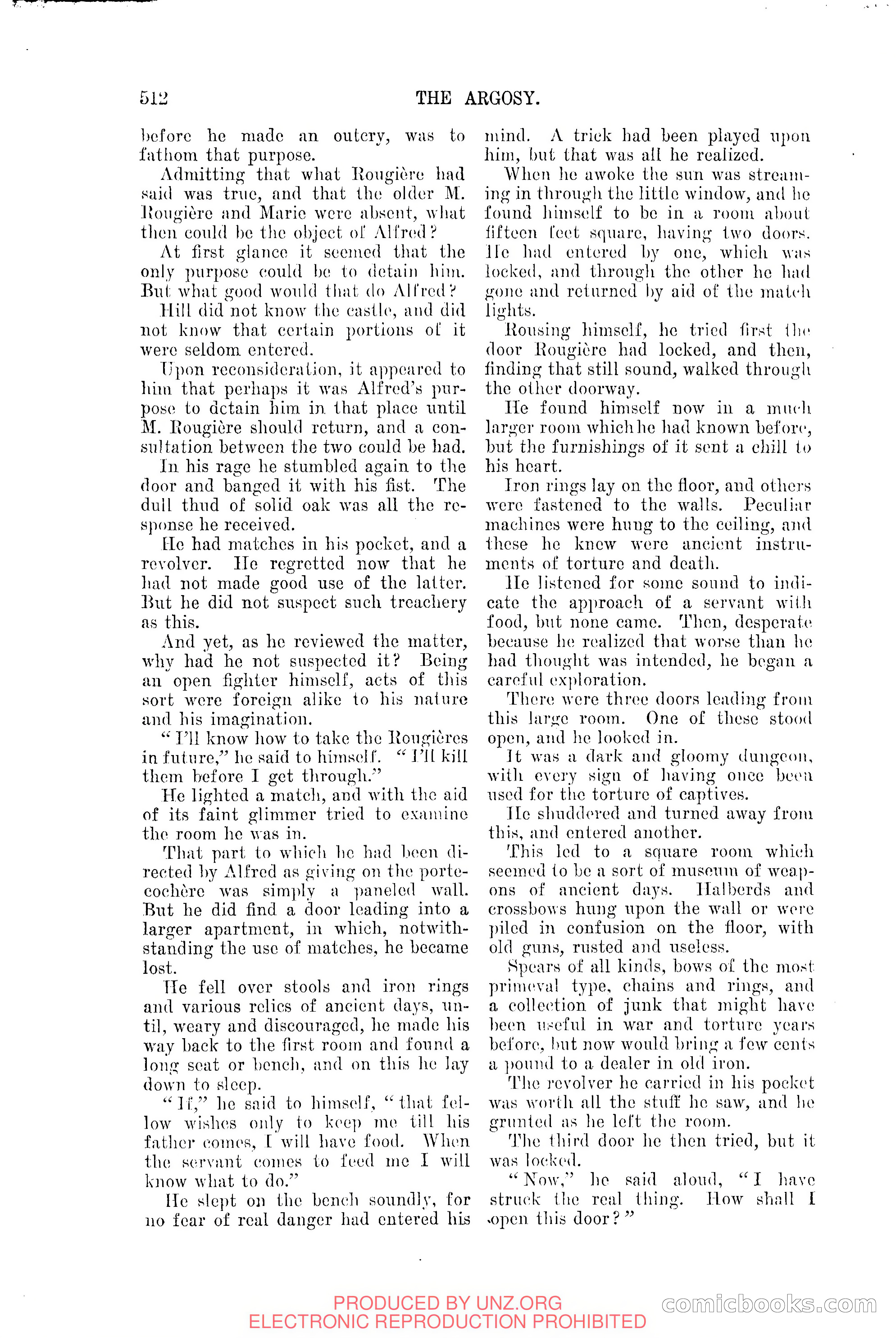
A restored page from Pulp Fiction, 1904. Page through the whole issue in the reader above.
📄 Transcribed text from this page (OCR, searchable)
Machine-transcribed from the original scan — historical spelling and the odd misread are preserved.
ole before he made an outcry, was to fathom that purpose. Admitting that what Rougiére had said was true, and that the older M. Rougiére and Marie were absent, what then could be the object of Alfred ? At first glance it seemed that the only purpose could be to detain him. But what good would that do Alfred ? Hill did 08 know the castle, and did not know that certain portions of it were seldom entered. Upon reconsideration, 1t appeared to him that perhaps it was Alfred’s pur- pose to detain him in that place until M. Rougit¢re should return, and a con- sultation between the two could be had. In his rage he stumbled again to the door and banged it with his fist. The dull thud of solid oak was all the re- sponse he received. He had matches in his pocket, and a revolver. He regretted now that he had not made eood use of the latter. But he did not suspect such treachery as this. And yet, as he reviewed the matter, why had he not suspected it? Being an open fighter himself, acts of this sort were foreign alike to his nature and his imagination. sl li row how to take the Rougicres in future,” he said to himself. “ PIL kill them before I get through.” He lighted a match, and with the aid of its faint glimmer ‘tried to examine the room he was in. That part to which he had been di- rected by Alfred as giving on the porte- cochére was simply él “paneled wall. But he did find a door leading into a larger apartment, in which, notwith- standing the use of matches, he became lost. We fell over stools and iron rings and various relics of ancient days, un- til, weary and discouraged, he made his way back to the first room and found a long seat or bench, and on this he lay down to sleep. “Ti,” he said to himself, “that fel- low wishes only to keep me till his father comes, [ will have food. When the servant comes to feed me Lf will know what to do.” He slept on the bench soundly, for no fear of real danger had entered his PRODUCED BY UNZ.ORG ELECTRONIC REPRODUCTION PROHIBITED THE ARGOSY. mind, <A trick had been played upon him, but that was all he realized. When he awoke the sun was streaim- ing in through the httle window, and he found himself to be in a room about fifteen [eet square, having 1wo doors. Ile had entered by one, which was locked, and through the other he had gone and returned by aid of the match hehts. Rousing himself, he tried first the door Rougitre had locked, and then, finding that still sound, walked through the other doorway. We found himself now in a much Jarger room which he had known before, but the furnishin gs of it sent a chill Lo his heart. Tron rings lay on the floor, and others were fastened to the walls. Peculiar machines were hung to the ceiling, and these he knew were ancient instru- ments of torture and death. Ile listened for some sound to indi- cate the approach of a servant with food, but none came. Then, desperate because he realized that worse than he had thought was intended, he began a careful exploration. There were three doors leading from this large room. One of these stood open, and he looked In. It was a dark and gloomy dungeon, with every sign of having once ‘been used for the torture of captives. Ife shuddered and turned away from this, and entered another. This led to a square room which seemed to be a sort of musetm of weap- ons of ancient days. THalberds and crossbows hung wpon the wall or were piled in confusion on the floor, with old guns, rusted and useless. Spears of all kinds, bows of the most primeval type, chains and rings, and a collection of junk that might have heen useful in war and torture years before, but now would bring a few cents a pound to a dealer in old iron. The revolver he carried in his poekct was worth all the stuff he saw, and he erunted as he left the room. The third door he then tried, but it was locked. “Now,” he said aloud, “J have struck the real thing. How shall [ open this door?” DOOKKS C@ Ss} (C C@ =