
Pulp Fiction, 1897 · page 96 of 192
The Argosy, Vol. XXV, No. 3 — page 96: what you’re looking at
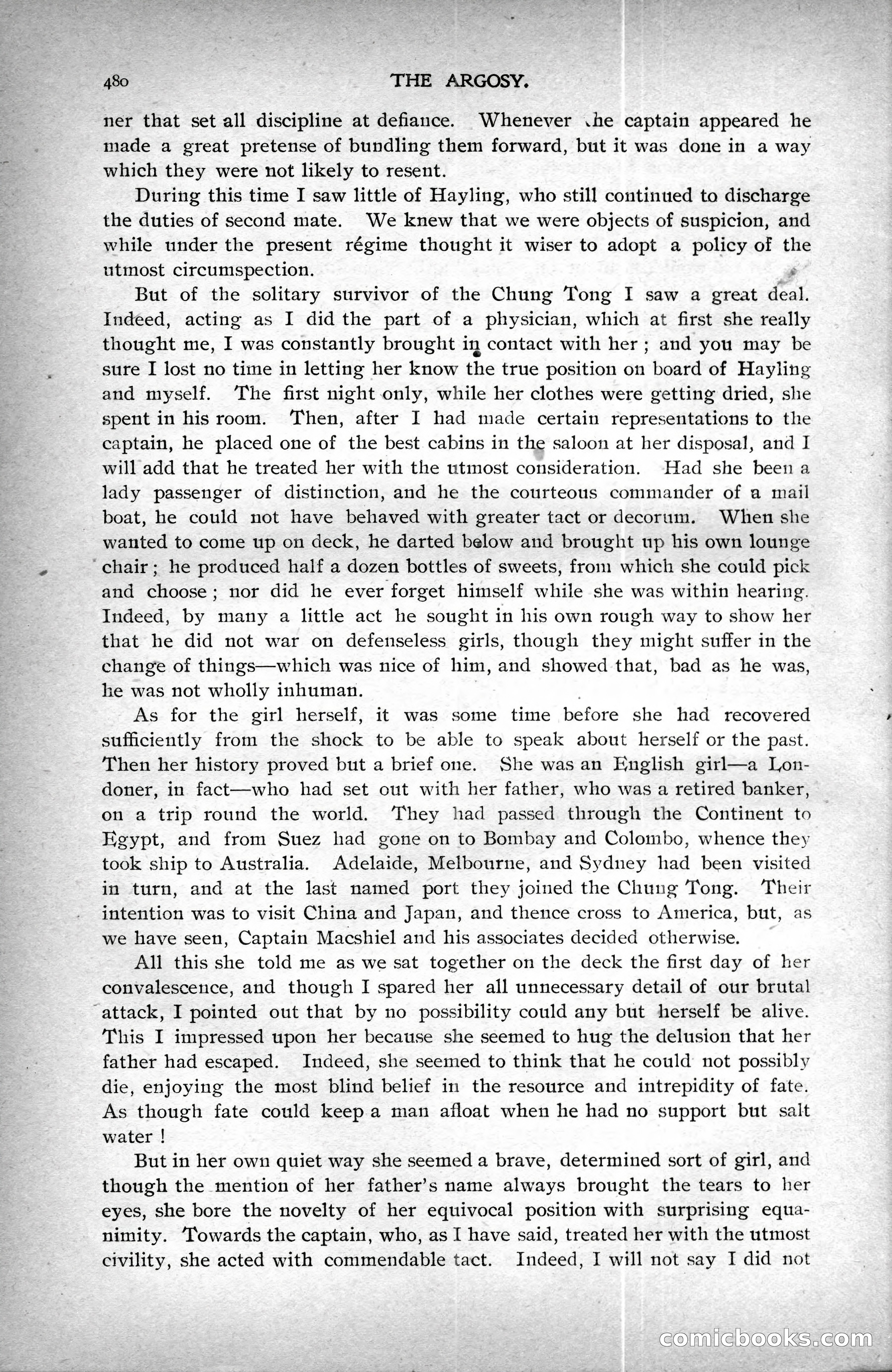
A restored page from Pulp Fiction, 1897. Page through the whole issue in the reader above.
📄 Transcribed text from this page (OCR, searchable)
Machine-transcribed from the original scan — historical spelling and the odd misread are preserved.
480 THE ARGOSY. ner that set all discipline at defiance. Whenever .he captain appeared he made a great pretense of bundling them forward, but it was done in a way which they were not likely to resent. During this time I saw little of Hayling, who still continued to discharge the duties of second mate. We knew that we were objects of suspicion, and while under the present régime thought it wiser to adopt a policy of the utmost circumspection. , But of the solitary survivor of the Chung Tong I saw a great deal. Indeed, acting as I did the part of a physician, which at first she really thought me, I was constantly brought in contact with her ; and you may be sure I lost no time in letting her know the true position on board of Hayling and myself. ‘The first night only, while her clothes were getting dried, she spent in his room. Then, after I had made certain representations to the captain, he placed one of the best cabins in the saloon at her disposal, and I will add that he treated her with the utmost consideration. Had she been a lady passenger of distinction, and he the courteous commander of a mail boat, he could not have behaved with greater tact or decorum. When she wanted to come up on deck, he darted below and brought up his own lounge chair; he produced half a dozen bottles of sweets, fron which she could pick and choose; nor did he ever forget himself while she was within hearing. Indeed, by many a little act he sought in his own rough way to show her that he did not war on defenseless girls, though they might suffer in the change of things—which was nice of him, and showed that, bad as he was, he was not wholly inhuman. As for the girl herself, it was some time before she had recovered sufficiently from the shock to be able to speak about herself or the past. Then her history proved but a brief one. She was an English girl—a Lon- doner, in fact—who had set out with her father, who was a retired banker, on a trip round the world. They had passed through the Continent to Egypt, and from Suez had gone on to Bombay and Colombo, whence they took ship to Australia. Adelaide, Melbourne, and Sydney had been visited in turn, and at the last named port they joined the Chung Tong. Their intention was to visit China and Japan, and thence cross to America, but, as we have seen, Captain Macshiel and his associates decided otherwise. All this she told me as we sat together on the deck the first day of her convalescence, and though I spared her all unnecessary detail of our brutal ‘attack, I pointed out that by no possibility could any but herself be alive. This I impressed upon her because she seemed to hug the delusion that her father had escaped. Indeed, she seemed to think that he could not possibly die, enjoying the most blind belief in the resource and intrepidity of fate. As though fate could keep a man afloat when he had no support but salt water ! But in her own quiet way she seemed a brave, determined sort of girl, and though the mention of her father’s name always brought the tears to her eyes, she bore the novelty of her equivocal position with surprising equa- nimity. Towards the captain, who, as I have said, treated her with the utmost civility, she acted with commendable tact. Indeed, I will not say I did not Eomicbooks (S@)