
Pulp Fiction, 1897 · page 71 of 192
The Argosy, Vol. XXV, No. 3 — page 71: what you’re looking at
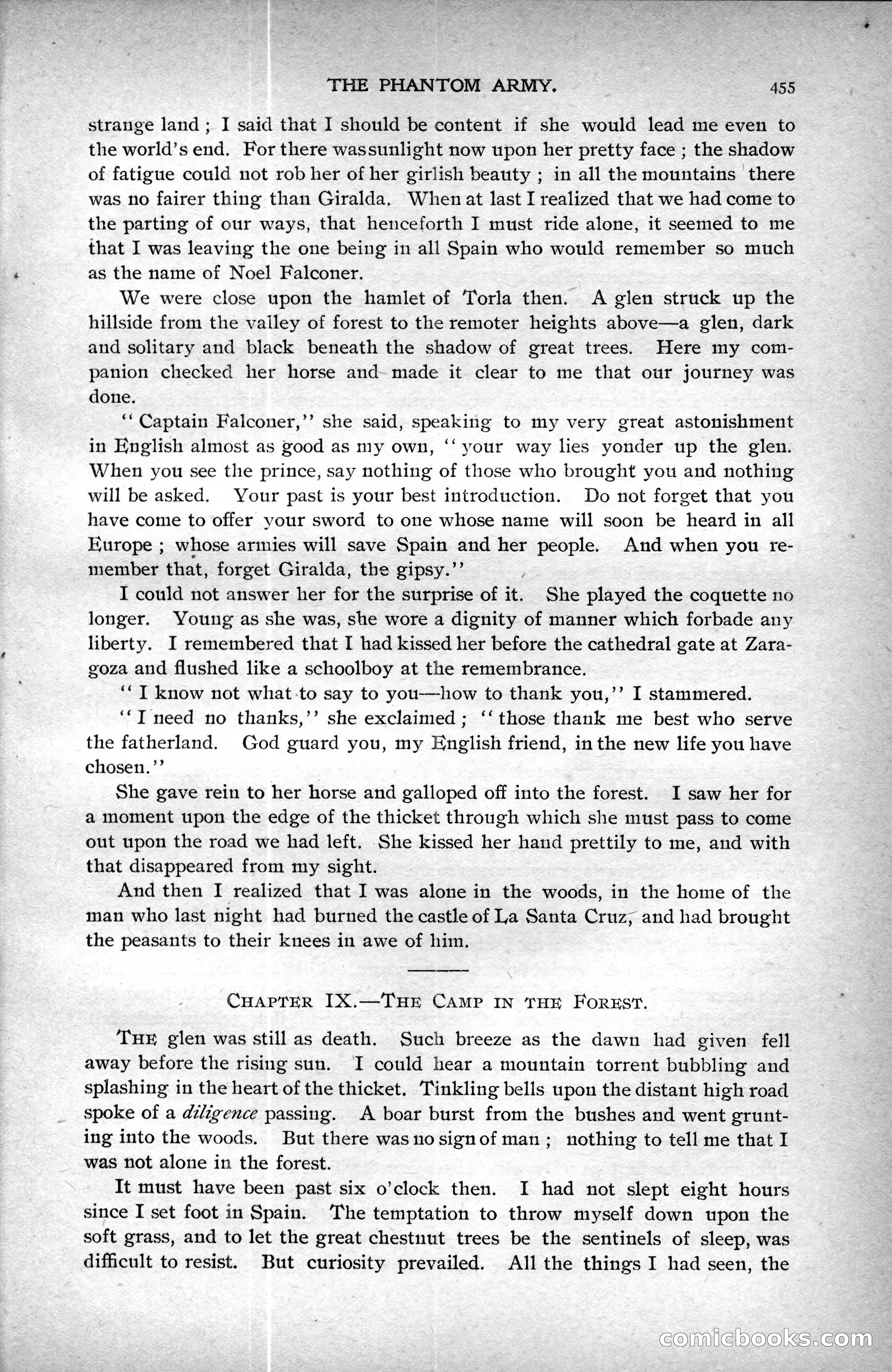
A restored page from Pulp Fiction, 1897. Page through the whole issue in the reader above.
📄 Transcribed text from this page (OCR, searchable)
Machine-transcribed from the original scan — historical spelling and the odd misread are preserved.
THE PHANTOM ARMY, 455 strange land ; I said that I should be content if she would lead me even to the world’s end. For there wassunlight now upon her pretty face ; the shadow of fatigue could not rob her of her girlish beauty ; in all the mountains there was no fairer thing than Giralda. When at last I realized that we had come to the parting of our ways, that henceforth I must ride alone, it seemed to me that I was leaving the one being in all Spain who would remember so much as the name of Noel Falconer. We were close upon the hamlet of Torla then. A glen struck up the hillside from the vailey of forest to the remoter heights above—a glen, dark and solitary and black beneath the shadow of great trees. Here my com- panion checked her horse and- made it clear to me that our journey was done. ‘‘ Captain Falconer,’’ she said, speaking to my very great astonishment in English almost as good as my own, ‘‘ your way lies yonder up the glen. When you see the prince, say nothing of those who brought you and nothing will be asked. Your past is your best introduction. Do not forget that you have come to offer your sword to one whose name will soon be heard in all Kurope ; whose armies will save eee = her people. And when you re- member that, forget Giralda, the gipsy.’ I could not answer her for the surprise of a She played the coquette no longer. Young as she was, she wore a dignity of manner which forbade any liberty. I remembered that I had kissed her before the cathedral gate at Zara- goza and flushed like a schoolboy at the remembrance. ‘“T know not what-to say to you-—how to thank you,’’ I stammered. ‘‘T need no thanks,’’ she exclaimed; ‘‘ those thank me best who serve the fatherland. God guard you, my English friend, inthe new life you have chosen.”’ She gave rein to her horse and galloped off into the forest. I saw her for a moment upon the edge of the thicket through which she must pass to come out upon the road we had left. She kissed her hand prettily to me, and with that disappeared from my sight. And then I realized that I was alone in the woods, in the home of the man who last night had burned the castle of La Santa Cruz, and had brought the peasants to their knees in awe of him. CHAPTER IX.—THE CAMP IN THE ForES?. THE glen was still as death. Such breeze as the dawn had given fell away before the rising sun. I could hear a mountain torrent bubbling and splashing in the heart of the thicket. Tinkling bells upon the distant high road spoke of a dzligence passing. A boar burst from the bushes and went grunt- ing into the woods. But there wasnosignofman; nothing to tell me that I was not alone in the forest. It must have been past six o’clock then. I had not slept eight hours since I set foot in Spain. The temptation to throw myself down upon the soft grass, and to let the great chestnut trees be the sentinels of sleep, was difficult to resist. But curiosity prevailed. All the things I had seen, the Eomichook (S@)