
Pulp Fiction, 1897 · page 68 of 192
The Argosy — page 68: what you’re looking at
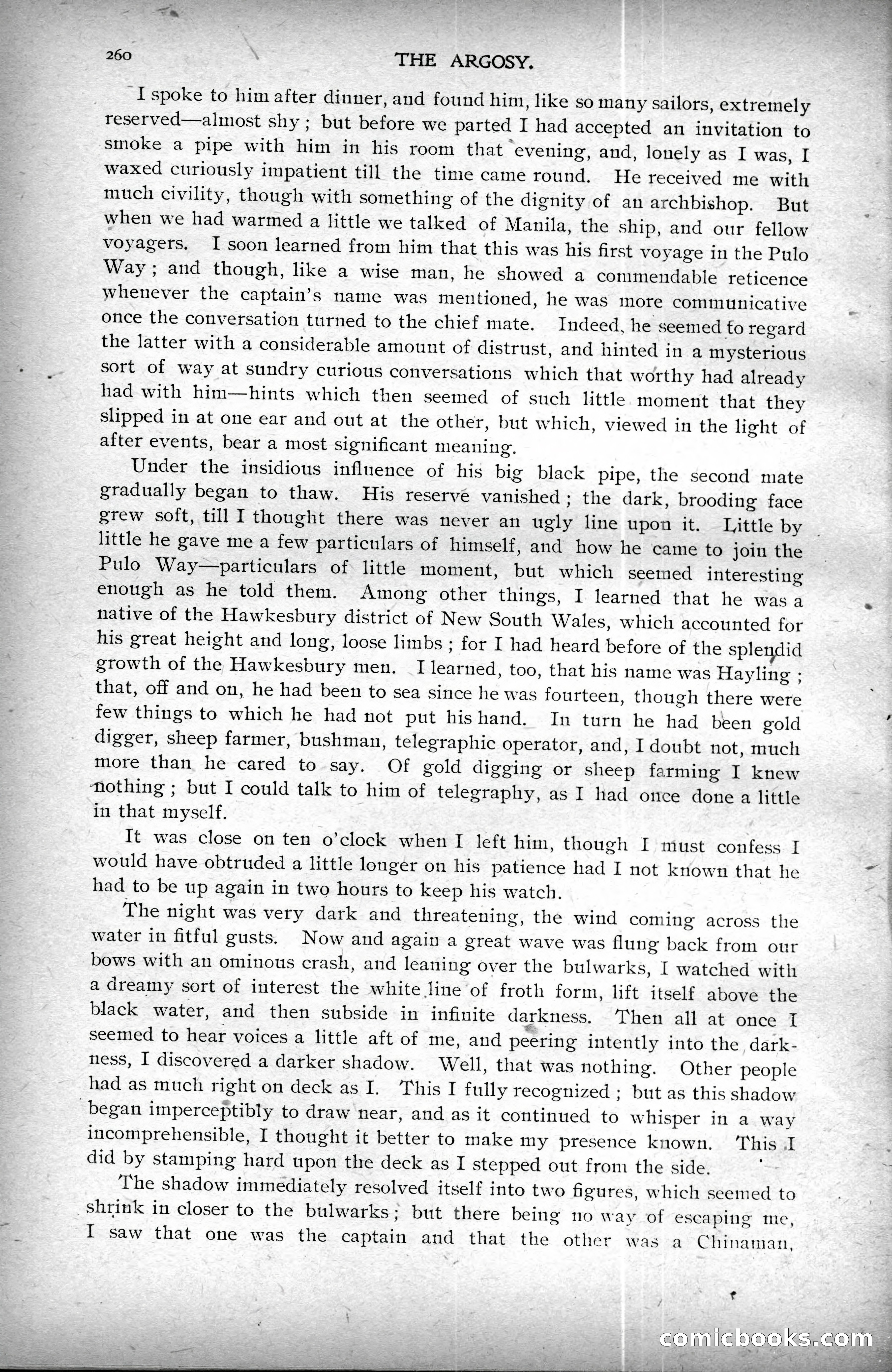
A restored page from Pulp Fiction, 1897. Page through the whole issue in the reader above.
📄 Transcribed text from this page (OCR, searchable)
Machine-transcribed from the original scan — historical spelling and the odd misread are preserved.
= | THE ARGOSY. -Ispoke to him after dinner, and found him, like so many sailors, extremely reserved—almost shy; but before we parted I had accepted an invitation to smoke a pipe with him in his room that ‘evening, and, lonely as I was, I waxed curiously impatient till the time came round. He received me with much civility, though with something of the dignity of an archbishop. But when we had warmed a little we talked of Manila, the ship, and our fellow voyagers. I soon learned from him that this was his first voyage in the Pulo Way ; and though, like a wise man, he showed a commendable reticence whenever the captain’s name was mentioned, he was more communicative once the conversation turned to the chief mate. Indeed, he seemed fo regard the latter with a considerable amount of distrust, and hinted in a mysterious sort of way at sundry curious conversations which that worthy had already had with him—hints which then seemed of such little moment that they slipped in at one ear and out at the other, but which, viewed in the light of after events, bear a most significant meaning. Under the insidious influence of his big black pipe, the second mate gradually began to thaw. His reservé vanished ; the dark, brooding face grew soft, till I thought there was never an ugly line upon it. Little by little he gave me a few particulars of himself, and how he came to join the Pulo Way—particulars of little moment, but which seemed interesting enough as he told them. Among other things, I learned that he wasa ° native of the Hawkesbury district of New South Wales, which accounted for his great height and long, loose limbs ; for I had heard before of the splendid growth of the Hawkesbury men. I learned, too, that his name was Hayling ; that, off and on, he had been to sea since he was fourteen, though there were few things to which he had not put hishand. In turn he had been gold digger, sheep farmer, bushman, telegraphic operator, and, I doubt not, much more than he cared to say. Of gold digging or sheep farming I knew Nothing ; but I could talk to him of telegraphy, as I had once done a little in that myself. It was close on ten o’clock when I left him, though I must confess I would have obtruded a little longer on his patience had I not known that he had to be up again in two hours to keep his watch. The night was very dark and threatening, the wind coming across the water in fitful gusts. Now and again a great wave was flung back from our bows with an ominous crash, and leaning over the bulwarks, I watched with a dreamy sort of interest the white line of froth form, lift itself above the black water, and then subside in infinite darkness. ‘Then all at once I seemed to hear voices a little aft of me, and peering intently into the dark- ness, I discovered a darker shadow. Well, that was nothing. Other people had as much right on deck as I. This I fully recognized ; but as this shadow began imperceptibly to draw near, and as it continued to whisper in a way incomprehensible, I thought it better to make my presence known. ‘This .I did by stamping hard upon the deck as I stepped out from the side. The shadow immediately resolved itself into two figures, which seemed to shrink in closer to the bulwarks: but there being no way of escaping me, I saw that one was the captain and that the other was a Chinaman, Comicbooks.com —