
Pulp Fiction, 1897 · page 55 of 192
The Argosy — page 55: what you’re looking at
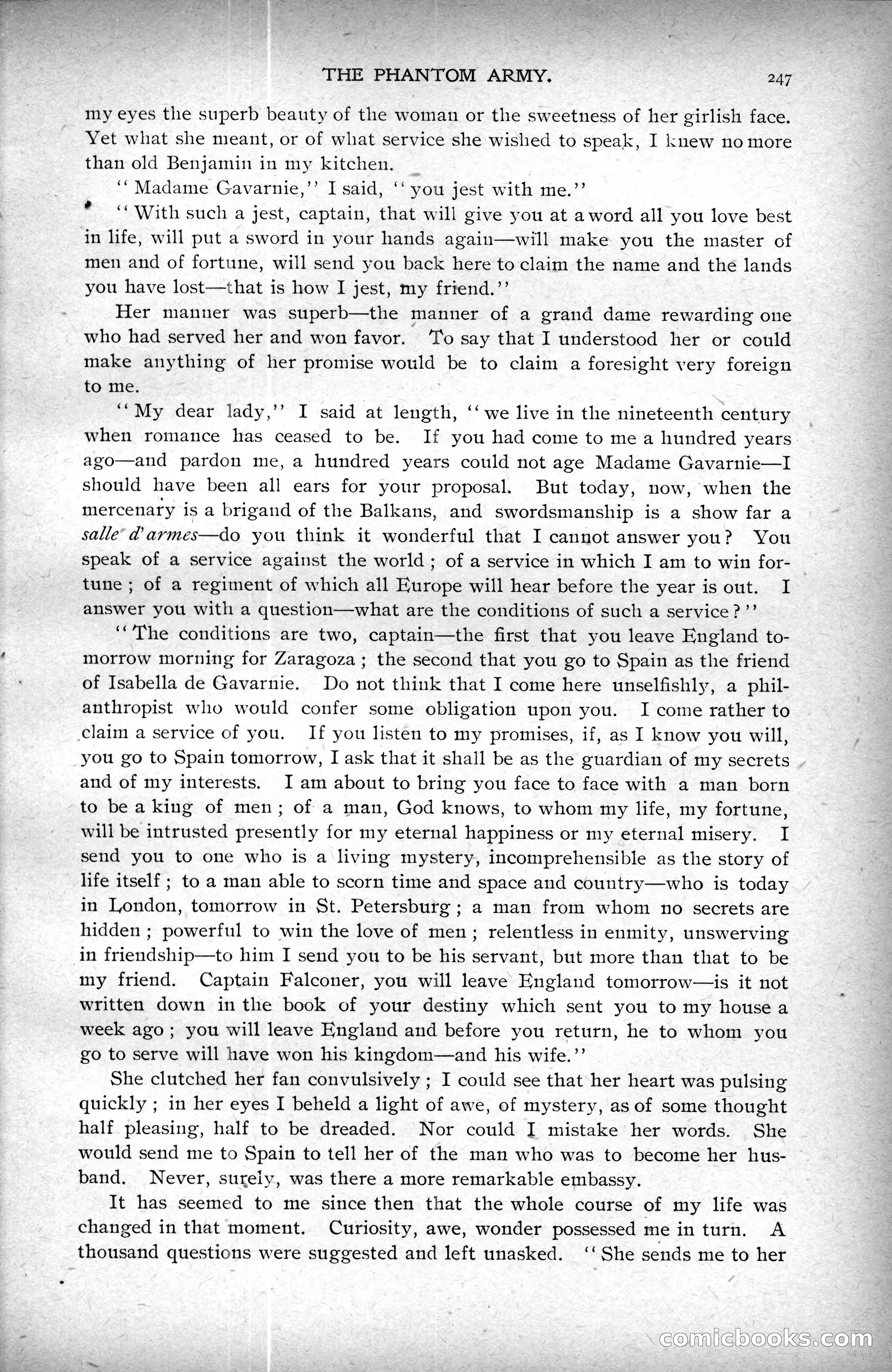
A restored page from Pulp Fiction, 1897. Page through the whole issue in the reader above.
📄 Transcribed text from this page (OCR, searchable)
Machine-transcribed from the original scan — historical spelling and the odd misread are preserved.
THE PHANTOM ARMY. 247 my eyes the superb beauty of the woman or the sweetness of her girlish face. Yet what she meant, or of what service she wished to speak, I knew no more than old Benjamin in my kitchen. ‘“ Madame Gavarnie,’’ I said, ‘‘ you jest with me.’’ ‘With such a jest, captain, that will give you at aword all you love best in life, will put a sword in your hands again—will make you the master of men and of fortune, will send you back here to claim the name and the lands you have lost—that is how I jest, my friend.’’ Her manner was superb—the manner of a grand dame rewarding one who had served her and won favor. ‘To say that I understood her or could make anything of her promise would be to claim a foresight very foreign to me. ‘“My dear lady,’’ I said at length, ‘‘ we live in the nineteenth century when romance has ceased to be. If you had come to mea hundred years ago—and pardon me, a hundred years could not age Madame Gavarnie—I should have been all ears for your proposal. But today, now, when the mercenary is a brigand of the Balkans, and swordsmanship is a show far a salle’ @armes—do you think it wonderful that I cannot answer you? You speak of a service against the world; of a service in which I am to win for- tune ; of a regiment of which all Europe will hear before the year is out. I answer you with a question—what are the conditions of such a service?”’ ‘“The conditions are two, captain—the first that you leave England to- morrow morning for Zaragoza ; the second that you go to Spain as the friend of Isabella de Gavarnie. Do not think that I come here unselfishly, a phil- anthropist who would confer some obligation upon you. I come rather to claim a service of you. If you listen to my promises, if, as I know you will, you go to Spain tomorrow, I ask that it shall be as the guardian of my secrets and of my interests. JI am about to bring you face to face with a man born to be aking of men; of a man, God knows, to whom my life, my fortune, will be intrusted presently for my eternal happiness or my eternal misery. I send you to one who is a living mystery, incomprehensible as the story of life itself ; to a man able to scorn time and space and country—who is today in London, tomorrow in St. Petersburg ; a man from whom no secrets are hidden ; powerful to win the love of men; relentless in enmity, unswerving in friendship—to him I send you to be his servant, but more than that to be my friend. Captain Falconer, you will leave England tomorrow—is it not written down inthe book of your destiny which sent you to my house a week ago; you will leave England and before you return, he to whom you go to serve will have won his kingdom—and his wife.’’ She clutched her fan convulsively ; I could see that her heart was pulsing quickly ; in her eyes I beheld a light of awe, of mystery, as of some thought half pleasing, half to be dreaded. Nor could I mistake her words. She would send me to Spain to tell her of the man who was to become her hus- band. Never, surely, was there a more remarkable embassy. It has seemed to me since then that the whole course of my life was changed in that moment. Curiosity, awe, wonder possessed me inturn. A thousand questions were suggested and left unasked. ‘‘ She sends me to her id EComichook (S@)