
Pulp Fiction, 1897 · page 43 of 192
The Argosy — page 43: what you’re looking at
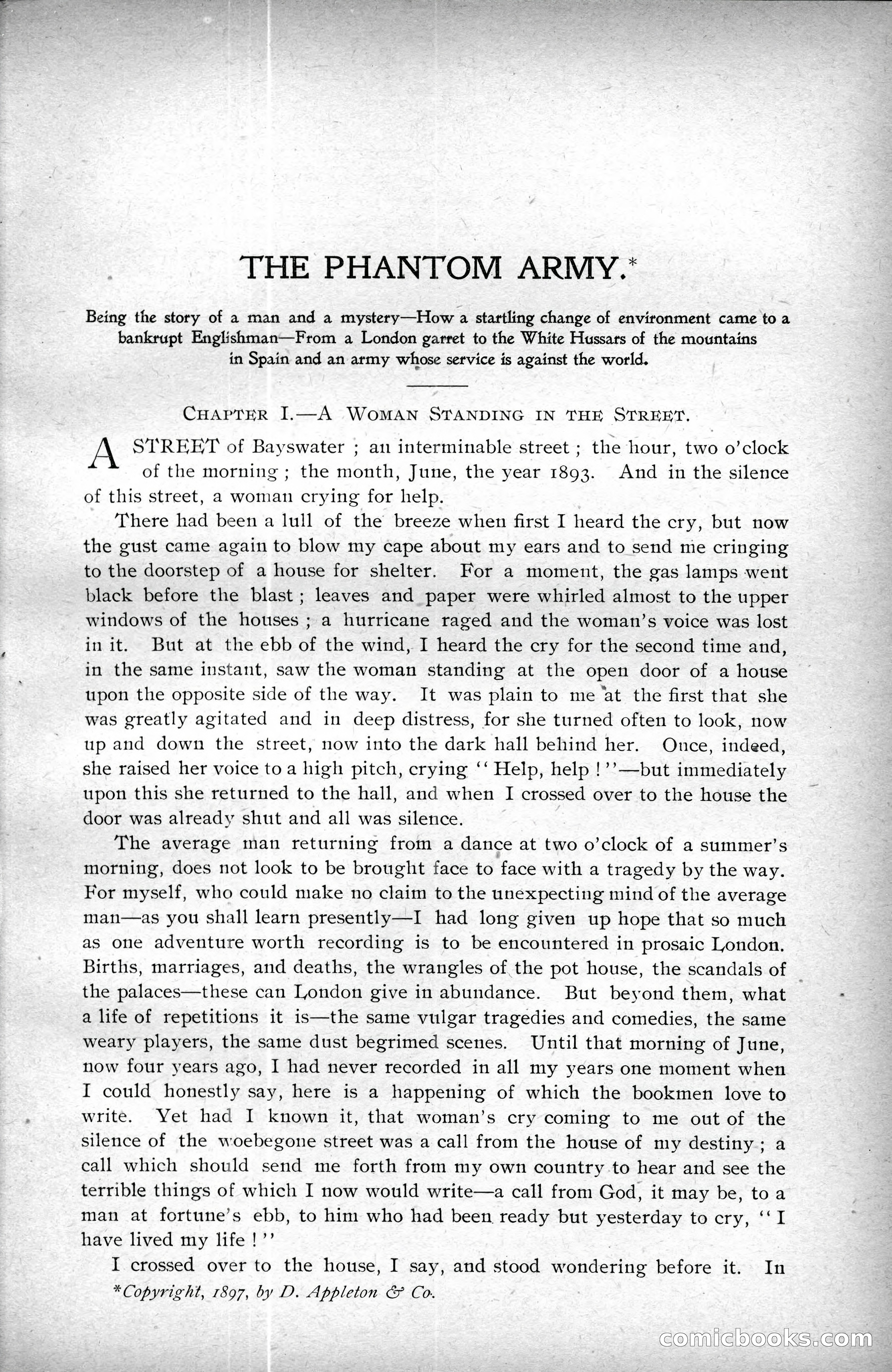
A restored page from Pulp Fiction, 1897. Page through the whole issue in the reader above.
📄 Transcribed text from this page (OCR, searchable)
Machine-transcribed from the original scan — historical spelling and the odd misread are preserved.
THE PHANTOM ARMY.* Being the story of a man and a mystery—How a startling change of environment came to a bankrupt Englishman—From a London garret to the White Hussars of the mountains in Spain and an army whose service is against the world. CHAPTER I.—A WoMAN STANDING IN THE STREET, STREET of Bayswater ; an interminable street ; the hour, two o’clock of the morning ; the month, June, the year 1893. And in the silence of this street, a woman crying for help. There had been a lull of the breeze when first I heard the cry, but now the gust came again to blow my cape about my ears and to send mie cringing to the doorstep of a house for shelter. For a moment, the gas lamps went black before the blast; leaves and paper were whirled almost to the upper windows of the houses ; a hurricane raged and the woman’s voice was lost init. But at the ebb of the wind, I heard the cry for the second time and, in the same instant, saw the woman standing at the open door of a house upon the opposite side of the way. It was plain to me at the first that she was greatly agitated and in deep distress, for she turned often to look, now up and down the street, now into the dark hall behind her. Once, indeed, she raised her voice to a high pitch, crying ‘‘ Help, help !’’—but immediately upon this she returned to the hall, and when I crossed over to the house the door was already shut and all was silence. The average man returning from a dance at two o’clock of a summer’s morning, does not look to be brought face to face with a tragedy by the way. For myself, who could make no claim to the unexpecting mind of the average man—as you shall learn presently—I had long given up hope that so much as one adventure worth recording is to be encountered in prosaic London. Births, marriages, and deaths, the wrangles of the pot house, the scandals of the palaces—these can London give in abundance. But beyond them, what a life of repetitions it is—the same vulgar tragedies and comedies, the same weary players, the same dust begrimed scenes. Until that morning of June, now four years ago, I had never recorded in all my years one moment when I could honestly say, here is a happening of which the bookmen love to write. Yet had I known it, that woman’s cry coming to me out of the silence of the woebegone street was a call from the house of my destiny; a call which should send me forth from my own country to hear and see the terrible things of which I now would write—a call from God, it may be, toa man at fortune’s ebb, to him who had been ready but yesterday to cry, ‘‘I have lived my life !’’ | I crossed over to the house, I say, and stood wondering before it. In *Copyright, 1897, by D. Appleton & Co. (S@) ComiclaoolK<