
Pulp Fiction, 1897 · page 38 of 192
The Argosy — page 38: what you’re looking at
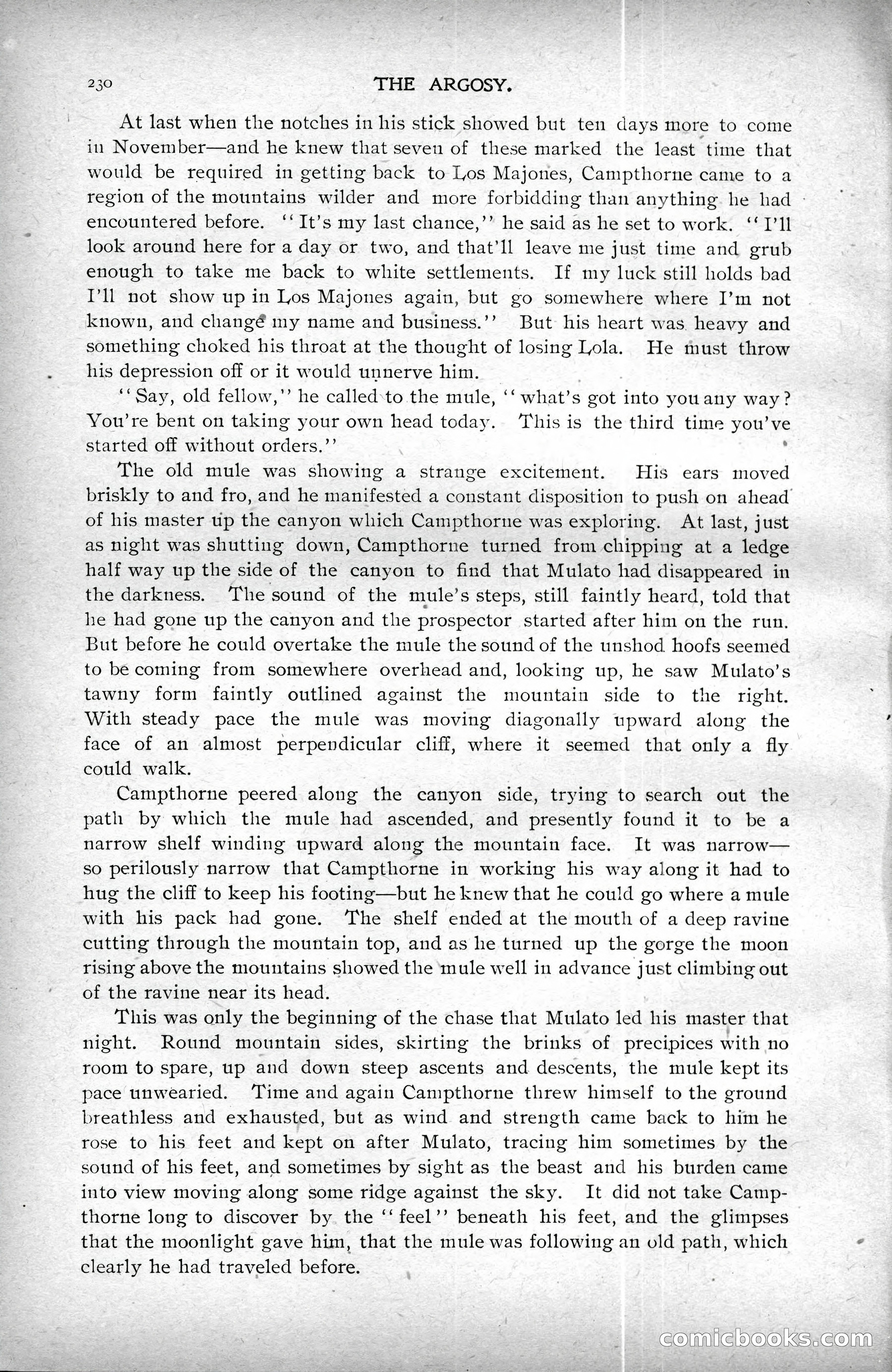
A restored page from Pulp Fiction, 1897. Page through the whole issue in the reader above.
📄 Transcribed text from this page (OCR, searchable)
Machine-transcribed from the original scan — historical spelling and the odd misread are preserved.
230 THE ARGOSY. At last when the notches in his stick showed but ten days more to come in November—and he knew that seven of these marked the least time that would be required in getting back to Los Majones, Campthorne came to a region of the mountains wilder and more forbidding than anything he had - encountered before. ‘‘ It’s my last chance,’’ he said as he set to work. ‘‘ I'll look around here for a day or two, and that'll leave me just time and grub enough to take me back to white settlements. If my luck still holds bad Ill not show up in Los Majones again, but go somewhere where I’m not known, and changé my name and business.’’ But his heart was heavy and something choked his throat at the thought of losing Lola. He must throw his depression off or it would unnerve him. ‘‘Say, old fellow,’ he called:to the mule, ‘‘ what’s got into youany way? You’re bent on taking your own head today. ‘This is the third time you’ve started off without orders.”’ : The old mule was showing a strange excitement. His ears moved briskly to and fro, and he manifested a constant disposition to push on ahead of his master up the canyon which Campthorne was exploring. At last, just as night was shutting down, Campthorne turned from chipping at a ledge half way up the side of the canyon to find that Mulato had disappeared in the darkness. The sound of the mule’s steps, still faintly heard, told that he had gone up the canyon and the prospector started after him on the run. But before he could overtake the mule the sound of the unshod hoofs seemed to be coming from somewhere overhead and, looking up, he saw Mulato’s tawny form faintly outlined against the mountain side to the right. With steady pace the mule was moving diagonally upward along the face of an almost perpendicular cliff, where it seemed that only a fly could walk. Campthorne peered along the canyon side, trying to search out the path by which the mule had ascended, and presently found it to be a narrow shelf winding upward along the mountain face. It was narrow— so perilously narrow that Campthorne in working his way along it had to hug the cliff to keep his footing—but he knew that he could go where a mule with his pack had gone. The shelf ended at the mouth of a deep ravine cutting through the mountain top, and as he turned up the gorge the moon rising above the mountains showed the mule well in advance just climbing out of the ravine near its head. . This was only the beginning of the chase that Mulato led his master that night. Round mountain sides, skirting the brinks of precipices with no room to spare, up and down steep ascents and descents, the mule kept its pace unwearied. ‘Time and again Campthorne threw himself to the ground breathless and exhausted, but as wind and strength came back to him he rose to his feet and kept on after Mulato, tracing him sometimes by the sound of his feet, and sometimes by sight as the beast and his burden came into view moving along some ridge against the sky. It did not take Camp- thorne long to discover by the ‘‘feel’’ beneath his feet, and the glimpses that the moonlight gave him, that the mule was following an old path, which clearly he had traveled before. Eomichook (E@)