
Pulp Fiction, 1897 · page 29 of 192
The Argosy — page 29: what you’re looking at
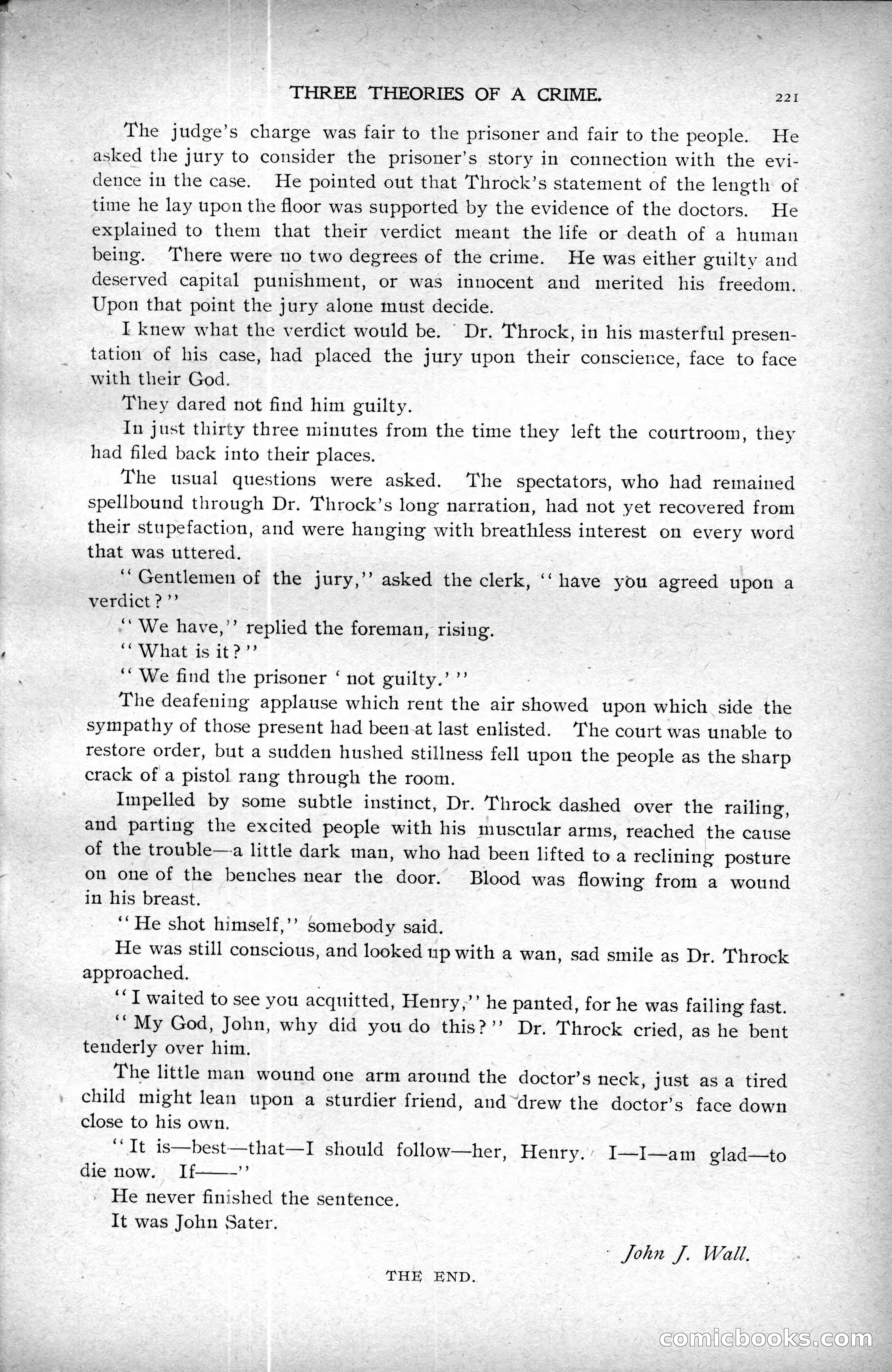
A restored page from Pulp Fiction, 1897. Page through the whole issue in the reader above.
📄 Transcribed text from this page (OCR, searchable)
Machine-transcribed from the original scan — historical spelling and the odd misread are preserved.
THREE THEORIES OF A CRIME. 221 The judge’s charge was fair to the prisoner and fair to the people. He asked the jury to consider the prisoner’s story in connection with the evi- dence in the case. He pointed out that Throck’s statement of the length of time he lay upon the floor was supported by the evidence of the doctors. He explained to them that their verdict meant the life or death of a human being. There were no two degrees of the crime. He was either guilty and deserved capital punishment, or was innocent and merited his freedom. Upon that point the jury alone must decide. I knew what the verdict would be. Dr. Throck, in his masterful presen- tation of his case, had placed the jury upon their conscience, face to face with their God. They dared not find him guilty. In just thirty three minutes from the time they left the courtroom, they had filed back into their places. The usual questions were asked. The spectators, who had remained spellbound through Dr. Throck’s long narration, had not yet recovered from their stupefaction, and were hanging with breathless interest on every word that was uttered. ‘“Gentlemen of the jury,’’ asked the clerk, ‘‘ have you agreed upon a verdict ?”’ ‘We have,”’ replied the foreman, rising. ‘“ What is it?”’ ‘‘ We find the prisoner ‘ not guilty.’ ”’ The deafening applause which rent the air showed upon which side the sympathy of those present had been_at last enlisted. /The court was unable to restore order, but a sudden hushed stillness fell upon the people as the sharp crack of a pistol rang through the room. Impelled by some subtle instinct, Dr. Throck dashed over the railing, and parting the excited people with his muscular arms, reached the cause of the trouble—a little dark man, who had been lifted to a reclining posture on one of the benches near the door. Blood was flowing from a wound in his breast. ‘“ He shot himself,’’ somebody said. } He was still conscious, and looked up with a wan, sad smile as Dr. T’hrock approached. ; ‘I waited to see you acquitted, Henry,’’ he panted, for he was failing fast. ‘“ My God, John, why did you do this?’ Dr. Throck cried, as he bent tenderly over him. The little man wound one arm around the doctor’s neck, just asa tired child might lean upon a sturdier friend, and~drew the doctor’s face down close to his own. ‘“It is—best—that—I should follow—her, Henry.’ I—I—am glad—to die now. If——’’ He never finished the sentence. It was John Sater. - John J. Wall. THE END. Eomichook (S@)