
Pulp Fiction, 1897 · page 19 of 192
The Argosy — page 19: what you’re looking at
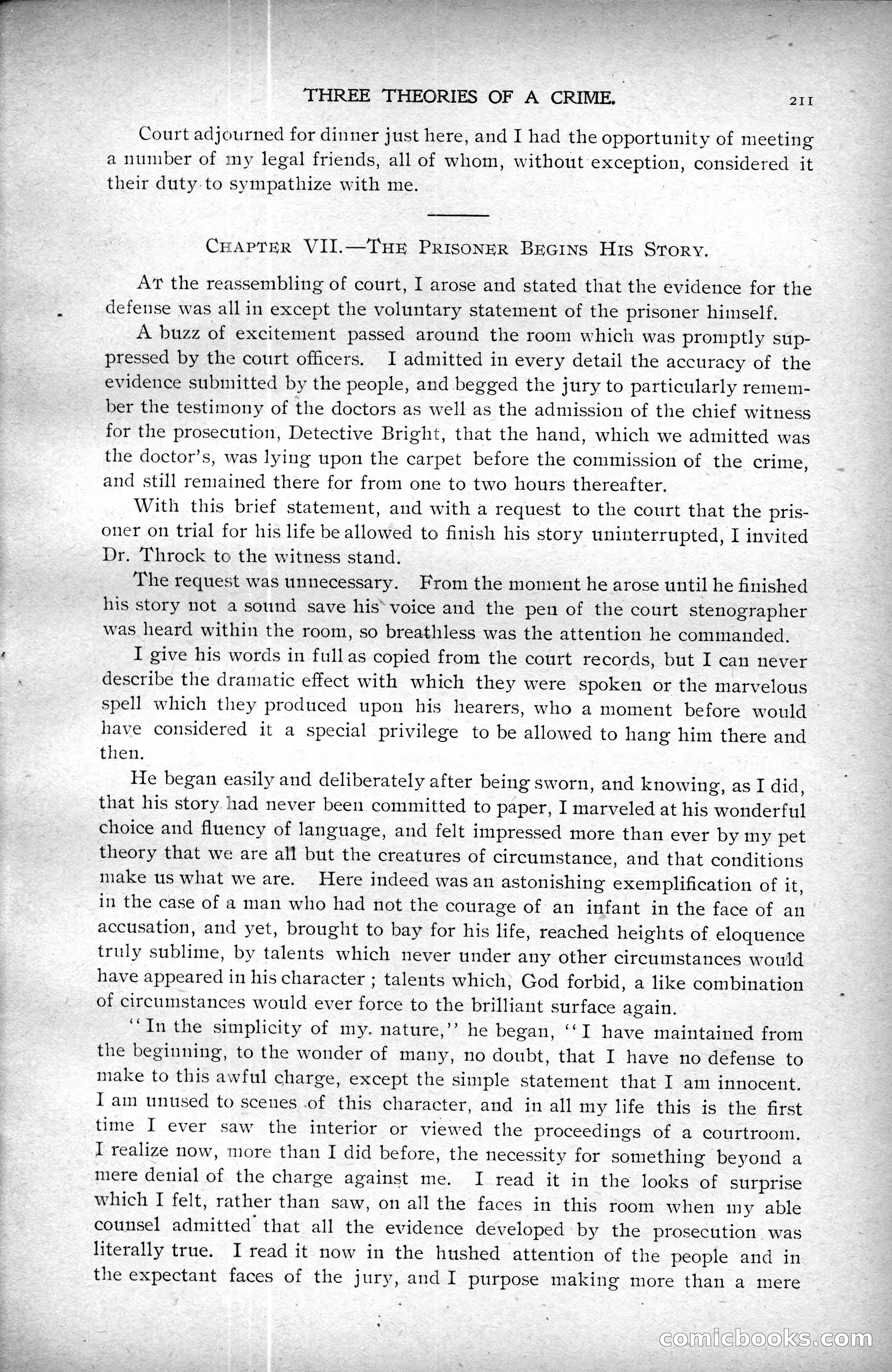
A restored page from Pulp Fiction, 1897. Page through the whole issue in the reader above.
📄 Transcribed text from this page (OCR, searchable)
Machine-transcribed from the original scan — historical spelling and the odd misread are preserved.
THREE THEORIES OF A CRIME. ee Court adjourned for dinner just here, and I had the opportunity of meeting a number of my legal friends, all of whom, without exception, considered it their duty.to sympathize with me. CERAPTER VII.—THE PRISONER BEGINS His Story. AT the reassembling of court, I arose and stated that the evidence for the defense was all in except the voluntary statement of the prisoner himself, A buzz of excitement passed around the room which was promptly sup- pressed by the court officers. I admitted in every detail the accuracy of the evidence submitted by the people, and begged the jury to particularly remem- ber the testimony of the doctors as well as the admission of the chief witness for the prosecution, Detective Bright, that the hand, which we admitted was the doctor’s, was lying upon the carpet before the commission of the crime, and still remained there for from one to two hours thereafter, With this brief statement, and with a request to the court that the pris- oner on trial for his life be allowed to finish his story uninterrupted, I invited Dr. Throck to the witness stand. The request was unnecessary. From the moment he arose until he finished his story not a sound save his* voice and the pen of the court stenographer was heard within the room, so breathless was the attention he commanded. I give his words in fullas copied from the court records, but I can never describe the dramatic effect with which they were spoken or the marvelous spell which they produced upon his hearers, who a moment before would — have considered it a special privilege to be allowed to hang him there and then. He began easily and deliberately after being sworn, and knowing, as I did, that his story had never been committed to paper, I marveled at his wonderful choice and fluency of language, and felt impressed more than ever by my pet theory that we are all but the creatures of circumstance, and that conditions make us what we are. Here indeed was an astonishing exemplification of it, in the case of a man who had not the courage of an infant in the face of an accusation, and yet, brought to bay for his life, reached heights of eloquence truly sublime, by talents which never under any other circumstances would have appeared in his character ; talents which, God forbid, a like combination of circumstances would ever force to the brilliant surface again. “In the simplicity of my. nature,’’ he began, ‘‘I have maintained from — the beginning, to the wonder of many, no doubt, that I have no defense to make to this awful charge, except the simple statement that I am innocent. Iam unused to scenes .of this character, and in all my life this is the first time I ever saw the interior or viewed the proceedings of a courtroom. I realize now, more than I did before, the necessity for something beyond a mere denial of the charge against me. I read it in the looks of surprise which I felt, rather than saw, on all the faces in this room when my able counsel admitted that all the evidence developed by the prosecution was literally true. I read it now in the hushed attention of the people and in the expectant faces of the jury, and I purpose making more than a mere Eomicbooks (S@)