
Pulp Fiction, 1897 · page 16 of 192
The Argosy — page 16: what you’re looking at
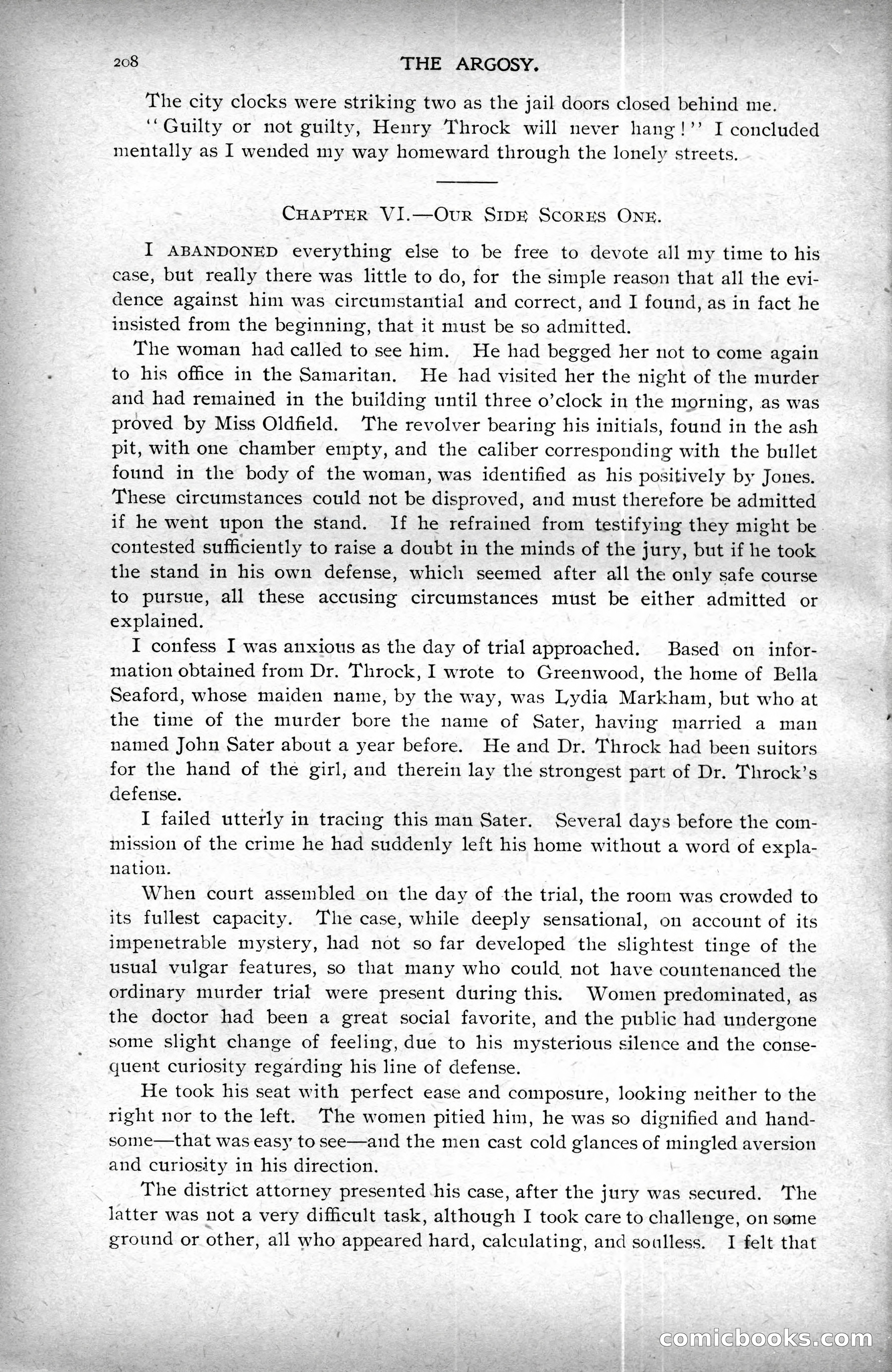
A restored page from Pulp Fiction, 1897. Page through the whole issue in the reader above.
📄 Transcribed text from this page (OCR, searchable)
Machine-transcribed from the original scan — historical spelling and the odd misread are preserved.
208 THE ARGOSY. The city clocks were striking two as the jail doors closed behind me. ‘“Guilty or not guilty, Henry Throck will never hang!’’ I concluded mentally as I wended my way homeward through the lonely streets. CHAPTER VI.—OvuR SIDE SCORES ONE. I ABANDONED everything else to be free to devote all my time to his case, but really there was little to do, for the simple reason that all the evi- dence against him was circumstantial and correct, and I found, as in fact he insisted from the beginning, that it must be so admitted. The woman had called to see him. He had begged her not to come again to his office in the Samaritan. He had visited her the night of the murder and had remained in the building until three o’clock in the morning, as was proved by Miss Oldfield. The revolver bearing his initials, found in the ash pit, with one chamber empty, and the caliber corresponding with the bullet found in the body of the woman, was identified as his positively by Jones. These circumstances could not be disproved, and must therefore be admitted if he went upon the stand. If he refrained from testifying they might be. contested sufficiently to raise a doubt in the minds of the jury, but if he took the stand in his own defense, whicli seemed after all the only safe course to pursue, all these accusing circumstances must be either admitted or explained. I confess I was anxious as the day of trial approached. Based on infor- mation obtained from Dr. Throck, I wrote to Greenwood, the home of Bella Seaford, whose maiden namie, by the way, was Lydia Markham, but who at the time of the murder bore the name of Sater, having married a man named John Sater about a year before. He and Dr. Throck had been suitors for the hand of the girl, and therein lay the strongest part of Dr. Throck’s defense. I failed utterly in tracing this man Sater. Several days before the com- mission of the crime he had suddenly left his home without a word of expla- nation. 3 When court assembled on the day of the trial, the room was crowded to its fullest capacity. The case, while deeply sensational, on account of its impenetrable mystery, had not so far developed the slightest tinge of the usual vulgar features, so that many who could not have countenanced the ordinary murder trial were present during this. Women predominated, as the doctor had been a great social favorite, and the public had undergone some slight change of feeling, due to his mysterious silence and the conse- quent curiosity regarding his line of defense. He took his seat with perfect ease and composure, looking neither to the right nor to the left. The women pitied him, he was so dignified and hand- some—that was easy to see—and the men cast cold glances of mingled aversion and curiosity in his direction. The district attorney presented his case, after the jury was secured. ‘The latter was not a very difficult task, although I took care to challenge, on some ground or other, all who appeared hard, calculating, and soulless. I felt that Eomicbooks ((0)