
Pulp Fiction, 1897 · page 14 of 192
The Argosy — page 14: what you’re looking at
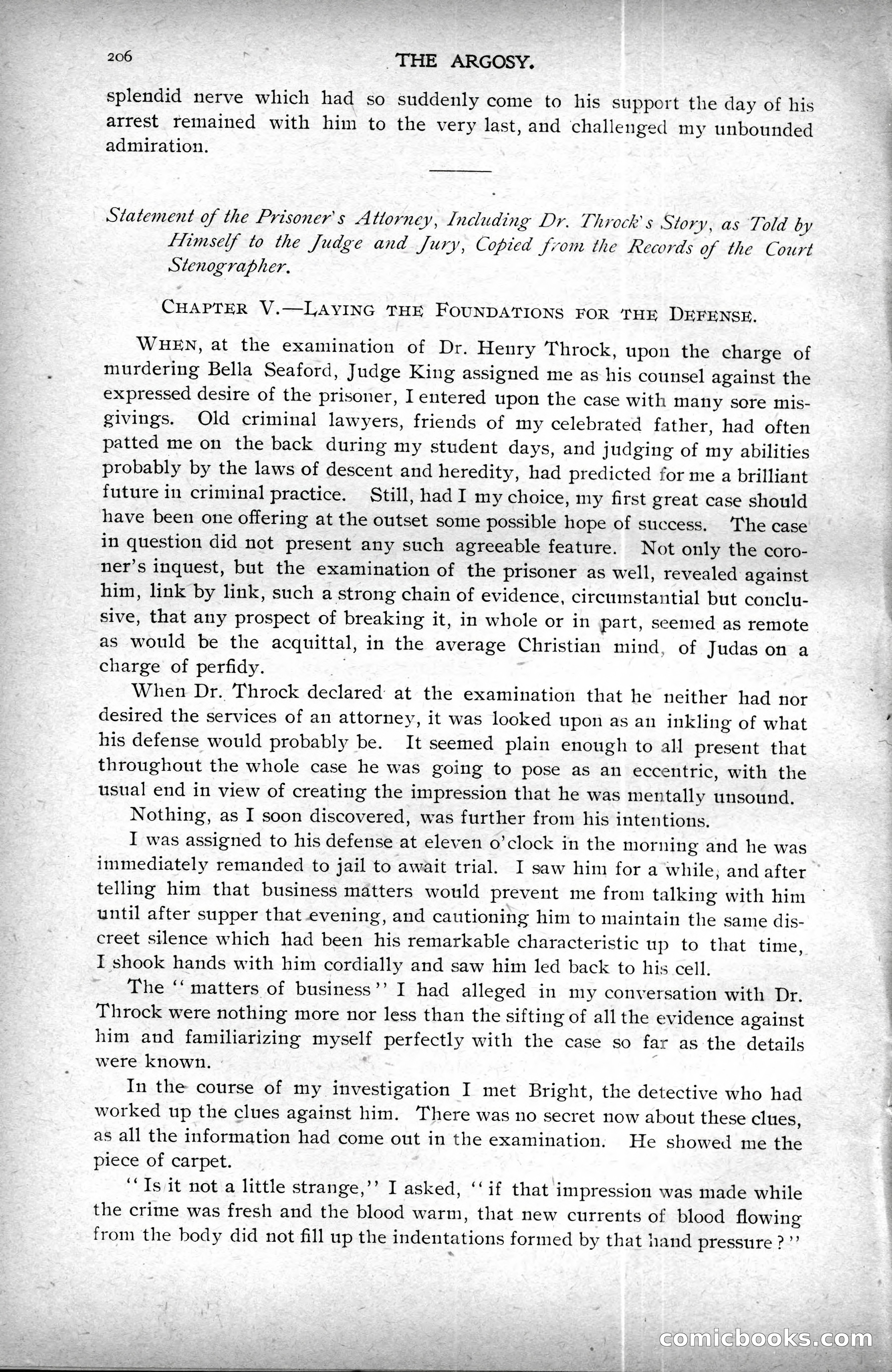
A restored page from Pulp Fiction, 1897. Page through the whole issue in the reader above.
📄 Transcribed text from this page (OCR, searchable)
Machine-transcribed from the original scan — historical spelling and the odd misread are preserved.
206 THE ARGOSY. splendid nerve which had so suddenly come to his support the day of his arrest remained with him to the very last, and challenged my unbounded admiration. —____. Statement of the Prisoner's Attorney, Lneluding Dr. Throck’s Story, as Told by flimself to the Judge and Jury, Copied Jrom the Records of the Court Stenographer. CHAPTER V.—LAYING THE FOUNDATIONS FOR THE DEFENSE. WHEN, at the examination of Dr. Henry Throck, upon the charge of murdering Bella Seaford, Judge King assigned me as his counsel against the expressed desire of the prisoner, I entered upon the case with many sore mis- givings. Old criminal lawyers, friends of my celebrated father, had often patted me on the back during my student days, and judging of my abilities probably by the laws of descent and heredity, had predicted for me a brilliant future in criminal practice. Still, had I my choice, my first great case should have been one offering at the outset some possible hope of success. ‘The case in question did not present any such agreeable feature. Not only the coro- ner’s inquest, but the examination of the prisoner as well, revealed against him, link by link, such a strong chain of evidence, circumstantial but conclu- sive, that any prospect of breaking it, in whole or in part, seemed as remote as would be the acquittal, in the average Christian mind, of Judas on a charge of perfidy. he When Dr. Throck declared at the examination that he neither had nor desired the services of an attorney, it was looked upon as an inkling of what his defense would probably be. It seemed plain enough to all present that throughout the whole case he was going to pose as an eccentric, with the usual end in view of creating the impression that he was mentally unsound. Nothing, as I soon discovered, was further from his intentions. I was assigned to his defense at eleven o’clock in the morning and he was immediately remanded to jail to await trial. I saw him for a while; and after telling him that business matters would prevent me from talking with him until after supper that evening, and cautioning him to maintain the same dis- creet silence which had been his remarkable characteristic up to that time, I shook hands with him cordially and saw him led back to his cell. The ‘‘ matters of business’’ I had alleged in my conversation with Dr. Throck were nothing more nor less than the sifting of all the evidence against him and familiarizing myself perfectly with the case so far as the details were known. | In the course of my investigation I met Bright, the detective who had worked up the clues against him. There was no secret now about these clues, as all the information had come out in the examination. He showed me the piece of carpet. ‘Is it not a little strange,’’ I asked, ‘‘if that impression was made while the crime was fresh and the blood warm, that new currents of blood flowing from the body did not fill up the indentations formed by that hand pressure ?”’ Eomichboo Sy (Ko)