
Pulp Fiction, 1897 · page 1 of 192
The Argosy — page 1: what you’re looking at
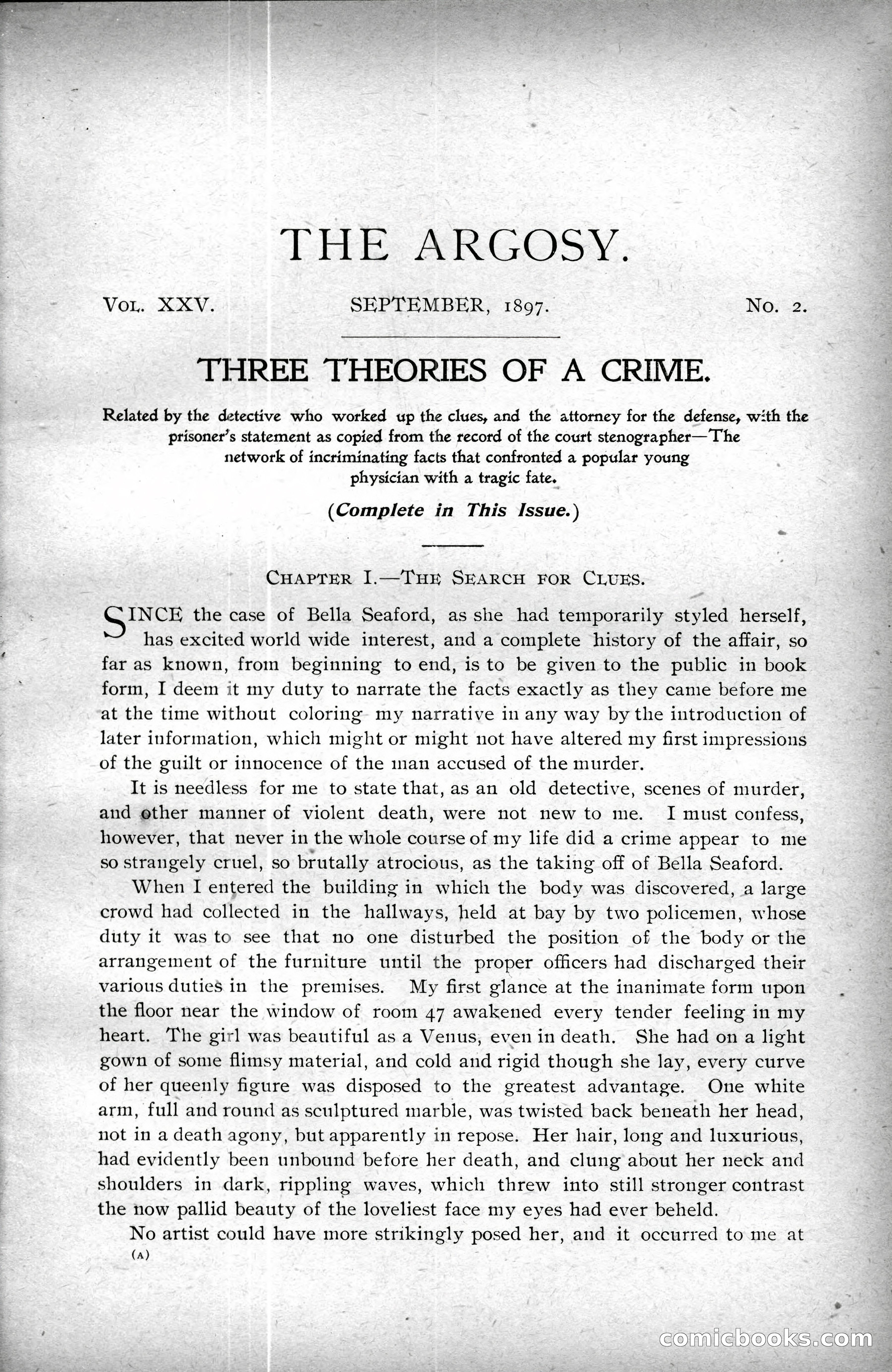
A restored page from Pulp Fiction, 1897. Page through the whole issue in the reader above.
📄 Transcribed text from this page (OCR, searchable)
Machine-transcribed from the original scan — historical spelling and the odd misread are preserved.
THE ARGOSY. VoL. XXV. SEPTEMBER, 1897. No. 2. THREE THEORIES OF A CRIME. Related by the detective who worked up the clues, and the attorney for the defense, wth the prisoner’s statement as copied from the record of the court stenographer— The network of incriminating facts that confronted a popular young physician with a tragic fate. (Complete in This Issue.) CHAPTER I.—THE SEARCH FOR CLUES. SINCE the case of Bella Seaford, as she had temporarily styled herself, has excited world wide interest, and a complete history of the affair, so far as known, from beginning to end, is to be given to the public in book form, I deem it my duty to narrate the facts exactly as they came before me at the time without coloring my narrative in any way by the introduction of later information, which might or might not have altered my first impressions of the guilt or innocence of the man accused of the murder. It is needless for me to state that, as an old detective, scenes of murder, and ether manner of violent death, were not new to me. I must confess, however, that never in the whole course of my life did a crime appear to me so strangely cruel, so brutally atrocious, as the taking off of Bella Seaford. When I entered the building in which the body was discovered, a large crowd had collected in the hallways, held at bay by two policemen, whose duty it was to see that no one disturbed the position of the body or the arrangement of the furniture until the proper officers had discharged their various duties in the premises. My first glance at the inanimate form upon the floor near the window of room 47 awakened every tender feeling in my heart. The girl was beautiful as a Venus, evenin death. She had on a light gown of some flimsy material, and cold and rigid though she lay, every curve of her queenly figure was disposed to the greatest advantage. One white arm, full and round as sculptured marble, was twisted back beneath her head, not in a death agony, but apparently in repose. Her hair, long and luxurious, had evidently been unbound before her death, and clung about her neck and shoulders in dark, rippling waves, which threw into still stronger contrast the now pallid beauty of the loveliest face my eyes had ever beheld. No artist could have more strikingly posed her, and it occurred to me at (a) Eomichbooks (e(o)