
Pulp Fiction, 1897 · page 148 of 192
The Argosy, Vol. XXV, No. 1 — page 148: what you’re looking at
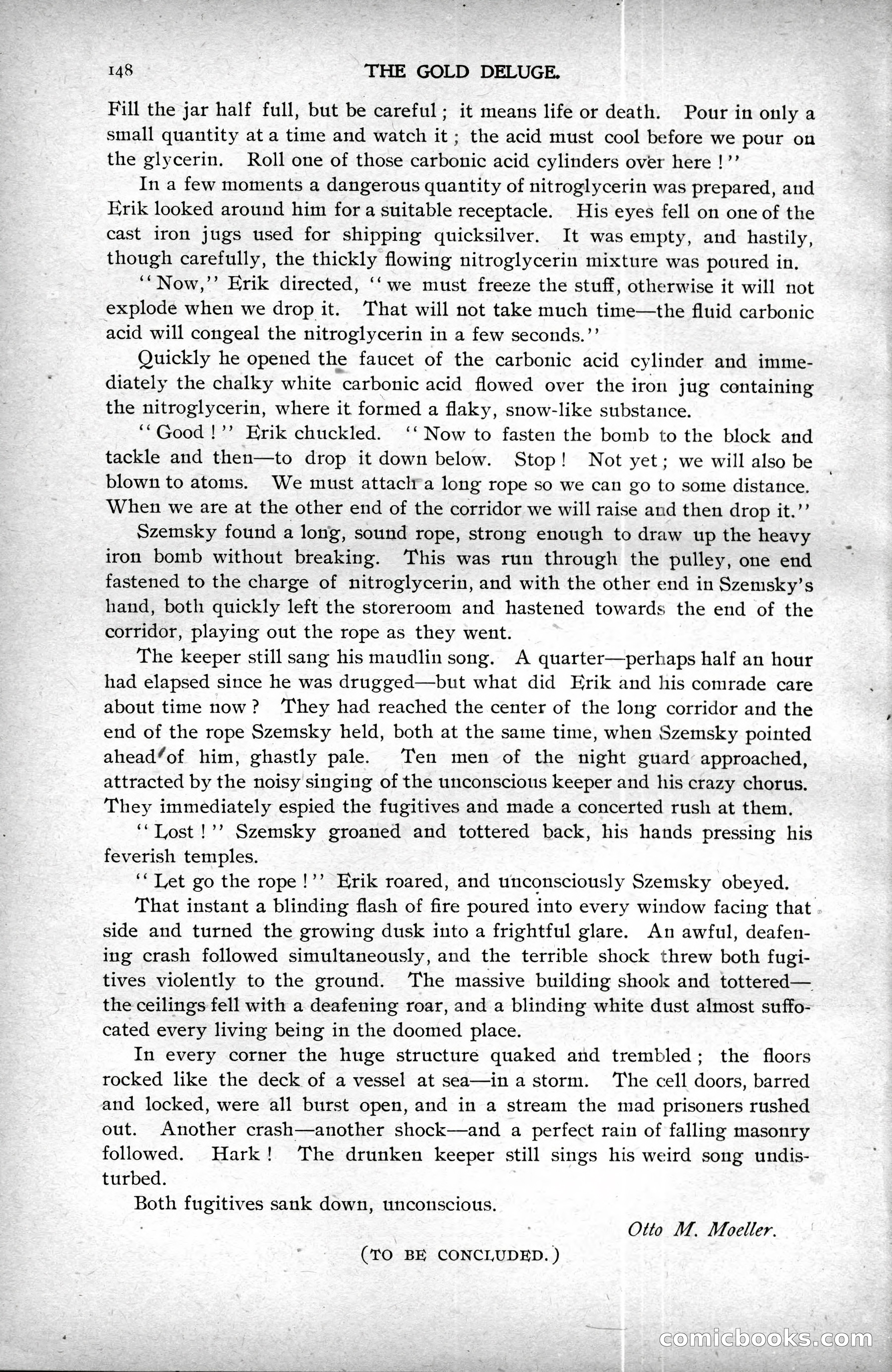
A restored page from Pulp Fiction, 1897. Page through the whole issue in the reader above.
📄 Transcribed text from this page (OCR, searchable)
Machine-transcribed from the original scan — historical spelling and the odd misread are preserved.
148 3 THE GOLD DELUGE. Fill the jar half full, but be careful; it means life or death. Pour in only a small quantity at a time and watch it ; the acid must cool before we pour on the glycerin. Roll one of those carbonic acid cylinders over here !’’ In a few moments a dangerous quantity of nitroglycerin was prepared, and Krik looked around him fora suitable receptacle. His eyes fell on one of the cast iron jugs used for shipping quicksilver. It was empty, and hastily, though carefully, the thickly flowing nitroglycerin mixture was poured in. ‘“Now,’’ Erik directed, ‘‘we must freeze the stuff, otherwise it will not explode when we drop it. That will not take much time—the fluid carbonic acid will congeal the nitroglycerin in a few seconds.”’ Quickly he opened the faucet of the carbonic acid cylinder and imme- diately the chalky white ‘carbonic acid flowed over the iron jug containing the nitroglycerin, where it formed a flaky, snow-like substance. ‘‘Good!’’ Hrik chuckled. ‘‘ Now to fasten the bomb to the block and tackle and then—to drop it down below. Stop! Not yet; we will also be blown to atoms. We must attaclra long rope so we can go to some distance. When we are at the other end of the corridor we will raise and then drop it.”’ Szemsky found a long, sound rope, strong enough to draw up the heavy iron bomb without breaking. This was run through the pulley, one end fastened to the charge of nitroglycerin, and with the other end in Szemsky’s hand, both quickly left the storeroom and hastened towards the end of the corridor, playing out the rope as they went. The keeper still sang his maudlin song. A quarter—perhaps half an hour had elapsed since he was drugged—but what did Erik and his comrade care about time now? ‘They had reached the center of the long corridor and the end of the rope Szemsky held, both at the same time, when Szemsky pointed ahead’of him, ghastly pale. Ten men of the night guard approached, attracted by the noisy singing of the unconscious keeper and his crazy chorus. They immediately espied the fugitives and made a concerted rush at them. ‘“Lost!’’ Szemsky groaned and tottered back, his hands pressing his feverish temples. | ‘‘ Let go the rope!’’ Erik roared, and unconsciously Szemsky obeyed. That instant a blinding flash of fire poured into every window facing that side and turned the growing dusk into a frightful glare. An awful, deafen- ing crash followed simultaneously, and the terrible shock threw both fugi- tives violently to the ground. ‘The massive building shook and tottered— the ceilings fell with a deafening roar, and a blinding white dust almost suffo- cated every living being in the doomed place. In every corner the huge structure quaked and trembled; the floors rocked like the deck of a vessel at sea—inastorm. The cell doors, barred and locked, were all burst open, and in a stream the mad prisoners rushed out. Another crash—another shock—and a perfect rain of falling masonry followed. Hark! The drunken keeper still sings his weird song undis- turbed. Both fugitives sank down, unconscious. Otto M. Moeller. (TO BE CONCLUDED. ) Eomichbooks (S@)