
Pulp Fiction, 1897 · page 113 of 192
The Argosy, Vol. XXV, No. 1 — page 113: what you’re looking at
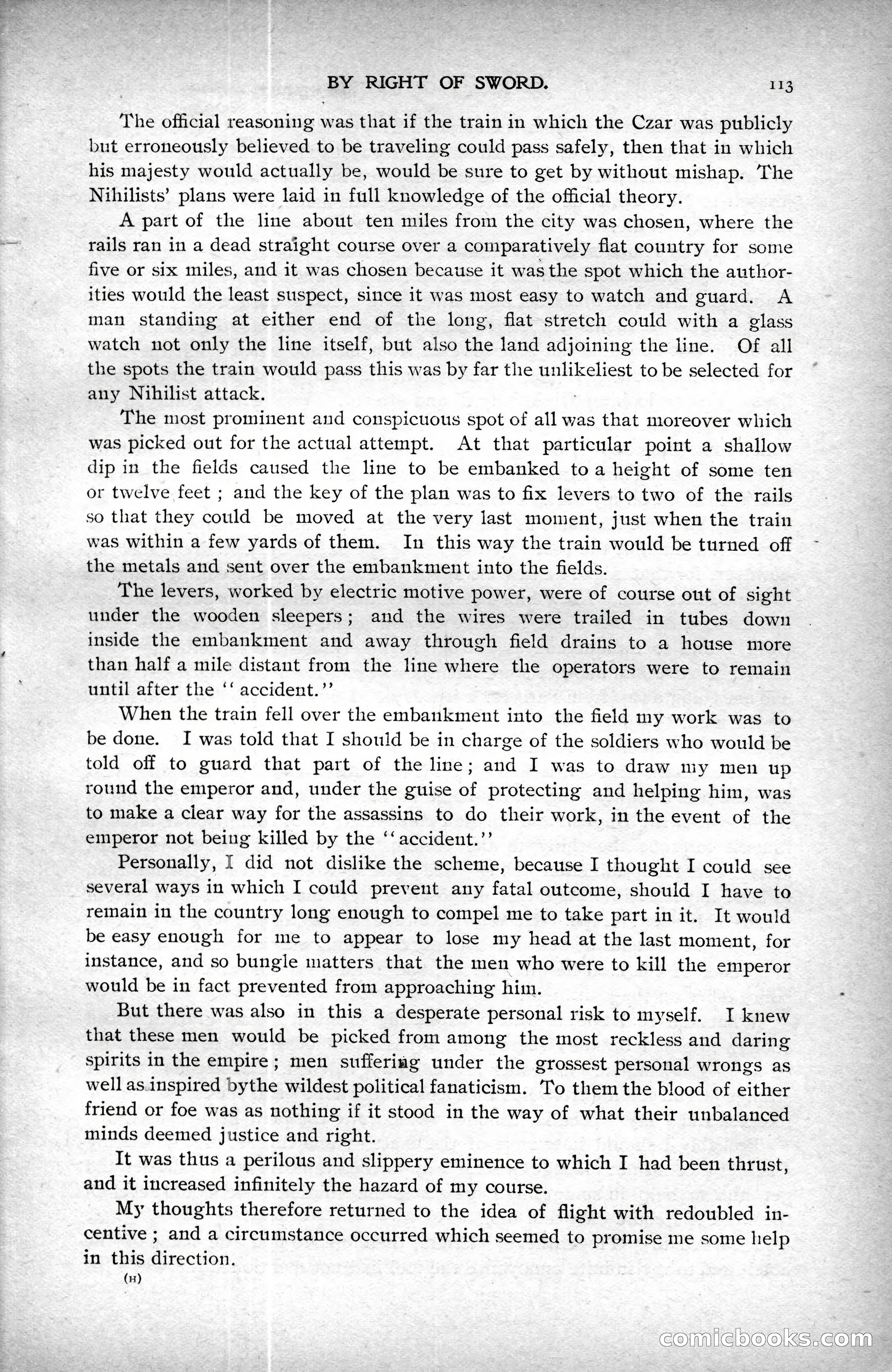
A restored page from Pulp Fiction, 1897. Page through the whole issue in the reader above.
📄 Transcribed text from this page (OCR, searchable)
Machine-transcribed from the original scan — historical spelling and the odd misread are preserved.
= a BY RIGHT OF SWORD. 113 The official reasoning was that if the train in which the Czar was publicly but erroneously believed to be traveling could pass safely, then that in which his majesty would actually be, would be sure to get by without mishap. The Nihilists’ plans were laid in full knowledge of the official theory. A part of the line about ten miles from the city was chosen, where the rails ran in a dead straight course over a comparatively flat country for some five or six miles, and it was chosen because it was the spot which the author- ities would the least suspect, since it was most easy to watch and guard. A man standing at either end of the long, flat stretch could with a glass watch not only the line itself, but also the land adjoining the line. Of all the spots the train would pass this was by far the unlikeliest to be selected for any Nihilist attack. : The most prominent and conspicuous spot of all was that moreover which was picked out for the actual attempt. At that particular point a shallow dip in the fields caused the line to be embanked toa height of some ten or twelve feet ; and the key of the plan was to fix levers to two of the rails so that they could be moved at the very last moment, just when the train was within a few yards of them. In this way the train would be turned off the metals and sent over the embankment into the fields. The levers, worked by electric motive power, were of course out of sight under the wooden sleepers; and the wires were trailed in tubes down inside the embankment sn away through field drains to a house more than half a mile distant from the line where the operators were to remain until after the ‘‘ accident.”’ When the train fell over the embankment into the field my work was to be done. I was told that I should be in charge of the soldiers who would be told off to guard that part of the line; and I was to draw my men up round the emperor and, under the guise of protecting and helping him, was to make a clear way for the assassins to do their work, in the event of the emperor not being killed by the ‘‘accident.’’ Personally, I did not dislike the scheme, because I thought I could see several ways in which I could prevent any fatal outcome, should I have to remain in the country long enough to compel me to take part in it. It would be easy enough for me to appear to lose my head at the last moment, for instance, and so bungle matters that the men who were to kill the emperor would be in fact prevented from approaching him. But there was also in this a desperate personal risk to myself. I knew that these men would be picked from among the most reckless and daring spirits in the empire ; men sufferiag under the grossest personal wrongs as well as.inspired bythe wildest political fanaticism. ‘To them the blood of either friend or foe was as nothing if it stood in the way of what their unbalanced minds deemed justice and right. It was thus a perilous and slippery eminence to which I had been thrust, and it increased infinitely the hazard of my course. My thoughts therefore returned to the idea of flight with redoubled in- centive ; and a circumstance occurred which seemed to promise me some help in this Wien: (H) Eomichook (©)