
Pulp Fiction, 1897 · page 8 of 198
Argosy, Volume XXIII — Index Page, 1897 — page 8: what you’re looking at
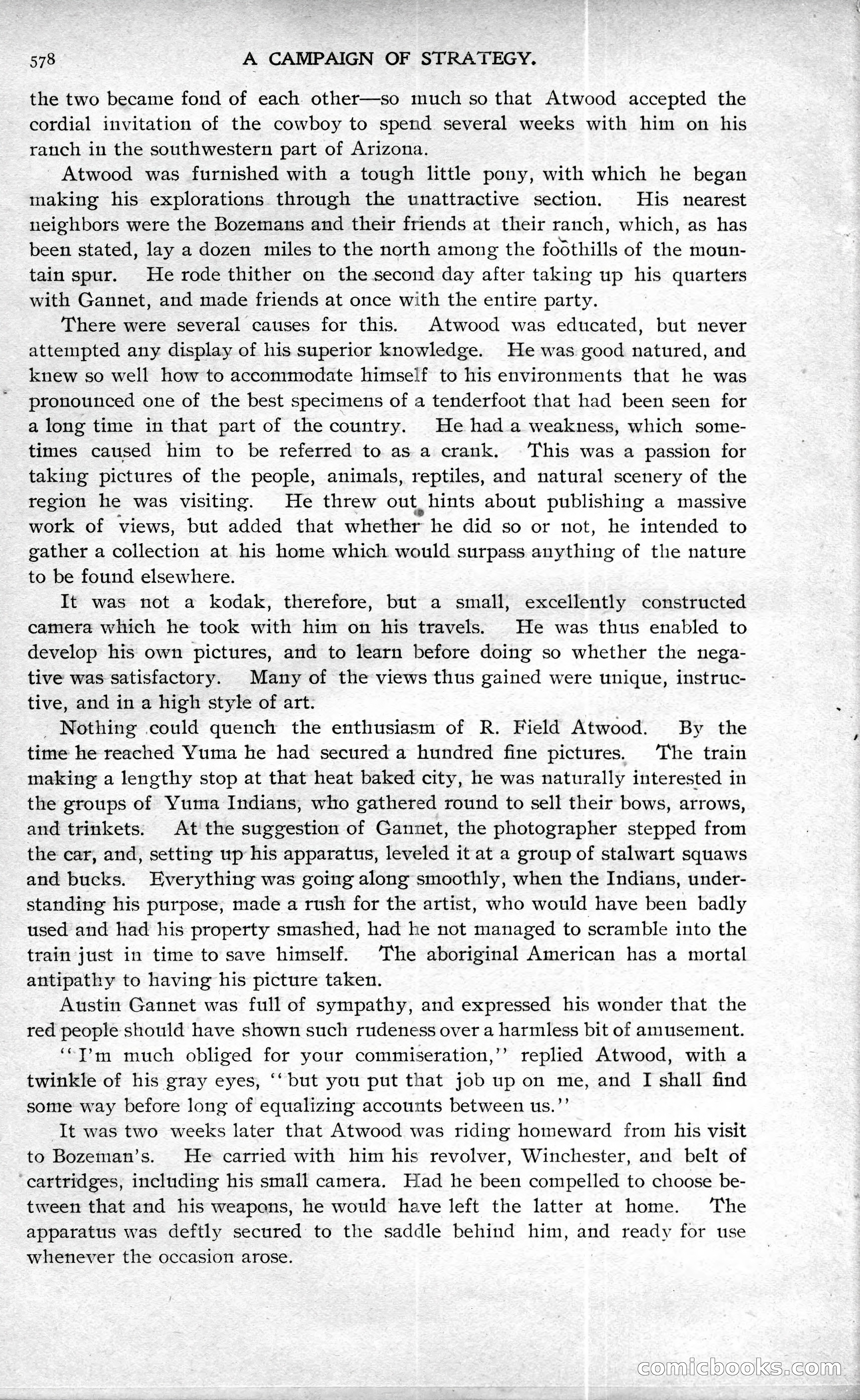
A restored page from Pulp Fiction, 1897. Page through the whole issue in the reader above.
📄 Transcribed text from this page (OCR, searchable)
Machine-transcribed from the original scan — historical spelling and the odd misread are preserved.
578 A CAMPAIGN OF STRATEGY. the two became fond of each other—so much so that Atwood accepted the cordial invitation of the cowboy to spend several weeks with him on his ratich in the southwestern part of Arizona. Atwood was furnished with a tough little pony, with which he began making his explorations through the unattractive section. His nearest neighbors were the Bozemans and their friends at their ranch, which, as has been stated, lay a dozen miles to the north among the foothills of the moun- tain spur. He rode thither on the second day after taking up his quarters with Gannet, and made friends at once with the entire party. There were several causes for this. Atwood was educated, but never attempted any display of his superior knowledge. He was good natured, and knew so well how to accommodate himself to his environments that he was pronounced one of the best specimens of a tenderfoot that had been seen for along time in that part of the country. He hada weakness, which some- times caused him to be referred to as a crank. This was a passion for taking pictures of the people, animals, reptiles, and natural scenery of the region he was visiting. He threw out hints about publishing a massive work of views, but added that whether he did so or not, he intended to gather a collection at his home which would surpass anything of the nature to be found elsewhere. It was not a kodak, therefore, but a small, excellently constructed camera which he took with him on his travels. He was thus enabled to develop his own pictures, and to learn before doing so whether the nega- tive was satisfactory. Many of the views thus gained were unique, instruc- tive, and in a high style of art. _ Nothing could quench the enthusiasm of R. Field Atwood. By the time he reached Yuma he had secured a hundred fine pictures. The train making a lengthy stop at that heat baked city, he was naturally interested in the groups of Yuma Indians, who gathered round to sell their bows, arrows, and trinkets. At the suggestion of Ganunet, the photographer stepped from the car, and, setting up his apparatus, leveled it at a group of stalwart squaws and bucks. Everything was going along smoothly, when the Indians, under- standing his purpose, made a rush for the artist, who would have been badly used and had his property smashed, had he not managed to scramble into the train just in time to save himself. The aboriginal American has a mortal antipathy to having his picture taken. Austin Gannet was full of sympathy, and expressed his wonder that the red people should have shown such rudeness over a harmless bit of amusement. ‘“T’m much obliged for your commiseration,’’ replied Atwood, with a twinkle of his gray eyes, ‘“‘ but you put that job up on me, and I shall find some way before long of equalizing accounts between us.’’ It was two weeks later that Atwood was riding homeward from his visit to Bozeman’s. He carried with him his revolver, Winchester, and belt of cartridges, including his small camera. Had he been compelled to choose be- tween that and his weapons, he would have left the latter at home. The apparatus was deftly secured to the saddle behind him, and ready for use whenever the occasion arose. comcoooks (C@