
Pulp Fiction, 1897 · page 167 of 198
Argosy, Volume XXIII — Index Page, 1897 — page 167: what you’re looking at
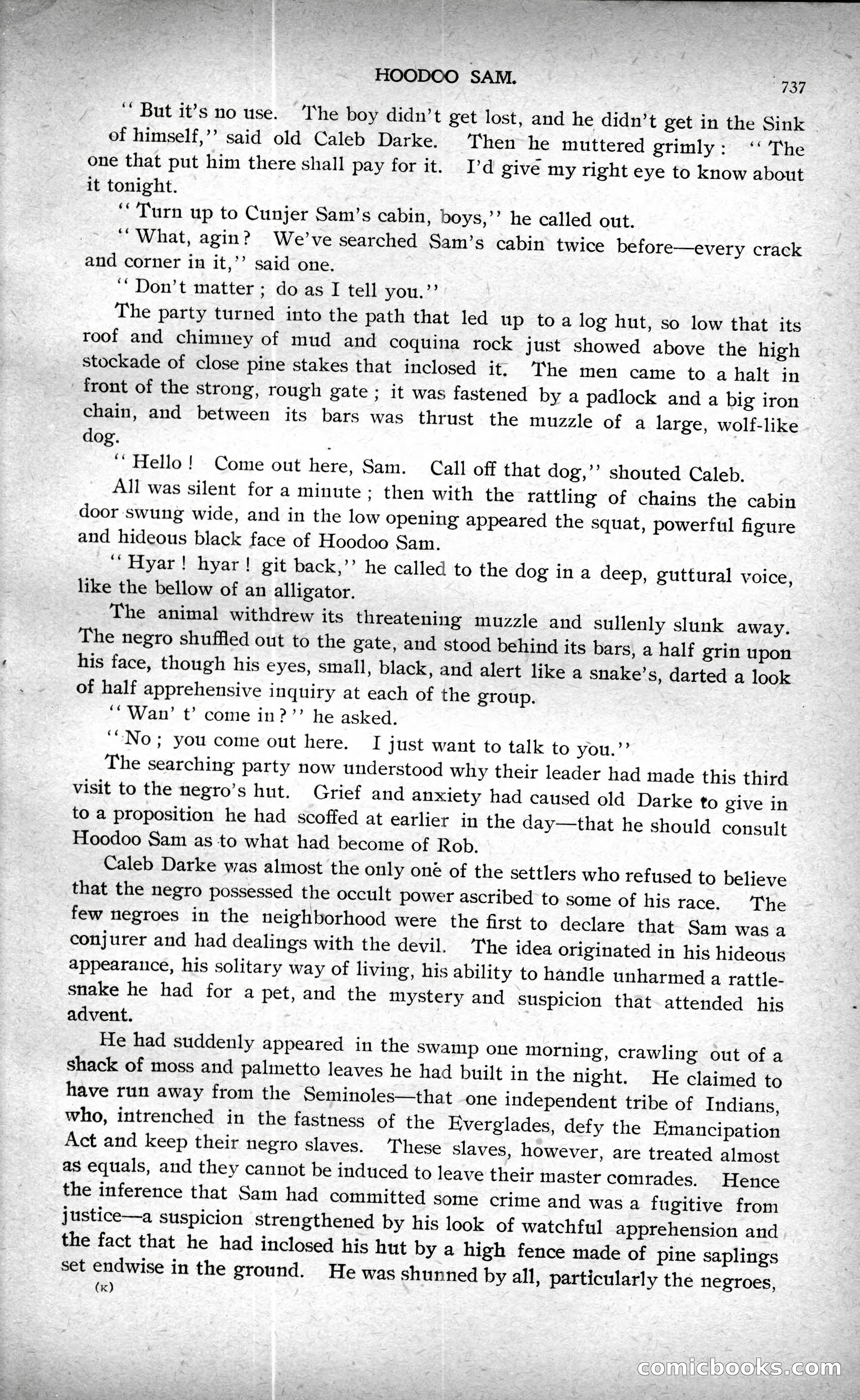
A restored page from Pulp Fiction, 1897. Page through the whole issue in the reader above.
📄 Transcribed text from this page (OCR, searchable)
Machine-transcribed from the original scan — historical spelling and the odd misread are preserved.
HOODOO SAM. 737 ‘‘ But it’s no use. ‘The boy didn’t get lost, and he didn’t get in the Sink — of himself,’’ said old Caleb Darke. Then he muttered grimly: ‘‘ The one that put him there shall pay for it. I'd give my right eye to know about it tonight. ‘Turn up to Cunjer Sam’s cabin, boys,’’ he called out. ‘‘ What, agin? We’ve searched Sam’s cabin twice before—every crack and corner in it,’’ said one. ‘“ Don’t matter; do as I tell you.”’ The party turned into the path that led up toa log hut, so low that its roof and chimney of mud and coquina rock just showed above the high stockade of close pine stakes that inclosed it: ‘The men came to a halt in front of the strong, rough gate ; it was fastened by a padlock and a big iron chain, and between its bars was thrust the muzzle of a large, wolf-like dog. Hello! Come out here, Sam. Call off that dog,’’ shouted Caleb. All was silent for a minute; then with the rattling of chains the cabin door swung wide, and in the low opening appeared the squat, powerful figure and hideous black face of Hoodoo Sam. ‘ Hyar! hyar! git back,’ he called to the dog in a deep, guttural voice, like the bellow of an alligator. The animal withdrew its threatening muzzle and sullenly slunk away. The negro shuffled out to the gate, and stood behind its bars, a half grin upon his face, though his eyes, small, black, and alert like a snake’s, darted a look of half apprehensive inquiry at each of the group. ‘Wan’ t’ come in?’’ he asked. ‘“No; you come out here, [I just want to talk to you.’’ The searching party now understood why their leader had made this third visit to the negro’s hut. Grief and anxiety had caused old Darke to give in to a proposition he had scoffed at earlier in the day—that he should consult Hoodoo Sam as to what had become of Rob. Caleb Darke was almost the only one of the settlers who refused to believe that the negro possessed the occult power ascribed to some of his race. The few negroes in the neighborhood were the first to declare that Sam was a conjurer and had dealings with the devil. The idea originated in his hideous appearance, his solitary way of living, his ability to handle unharmed a rattle- snake he had for a pet, and the mystery and suspicion that attended his advent. He had suddenly appeared in the Swamp one morning, crawling out of a shack of moss and palmetto leaves he had built in the night. He claimed to have run away from the Seminoles—that one independent tribe of Indians, who, intrenched in the fastness of the Everglades, defy the Emancipation Act and keep their negro slaves. ‘These slaves, however, are treated almost as equals, and they cannot be induced to leave their master comrades. Hence the inference that Sam had committed some crime and was a fugitive from justice—a suspicion strengthened by his look of watchful apprehension and the fact that he had inclosed his hut by a high fence made of pine saplings set endwise in the ground. He was shunned by all, particularly the negroes, (kK) Comichbooks >) (E(0)