
Pulp Fiction, 1897 · page 87 of 200
The Argosy, Vol. XXIV, No. 3 — page 87: what you’re looking at
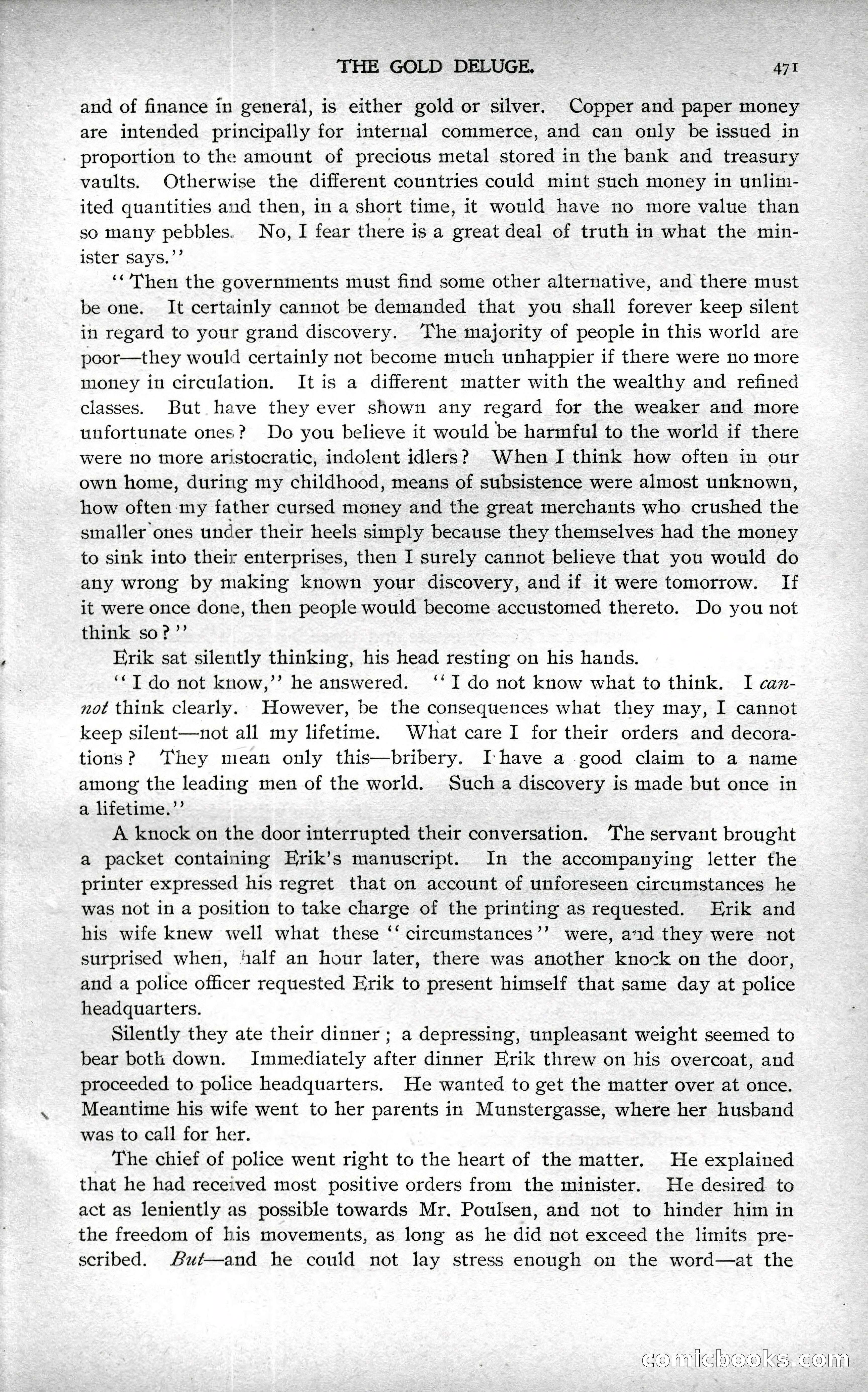
A restored page from Pulp Fiction, 1897. Page through the whole issue in the reader above.
📄 Transcribed text from this page (OCR, searchable)
Machine-transcribed from the original scan — historical spelling and the odd misread are preserved.
THE GOLD DELUGE. 471 and of finance in general, is either gold or silver. Copper and paper money are intended principally for internal commerce, and can only be issued in . proportion to the amount of precious metal stored in the bank and treasury vaults. Otherwise the different countries could mint such money in unlim- ited quantities and then, in a short time, it would have no more value than so many pebbles. No, I fear there is a great deal of truth in what the min- ister says.’’ ‘‘’Then the governments must find some other alternative, and there must be one. It certainly cannot be demanded that you shall forever keep silent in regard to your grand discovery. The majority of people in this world are poor—they would certainly not become much unhappier if there were no more money in circulation. It is a different matter with the wealthy and refined classes. But have they ever shown any regard for the weaker and more unfortunate ones? Do you believe it would be harmful to the world if there were no more aristocratic, indolent idlers? When I think how often in our own home, during my childhood, means of subsistence were almost unknown, how often my father cursed money and the great merchants who crushed the smaller ones under their heels simply because they themselves had the money to sink into their enterprises, then I surely cannot believe that you would do any wrong by making known your discovery, and if it were tomorrow. If it were once done, then people would become accustomed thereto. Do you not think so?”’ Hrik sat silently thinking, his head resting on his hands. ‘TI do not know,’’ he answered. ‘‘I do not know what to think. I caz- not think clearly. However, be the consequences what they may, I cannot keep silent—not all my lifetime. What careI for their orders and decora- tions? ‘They mean only this—bribery. Ihave a good claim to a name among the leading men of the world. Such a discovery is made but once in a lifetime.’’ A knock on the door interrupted their conversation. The servant brought a packet containing Hrik’s manuscript. In the accompanying letter the printer expressed his regret that on account of unforeseen circumstances he was not in a position to take charge of the printing as requested. Erik and his wife knew well what these ‘‘ circumstances’’ were, and they were not surprised when, ‘1alf an hour later, there was another knock on the door, and a police officer requested Erik to present himself that same day at police headquarters. Silently they ate their dinner ; a depressing, unpleasant weight seemed to bear both down. Immediately after dinner Erik threw on his overcoat, and proceeded to police headquarters. He wanted to get the matter over at once. Meantime his wife went to her parents in Munstergasse, where her husband was to call for her. The chief of police went right to the heart of the matter. He explained that he had received most positive orders from the minister. He desired to act as leniently as possible towards Mr. Poulsen, and not to hinder him in the freedom of his movements, as long as he did not exceed the limits pre- scribed. #ut—and he could not lay stress enough on the word—at the Comicloolks