
Pulp Fiction, 1897 · page 3 of 200
The Argosy, Vol. XXIV, No. 3 — page 3: what you’re looking at
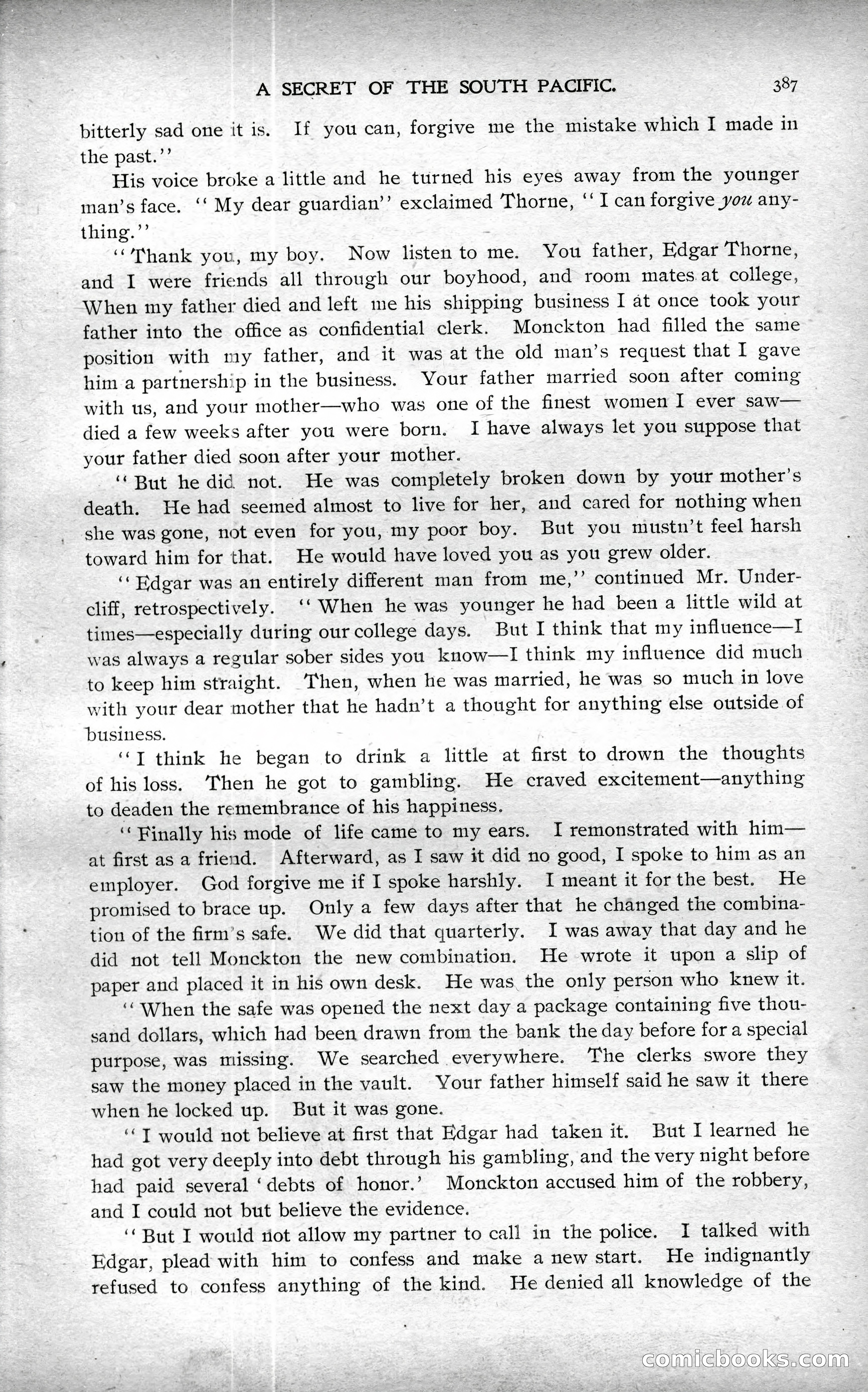
A restored page from Pulp Fiction, 1897. Page through the whole issue in the reader above.
📄 Transcribed text from this page (OCR, searchable)
Machine-transcribed from the original scan — historical spelling and the odd misread are preserved.
A SECRET OF THE SOUTH PACIFIC. 387 bitterly sad one it is. If you can, forgive me the mistake which I made in the past.’’ His voice broke a little and he turned his eyes away from the younger man’s face. ‘‘ My dear guardian’ exclaimed Thorne, ‘‘I can forgive you any- thing.’”’ “hank you, my boy. Now listen to me. You father, Edgar Thorne, and I were friends all through our boyhood, and room mates.at college, When my father died and left me his shipping business I at once took your father into the office as confidential clerk. Monckton had filled the same position with my father, and it was at the old man’s request that I gave him a partnership in the business. Your father married soon after coming with us, and your mother—who was one of the finest women I ever saw— died a few weeks after you were born. I have always let you suppose that your father died soon after your mother. “But he did not. He was completely broken down by your mother’s death. He had seemed almost to live for her, and cared for nothing when she was gone, not even for you, my poor boy. But you mustn’t feel harsh toward him for that. He would have loved you as you grew older. ‘Edgar was an entirely different man from me,”’ continued Mr. Under- cliff, retrospectively. ‘‘ When he was younger he had been a little wild at times—especially during our college days. But I think that my influence—I was always a regular sober sides you know—I think my influence did much to keep him straight. Then, when he was married, he was so much in love with your dear mother that he hadn’t a thought for anything else outside of business. 3 “T think he began to drink a little at first to drown the thoughts of his loss. ‘Then he got to gambling. He craved excitement—anything to deaden the remembrance of his happiness. ‘Finally his mode of life came to my ears. I remonstrated with him— at first as a friend. Afterward, as I saw it did no good, I spoke to him as an employer. God forgive me if I spoke harshly. I meant it for the best. He promised to brace up. Only a few days after that he changed the combina- tion of the firm’s safe. We did that quarterly. I was away that day and he did not tell Monckton the new combination. He wrote it upon a slip of paper and placed it in his own desk. He was, the only person who knew it. ‘When the safe was opened the next day a package containing five thou- sand dollars, which had been drawn from the bank the day before for a special purpose, was missing. We searched everywhere. The clerks swore they saw the money placed in the vault. Your father himself said he saw it there when he locked up. But it was gone. “JT would not believe at first that Edgar had taken it. But I learned he had got very deeply into debt through his gambling, and the very night before had paid several ‘debts of honor.’ Monckton accused him of the robbery, and I could not but believe the evidence. “But I would siot allow my partner to call in the police. I talked with Edgar, plead with him to confess and make a new start. He indignantly refused to confess anything of the kind. He denied all knowledge of the CORNICE DOOKS nO =}