
Pulp Fiction, 1897 · page 22 of 200
The Argosy, Vol. XXIV, No. 3 — page 22: what you’re looking at
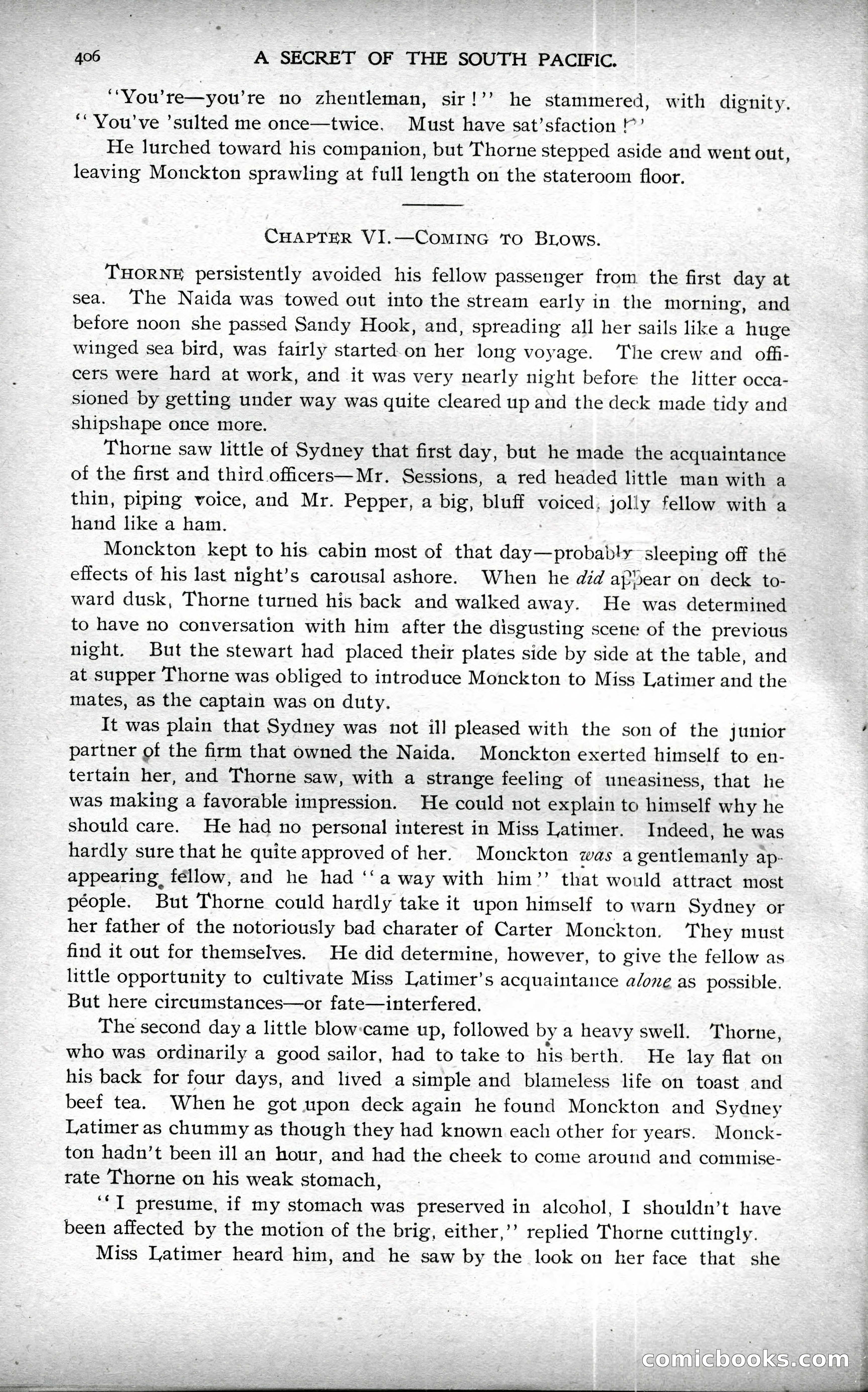
A restored page from Pulp Fiction, 1897. Page through the whole issue in the reader above.
📄 Transcribed text from this page (OCR, searchable)
Machine-transcribed from the original scan — historical spelling and the odd misread are preserved.
406 A SECRET OF THE SOUTH PACIFIC. You’re—you’re no zhentleman, sir!’’ he stammered, with dignity, ‘‘ You've ’sulted me once—twice. Must have sat’sfaction !°’ He lurched toward his companion, but Thorne stepped aside and went out, leaving Monckton sprawling at full length on the stateroom floor. CHAPTER VI.—ComING TO BLows. ete persistently avoided his fellow passenger from the first day at sea. The Naida was towed out into the stream early in the morning, and before noon she passed Sandy Hook, and, spreading all her sails like a huge winged sea bird, was fairly started-on her long voyage. ‘The crew and offi- cers were hard at work, and it was very nearly night before the litter occa- sioned by getting under way was quite cleared up and the deck made tidy and shipshape once more. Thorne saw little of Sydney that first day, but he made the acquaintance of the first and third officers—Mr. Sessions, a red headed little man with a thin, piping voice, and Mr. Pepper, a big, bluff voiced, jolly fellow with a hand like a ham. Monckton kept to his cabin most of that dis ohae sleeping off the effects of his last night’s carousal ashore. When he did apDear on deck to- ward dusk, Thorne turned his back and walked away. He was determined to have no conversation with him after the disgusting scene of the previous night. But the stewart had placed their plates side by side at the table, and at supper Thorne was obliged to introduce Monckton to Miss Latimer and the mates, as the captain was on duty. It was plain that Sydney was not ill pleased with the son of the junior : partner of the firm that owned the Naida. Monckton exerted himself to en- tertain her, and Thorne saw, with a strange feeling of uneasiness, that he was making a favorable impression. He could not explain to himself why he should care. He had no personal interest in Miss Latimer. Indeed, he was hardly sure that he quite approved of her. Monckton was a gentlemanly ap- appearing féllow, and he had ‘‘a way with him’”’ that would attract most péople. But Thorne could hardly take it upon himself to warn Sydney or her father of the notoriously bad charater of Carter Monckton. They must find it out for themselves. He did determine, however, to give the fellow as little opportunity to cultivate Miss Latimer’s acquaintance alone as possible. But here circumstances—or fate—interfered. The second day a little blow:came up, followed by a heavy swell. Thorne, who was ordinarily a good sailor, had to take to his berth. He lay flat on his back for four days, and lived a simple and blameless life on toast and beef tea. When he got upon deck again he found Monckton and Sydney Latimer as chummy as though they had known each other for years. Monck- ton hadn’t been ill an hour, and had the cheek to come aroutid and commise- rate Thorne on his weak stomach, | ‘‘I presume, if my stomach was preserved in alcohol, I shouldn’t have been affected by the motion of the brig, either,’’ replied Thorne cuttingly. Miss Latimer heard him, and he saw by the look on her face that she cGomicbooks: