
Pulp Fiction, 1897 · page 17 of 200
The Argosy, Vol. XXIV, No. 3 — page 17: what you’re looking at
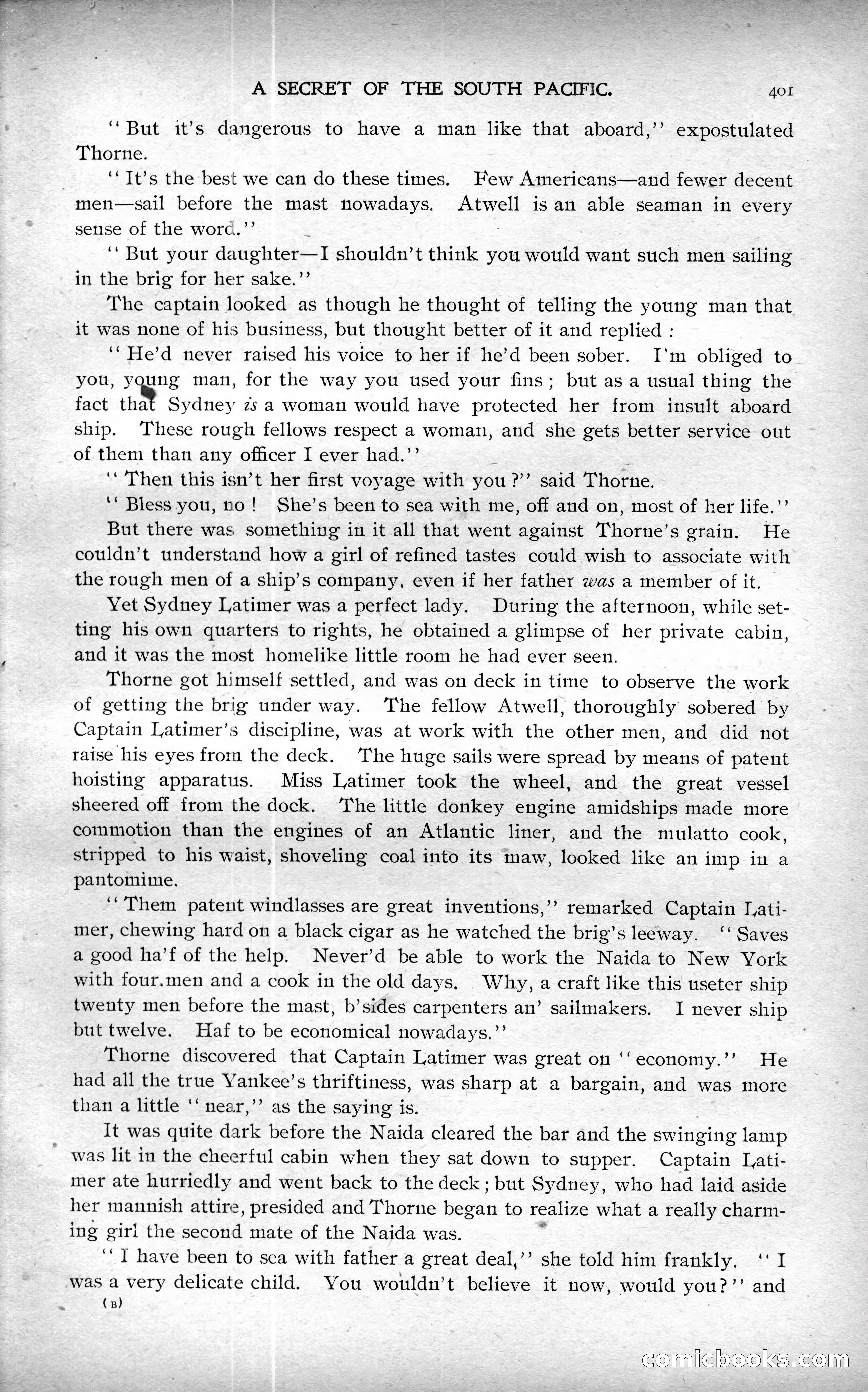
A restored page from Pulp Fiction, 1897. Page through the whole issue in the reader above.
📄 Transcribed text from this page (OCR, searchable)
Machine-transcribed from the original scan — historical spelling and the odd misread are preserved.
A SECRET OF THE SOUTH PACIFIC, 401 ‘“But it’s dangerous to have a man like that aboard,’’ expostulated Thorne. | ‘“It’s the best we can do these times. Few Americans—and fewer decent men—sail before the mast nowadays. Atwell is an able seaman in every sense of the word.’’ : ‘‘ But your daughter—I shouldn’t think you would want such men sailing in the brig for her sake.’’ The captain looked as though he thought of telling the young man that it was none of his business, but thought better of it and replied : ‘“He’d never raised his voice to her if he’d been sober. I'm obliged to you, young man, for the way you used your fins; but as a usual thing the fact that Sydney zs a woman would have protected her from insult aboard ship. These rough fellows respect a woman, and she gets better service out of them than any officer I ever had.’’ ‘‘ Then this isn’t her first voyage with you ?’’ said Thorne. ‘" Bless you, no! She’s been to sea with me, off and on, most of her life.’’ But there was something in it all that went against Thorne’s grain. He couldn’t understand how a girl of refined tastes could wish to associate with the rough men of a ship’s company, even if her father was a member of it. Yet Sydney Latimer was a perfect lady. During the afternoon, while set- ting his own quarters to rights, he obtained a glimpse of her private cabin, and it was the most homelike little room he had ever seen. Thorne got himself settled, and was on deck in time to observe the work of getting the brig under way. The fellow Atwell, thoroughly sobered by Captain Latimer’s discipline, was at work with the other men, and did not raise his eyes from the deck. The huge sails were spread by means of patent hoisting apparatus. Miss Latimer took the wheel, and the great vessel sheered off from the dock. The little donkey engine amidships made more commotion than the engines of an Atlantic liner, and the mulatto cook, stripped to his waist, shoveling coal into its maw, looked like an imp in a pantomime, “Them patent windlasses are great inventions,’’ remarked Captain Lati- mer, chewing hard on a black cigar as he watched the brig’s leeway. ‘‘ Saves a good ha’f of the help. Never’d be able to work the Naida to New York with four.men and a cook in the old days. Why, a craft like this useter ship twenty men before the mast, b’sides carpenters an’ sailmakers. I never ship but twelve. Haf to be economical nowadays,’’ Thorne discovered that Captain Latimer was great on ‘‘ economy.’’ He had all the true Yankee’s thriftiness, was sharp at a bargain, and was more than a little ‘‘ near,’’ as the saying is. It was quite dark before the Naida cleared the bar and the swinging lamp was lit in the cheerful cabin when they sat down to supper. Captain Lati- mer ate hurriedly and went back to the deck; but Sydney, who had laid aside her mannish attire, presided and Thorne beeen to realize what a really charm- ing girl the second mate of the Naida was. ‘ I have been to sea with father a great deal,’’ she told him frankly, ‘I was a very delicate child. You wouldn’t believe it now, would you?’’ and (a) EOmicdooks