
Pulp Fiction, 1897 · page 144 of 200
The Argosy, Vol. XXIV, No. 3 — page 144: what you’re looking at
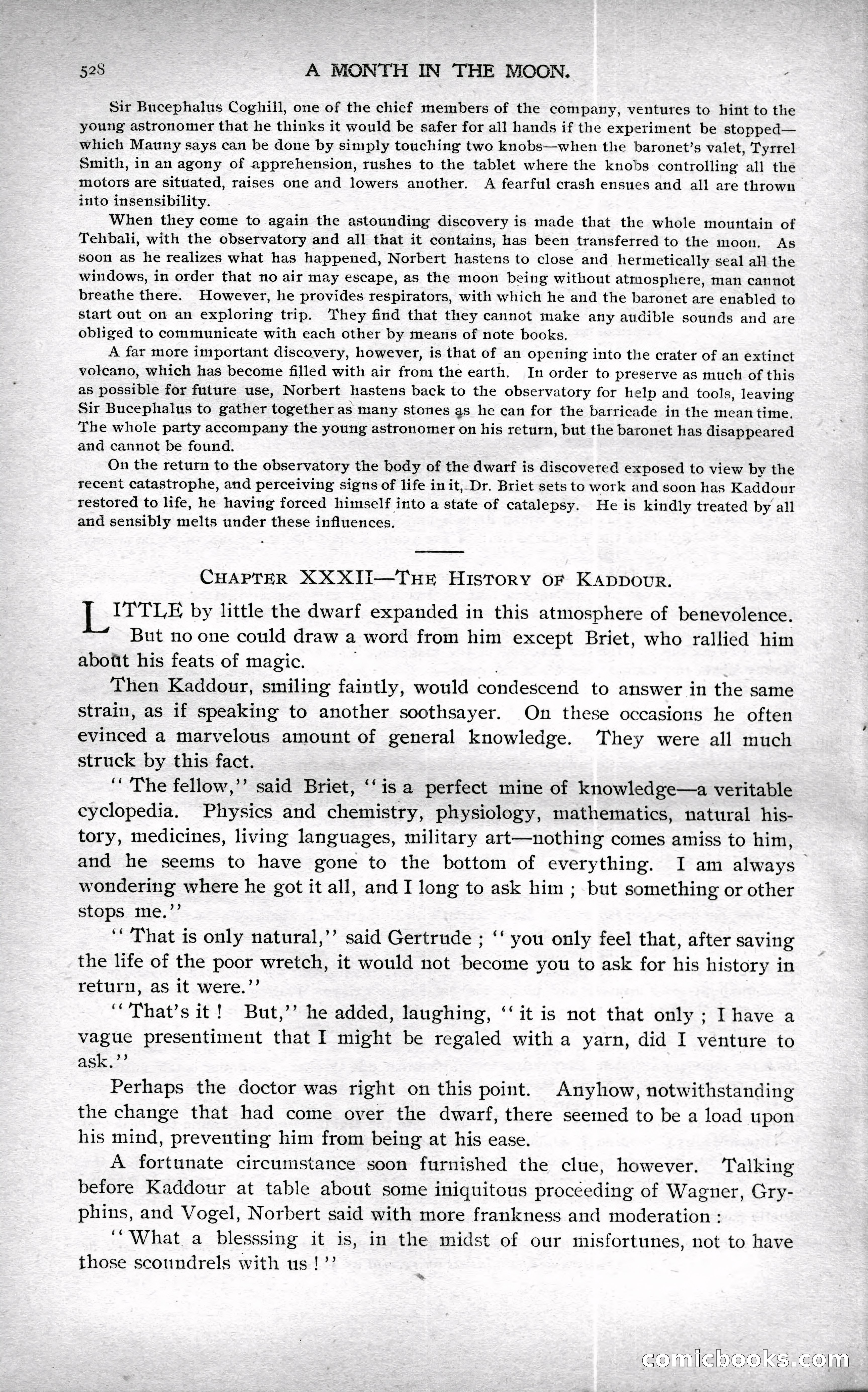
A restored page from Pulp Fiction, 1897. Page through the whole issue in the reader above.
📄 Transcribed text from this page (OCR, searchable)
Machine-transcribed from the original scan — historical spelling and the odd misread are preserved.
528 A MONTH IN THE MOON. : Sir Bucephalus Coghill, one of the chief members of the company, ventures to hint to the young astronomer that he thinks it would be safer for all hands if the experiment be stopped— which Mauny says can be done by simply touching two knobs—when the baronet’s valet, Tyrrel Smith, in an agony of apprehension, rushes to the tablet where the knobs controlling all the motors are situated, raises one and lowers another. A fearful crash ensues and all are thrown into insensibility. When they come to again the astounding discovery is made that the whole mountain of Tehbali, with the observatory and all that it contains, has been transferred to the moon. As soon as he realizes what has happened, Norbert hastens to close and hermetically seal all the windows, in order that no air may escape, as the moon being without atmosphere, man cannot breathe there. However, he provides respirators, with which he and the baronet are enabled to start out on an exploring trip. They find that they cannot make any audible sounds and are obliged to communicate with each other by means of note books, A far more important discovery, however, is that of an opening into the crater of an extinct volcano, which has become filled with air from the earth. In order to preserve as much of this as possible for future use, Norbert hastens back to the observatory for help and tools, leaving Sir Bucephalus to gather together as many stones as he can for the barricade in the mean time. The whole party accompany the young astronomer on his return, but the baronet has disappeared and cannot be found. On the return to the observatory the hody of the dwarf is discovered exposed to view by the recent catastrophe, and perceiving signs of life init, Dr. Briet sets to work and soon has Kaddour restored to life, he having forced himself into a state of catalepsy. He is kindly treated by all and sensibly melts under these influences. CHAPTER XXXII—TuE History oF KAppDouR. gol tile by little the dwarf expanded in this atmosphere of benevolence. But no one could draw a word from him except Briet, who rallied him abotit his feats of magic. | . Then Kaddour, smiling faintly, would condescend to answer in the same strain, as if speaking to another soothsayer. On these occasions he often evinced a marvelous amount of general knowledge. They were all much struck by this fact. ‘‘ The fellow,’’ said Briet, ‘‘is a perfect mine of knowledge—a veritable cyclopedia. Physics and chemistry, physiology, mathematics, natural his- tory, medicines, living languages, military art—nothing comes amiss to him, and he seems to have gone to the bottom of everything. I am always wondering where he got it all, and I long to ask him ; but something or other stops me,’’ ‘‘ That is only natural,’’ said Gertrude ; ‘‘ you only feel that, after saving the life of the poor wretch, it would not become you to ask for his history in return, as it were.’’ | ‘“That’s it! But,’’ he added, laughing, ‘‘it is not that only ; I have a vague presentiment that I might be regaled with a yarn, did I venture to ask.”’ Perhaps the doctor was right on this point. Anyhow, notwithstanding the change that had come over the dwarf, there seemed to be a load upon his mind, preventing him from being at his ease. A fortunate circumstance soon furnished the clue, however. Talking before Kaddour at table about some iniquitous proceeding of Wagner, Gry- phins, and Vogel, Norbert said with more frankness and moderation : ‘“What a blesssing it is, in the midst of our misfortunes, not to have those scoundrels with us !”’ ~ LOOKS (2) =) 3