
Pulp Fiction, 1897 · page 77 of 192
The Argosy, Vol. XXIV No. 2 — page 77: what you’re looking at
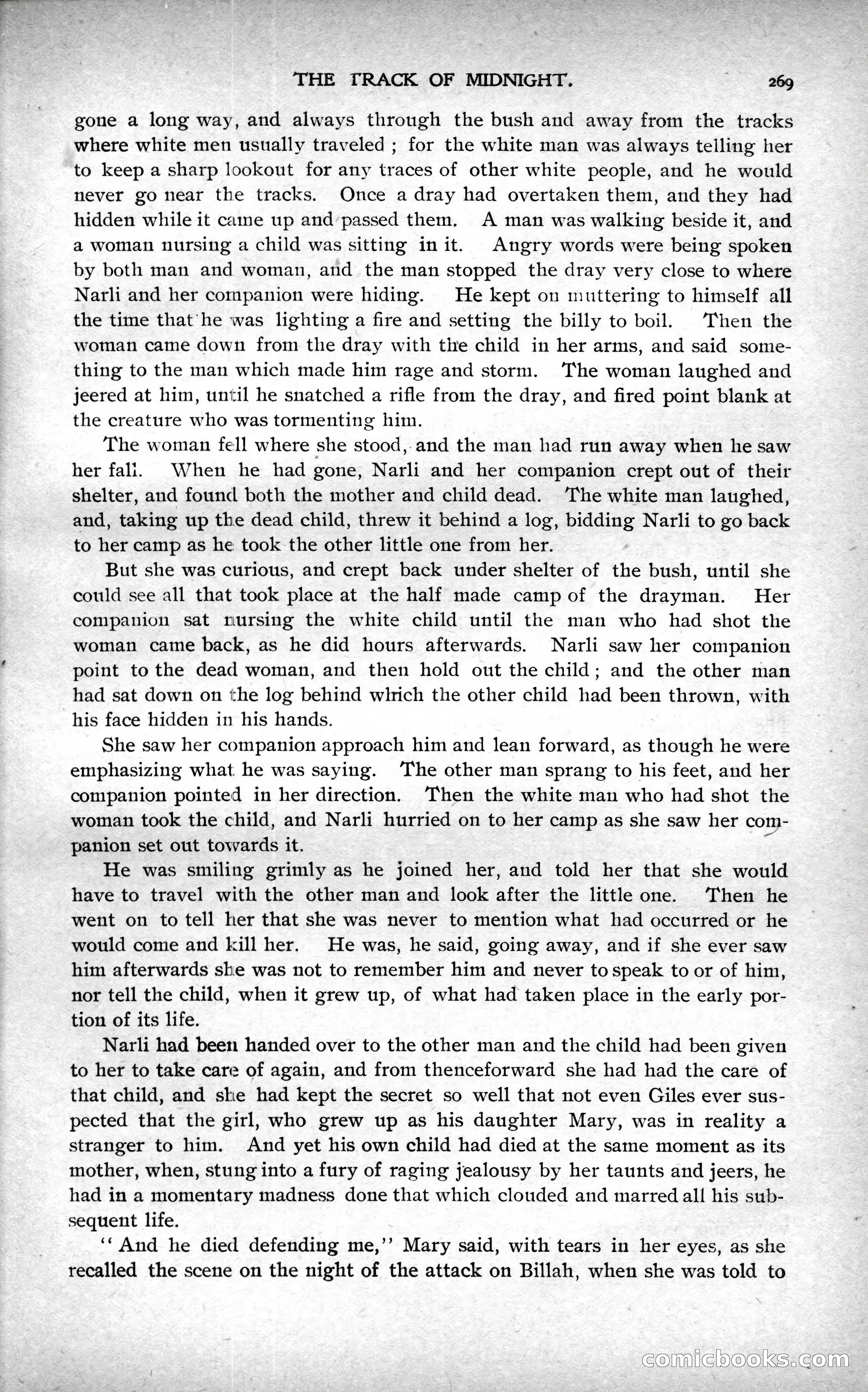
A restored page from Pulp Fiction, 1897. Page through the whole issue in the reader above.
📄 Transcribed text from this page (OCR, searchable)
Machine-transcribed from the original scan — historical spelling and the odd misread are preserved.
THE TRACK OF MIDNIGHT. 269 gone a long way, and always through the bush and away from the tracks where white men usually traveled ; for the white man was always telling her to keep a sharp lookout for any traces of other white people, and he would never go near the tracks. Once adray had overtaken them, and they had hidden while it caine up and passed them, A man was walking beside it, and a woman nursing a child was sitting init. Angry words were being spoken by both man and woman, and the man stopped the dray very close to where Narli and her companion were hiding. He kept on muttering to himself all the time that he was lighting a fire and setting the billy to boil. Then the wotman came down from the dray with the child in her arms, and said some- thing to the man which made him rage and storm. The woman laughed and jeered at him, until he snatched a rifle from the dray, and fired point blank at the creature who was tormenting him. The woman fell where she stood, and the man had run away when he saw her fali. When he had gone, Narli and her companion crept out of their shelter, and found both the mother and child dead. The white man laughed, and, taking up the dead child, threw it behind a log, bidding Narli to go back to her camp as he took the other little one from her. But she was curious, and crept back under shelter of the bush, until she could see all that took place at the half made camp of the drayman. Her companion sat nursing the white child until the man who had shot the woman came back, as he did hours afterwards. Narli saw her companion point to the dead woman, and then hold out the child; and the other man had sat down on the log behind which the other child had been thrown, with his face hidden in his hands. She saw her companion approach him and lean forward, as though he were emphasizing what he was saying. The other man sprang to his feet, and her companion pointed in her direction. Then the white man who had shot the woman took the child, and Narli hurried on to her camp as she saw her com- panion set out towards it. f He was smiling grimly as he joined her, and told her that she would have to travel with the other man and look after the little one. Then he went on to tell her that she was never to mention what had occurred or he would come and kill her. He was, he said, going away, and if she ever saw him afterwards she was not to remember him and never to speak to or of him, nor tell the child, when it grew up, of what had taken place in the early por- tion of its life. Narli had been handed over to the other man and the child had been given to her to take care of again, and from thenceforward she had had the care of that child, and she had kept the secret so well that not even Giles ever sus- pected that the girl, who grew up as his daughter Mary, was in reality a stranger to him. And yet his own child had died at the same moment as its mother, when, stung into a fury of raging jealousy by her taunts and jeers, he had in a momentary madness done that which clouded and marred all his sub- sequent life. ‘‘And he died defending me,’’ Mary said, with tears in her eyes, as she recalled the scene on the night of the attack on Billah, when she was told to CoORniclooolks CO)