
Pulp Fiction, 1897 · page 39 of 192
The Argosy, Vol. XXIV No. 2 — page 39: what you’re looking at
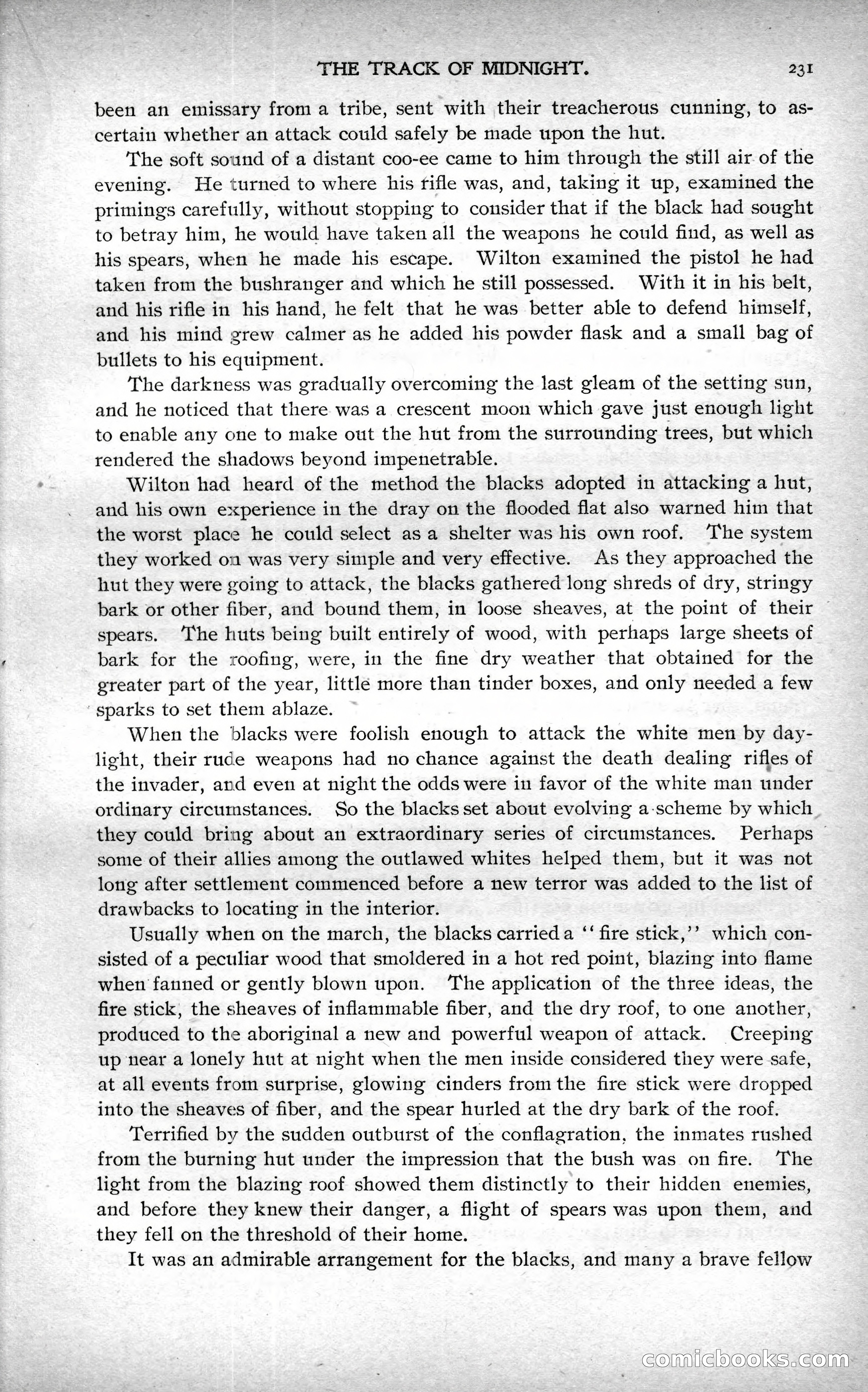
A restored page from Pulp Fiction, 1897. Page through the whole issue in the reader above.
📄 Transcribed text from this page (OCR, searchable)
Machine-transcribed from the original scan — historical spelling and the odd misread are preserved.
THE TRACK OF MIDNIGHT. 231 been an emissary from a tribe, sent with their treacherous cunning, to as- certain whether an attack could safely be made upon the hut. The soft sound of a distant coo-ee came to him through the still air of the evening. He turned to where his fifle was, and, taking it up, examined the primings carefully, without stopping to consider that if the black had sought to betray him, he would have taken all the weapons he could find, as well as his spears, when he made his escape. Wilton examined the pistol he had taken from the bushranger and which he still possessed. With it in his belt, and his rifle in his hand, he felt that he was better able to defend himself, and his mind grew calmer as he added his powder flask and a small bag of bullets to his equipment. The darkness was gradually overcoming the last gleam of the setting sun, and he noticed that there was a crescent moon which gave just enough light to enable any one to make out the hut from the surrounding trees, but which rendered the shadows beyond impenetrable. Wilton had heard of the method the blacks adopted in attacking a hut, and his own experience in the dray on the flooded flat also warned him that the worst place he could select asa shelter was his own roof. The system they worked on was very simple and very effective. As they approached the hut they were going to attack, the blacks gathered long shreds of dry, stringy bark or other fiber, and bound them, in loose sheaves, at the point of their spears. ‘The huts being built entirely of wood, with perhaps large sheets of bark for the roofing, were, in the fine dry weather that obtained for the greater part of the year, littlé more than tinder boxes, and only needed a few ‘sparks to set them ablaze. When the blacks were foolish enough to attack the white men by day- light, their rude weapons had no chance against the death dealing rifles of the invader, and even at night the odds were in favor of the white man under ordinary circumstances. So the blacks set about evolving a-scheme by which they could briug about an extraordinary series of circumstances. Perhaps — some of their allies among the outlawed whites helped them, but it was not long after settlement commenced before a new terror was added to the list of drawbacks to locating in the interior. Usually when on the march, the blacks carried a ‘‘ fire stick,’’ which con- sisted of a peculiar wood that smoldered in a hot red point, blazing into flame when fanned or gently blown upon. ‘The application of the three ideas, the fire stick, the sheaves of inflammable fiber, and the dry roof, to one another, produced to the aboriginal a new and powerful weapon of attack. Creeping up near a lonely hut at night when the men inside considered they were safe, at all events from surprise, glowing cinders fromthe fire stick were dropped into the sheaves of fiber, and the spear hurled at the dry bark of the roof. Terrified by the sudden outburst of the conflagration, the inmates rushed from the burning hut under the impression that the bush was on fire. The light from the blazing roof showed them distinctly to their hidden enemies, and before they knew their danger, a flight of spears was upon them, and they fell on the threshold of their home. : It was an admirable arrangement for the blacks, and many a brave fellow GOMIIcbooksEco S}